No Kumbayah Crap

James Carville is as slimy and repulsive a character as we've had to endure lurking around the orifices of our body politic in a long time. He's slimier than Karl Rove, and has a stupendously grating manner of speaking. Nevertheless, he is an acknowledged expert on Democratic politics. Over the last few years, since his patron was unceremoniously removed from power by the 22nd amendment, Carville has been increasingly, well, forceful in his advice to his fellow democrats.

Witness:

The problem with Democrat campaign speeches is "litany," and they need more narrative like Winnie the Pooh stories, political consultant and pundit James Carville said. ...Democratic candidates can’t succeed by shouting out to every group in a crowd. Instead candidates should tell stories with the three elements of any good story — setup, conflict and resolution.

"No Kumbayah crap," Carville said.

... In addition to breaking away from a laundry list of special interests, Carville said, Democrats need to learn that a candidate who can’t campaign can't succeed. "If you’re not competent in campaigns, you don’t have a chance to be competent in government," he said. Using Al Gore as an example, Carville said being a smart candidate is not enough.

...Democrats need to bring their causes together and work for them actively, he said. For example, the political consultant suggested taking the specific issue of racial affirmative action and helping those of all races with income-based affirmative action. If Democrats try to single out every issue, they’re back to litany, Carville said. He also said Democrats just can't say "no" to causes from gay rights to abortion to the poor.

"Sometimes the problem with being a Democrat is being a Democrat," he said.

That's not bad advice, and I hope that someone is listening.

Posted by Buckethead Buckethead on   |   § 0

Yes, no, maybe

Two more conservative heavyweights have, uh, weighed in on the Miers nomination. On both sides.

Newt Gingrich tells us to trust the President. For liberals, this presents something of a conundrum. They already don't trust the President, so does that mean the nominee will be a Souter or an Anti-Souter? Fear or relief? For conservatives, the problem is less stark, but still a problem. The core of Gingrich's argument is this: Bush ran as a conservative, and has held true to that over the last five years. He assembled a team of conservatives. He said that he'd appoint conservative judges, and has consistently done so to the dismay of many liberals. Miers is the one who helped him do this, and he's known Miers for years. Trust George. As far as the conservative judges go, 'ol Newt has a point. But Bush has not been consistently conservative, though I'll buy mostly conservative. But the spectre of steel tariffs, the prescription drug entitlement and other misteps haunts.

So far, this is the strongest argument I have seen in favor of Miers, aside from Patton's point that the Constitution says that the President can pick whomever he damn well pleases.

Charles Krauthammer has a rather different take. In an essay entitled, "Withdraw this nominee," the Kraut says - and I quote at length:

There are 1,084,504 lawyers in the United States. What distinguishes Harriet Miers from any of them, other than her connection with the president? To have selected her, when conservative jurisprudence has J. Harvie Wilkinson, Michael Luttig, Michael McConnell and at least a dozen others on a bench deeper than that of the New York Yankees, is scandalous.

It will be argued that this criticism is elitist. But this is not about the Ivy League. The issue is not the venue of Miers's constitutional scholarship, experience and engagement. The issue is their nonexistence.

Moreover, the Supreme Court is an elite institution. It is not one of the "popular" branches of government. That is the reason Sen. Roman Hruska achieved such unsought immortality when he declared, in support of an undistinguished Nixon nominee to the court, that, yes, G. Harrold Carswell is a mediocrity but mediocre Americans deserve representation on the court as well.

To serve in Congress, or even as president, there is no requirement for scholarship and brilliance. For good reason. It is not needed. It can even be a hindrance, as we learned from our experience with Woodrow Wilson, the most intellectually accomplished president of the 20th century and also the worst.

But constitutional jurisprudence is different. It is, by definition, an exercise of intellect steeped in scholarship. Otherwise it is nothing but raw politics. And is it not the conservative complaint that liberals have abused the courts by having them exercise raw super-legislative power, the most egregious example of which is the court's most intellectually bankrupt ruling, Roe v. Wade?

The President has a right to choose the nominee. But I have a right to carp and whinge that it is not a good choice. And I don't think that this one is a winner, not when there are so many other clearly distinguished candidates.

Posted by Buckethead Buckethead on   |   § 2

Speedracer needs an update

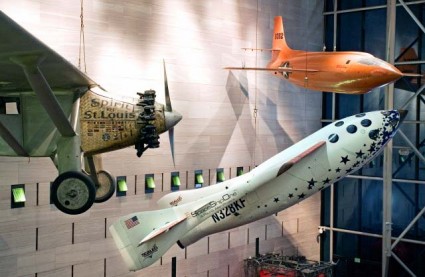
Quite a few things have been happening on the space front over the last week. Of interest to anyone in the DC area, Burt Rutan’s SpaceShipOne is now ensconced in the Smithsonian’s National Air and Space Museum, right next to the Spirit of St. Louis. I had intended to go over and pay my respects today, but seeing as it is raining a bit (3” expected over the next 24 hours) I think I’ll wait until next week.

SpaceShipOne in NASM

Rocket Jones noted this and even came up with a cool title, but I can’t leave it to him entirely.

A private group of rocketeers has banded together to create the Rocket Racing League with aims at blurring the line between competitive racing and human spaceflight. Their vision: A fleet of at least 10 stock rocket planes flown by crack pilots through a three-dimensional track 5,000 feet above the Earth.

This is just too cool for words. The RRL will conduct its races at Los Cruces, NM, where League co-founder Peter Diamandis (also founder of the X-Prize) is holding his X-Cup festival this month. The first races are scheduled for next fall, and should prove to be very interesting. These races aren’t going to be like drag races, where the fastest rocket wins. It will be more like formula one racing, or even yacht racing. Each rocket plane will have to stay inside a defined path, make turns, and complete the course in the fastest time. Since the burn time on an XCOR rocket plane is only about four minutes, pilots will need to strategically start and stop their engine, combining powered flight and judicious gliding to win the race. And since the kerosene/LOX rocket will have a bright orange plume, this race should be visually spectacular.

XCOR Rocket Plane

Back in the early days of aviation, one of the chief means of stoking public interest in and acceptance of airplanes was air races. As airplanes evolved, so to did the races. Here's a brief outline, adapted from the Society of Air Racing Historians:

Air Racing Eras 

Gordon Bennett Trophy Races: 1909-1920
This first important era of air racing brought to public attention the likes of Glen Curtiss, Maurice Prevost and Jules Vedrines who flew Bleriots, Curtiss, Wrights and Deperdussins. 

Schneider Trophy Races: 1913-1931
These great seaplane racers were the fastest aircraft in the world. They brought true speed to aviation, thanks to pilots like Jimmy Doolittle, Mario de Bernardi, John Boothman and David Rittenhouse. They flew planes built by Curtiss, Supermarine, Macchi, Gloster and Sopwith. Aviation progress resulted from the use of huge V-12 engines and advanced streamlining. 

Pulitzer Trophy Races: 1920-1925
These military pylon races brought the USA to the lead in speed, with pilots like Bert Acosta, Al Williams and C. C. Mosley flying Curtiss, VervilleSperry and Loening military racers. 

LONG-DISTANCE RACES: 1920's 1930's
Some of the greatest races were over long courses from one country to another, such as the 1934 MacRobertson Race from England to Australia won by the deHavilland Comet racer. Others such as the ill-fated Dole Race from California to Hawaii in 1927, won by the Travelair "Woolaroc", revealed the true hazards of long-distance flying. 

CLEVELAND AIR RACES 1929-1939
The "Golden Age of Air Racing" in which custom-built raceplanes ruled the roost. Lowell Bayles, Roscoe Turner, Tony LeVier, Art Chester, Steve Wittman, Harold Neumann , Jackie Cochran. Gee Bees, Wedell Williams, Keith Riders, Lairds, Folkerts and many others. These were the classic Thompson, Bendix and Greve Races. 

POST-WAR AIR RACES 1946-1960
Unprecedented speed from cut-down, souped-up ex-military fighter planes: P-38 Lightnings, P-39 Airacobras, P-51 Mustangs, F2G Corsairs, Cook Cleland, "Tex" Johnston, Paul Mantz, Anson Johnson, Beville & Raymond in the Thompson, Bendix and Sohio Races. 

RENO AIR RACES: 1964-???
The current era began in 1964 with Bill Stead’s experiment in the Nevada desert. Unlimiteds (Mustangs, Bearcats, Sea Furys and Yaks flown by Greenamyer, Sheldon, Lacy and Destefani) Formula Ones (Miller pushers, Cassutts and Shoestrings raced by Cote, Falck, Sharp and Miller) Sport Biplanes (Pitts, Starduster and Mongs flown by Christian and Boland) AT-6s (raced by Van Fossen and Dwelle) and Formula Vs (Sonerais and V-Witts raced by Dempsey and Terry).

If the new rocket races achieve any kind of media attention, they could fuel a lot of interest amongst the people for rockets and spaceflight.

And speaking of the X-Prize Cup, the first will be held this weekend. Among the highlights will be a test flight of the XCOR rocket plane mentioned above, a full on test flight of Armadillo Aerospace’s vertical take-off/vertical landing vehicle, and full scale mock-ups of several spaceships currently under development. Los Cruces is well on its way to becoming rockethead Mecca.

Posted by Buckethead Buckethead on   |   § 3

In Johno's Night Kitchen, vol. n+1

I don't suppose the preponderance of Texans we count among our member- and readership will have much use for this recipe, but for those of you in more northerly climes, this is recipe comes directly from my heart to you. It is a fairly simple* fall and winter soup, perfect for those nights when you can get a pleasant buzz on and fart a lot at home contentedly while the freezing wind whips the trees outside.

Vegetable Borscht with Barley

This simple vegetarian vegetable soup has a surprising depth of flavor - earthy, sweet, green, warm, and tangy. It is almost more like a stew than a soup as presented, thanks to the amount of vegetables. If you want a thinner soup, feel free to add more stock and kick up the dill and caraway a tiny bit to amplify their flavor. I like it this way, though. It takes me back to an imagined ancestry in the great sweep of Eastern Europe from Swabia and Poland all the way to Romania, sort of a Swabopolskiczechohungariromanimoldovan cuisine. Or just call it Fake Transylvanian for short. Stay tuned for my Thai-Italian fusion cuisine!

If you wish to use canned beets, you can, but nothing tops roasted beets for complexity. Frozen vegetables are absolutely okay in this soup, but be sure to par-cook any greens beforehand so they don't make the soup bitter.

3 medium carrots, diced
3 stalks celery, diced
2 large onions, diced
6 cloves garlic, minced (vary to taste)
2 tsp dill seeds
1/2 tsp caraway seeds
1 tsp dried thyme (more if stock contains no thyme)
1/2 cup hulled barley (the brown stuff preferably, not pearl)
6-8 cups lightly- or un-salted beef, chicken, or vegetable stock or water (at least some of which stock)
1 medium head green cabbage, shredded
6 medium beets (total 8-12 oz), roasted, peeled & diced
other vegetables as desired: green beans, turnips, turnip greens, kale, etc., I wouldn't use potatoes but you certainly may)
1/2 bunch parsley, finely chopped
1 T vinegar, red wine or cider
salt
pepper
vegetable oil

Heat oil in a large saucepan over medium-high heat and add carrots, celery, onions, garlic, and 1/2 tsp salt. Sweat until onions are translucent, about 7 minutes. Add caraway, dill, and thyme, reduce heat a bit, and cook about 5 minutes more.

Add liquid and barley. Bring to a boil and reduce heat to simmer for 1 hour, stirring occasionally.

Add cabbage, beets, and other vegetables and cook for about 20 minutes more. If necessary, add more liquid to cover. Adjust salt at this time.

Add pepper, vinegar, and parsley and cook 5 minutes. Taste and adjust one last time before serving.

This recipe could easily be converted for omnivores by the addition of maybe a pound of cubed stew meat browned in the pan prior to adding the aromatics and cooking until tender prior to adding the cabbage.

Serve with, oh, maybe a side of potato or sauerkraut pierogis fried with onions, or bread and butter and cheese, plus definitely lots of cold beer or Reisling for an authentically faux-Eastern Bloc experience. Now I'm hungry.

[wik] * About that word, simple. Of course this recipe is simple; it's a soup! But like so many things, "simple" doesn't necessarily mean the same thing as "easy." Stir-fries are simple, but the entire vocabulary of cooking them is fundamentally different than what Western cooks innately do. And baguettes- they are one of the easiest recipes for good bread going, but they sure aren't simple. Chess is easy too. Bouillabaisse isn't that hard, but there sure as hell is a trick to getting it to taste anything like the sublime fish soup of coastal France.

And, I suppose, no recipe is simple if you don't have a sense of how big "dice" should be, or what "salt to taste" means when you're standing over the pot with the saltshaker, or what a simmer is. So, I take it back, the word "simple."

[alsø wik] Comrade Hall asks how to roast beets. Easy! First, you need to kill your beets. As unfortunate as this is, beet flesh deteriorates very rapidly after death, so you must buy live ones. They are fast, slippery and surprisingly strong little buggers with a lot of fight in them, so this is often a challenge. The traditional method is to stuff one into a sack, grab it by the tail, and beat its head against a hard surface until it stops fighting. Then beat it some more because the treacherous little bastard might be faking. Then, the gutting. Trust me; the payoff for all this is delicious.

Oh wait, wait. Sorry, that was eels.

Beets.

First you need to kill your beets.

No. Damn.

Always buy beets with the greens attached. If the greens are sturdy and healthy, you've got to vegetables for the price of one. If not, they are still a guarantee that the roots are strong and fresh and not old, woody, and tasteless. For this recipe, one or two "bunches" will do, whatever your market or local dirt farmer calls a "bunch."

Remove the greens, leaving 1/2 to 1 inch of stem. Set greens aside to cook or pitch as necessary. Scrub beets gently to remove clinging dirt (though you will eventually peel them, dirt on the beets can contribute a dirty flavor (as opposed to earthy) to the final product) and pat dry. Do not peel at this time. Place beets on a layer of foil. At this point, if desired you can hit them with a little vegetable oil to promote fast cooking**. You can also slip some thyme and salt and pepper in the mix if so desired. I usually don't. Fold the beets up well into a rough packet, whatever you can manage. If you must divide the beets into two separate packets in order to close the foil around the beets, do so. Repeat with a second layer of foil, making sure that the beets are tightly wrapped - we want the steam, for the most part, to stay in. This goes double for the sugar-rich purple juices which will blacken in a second if they get free into the oven, and will stain the hell out of your clothes, hot-pads, and anything else they come near.

Place your double-wrapped beets on a baking sheet and place in a well-preheated (which means, "at temperature for at least 20 minutes with the door closed") 350-degree oven. Beets always take longer than you expect, so smallish to medium size ones will take about an hour, and very large ones can go 90 minutes or more. They are done when a paring knife penetrates to the middle with practically no resistance. (Beets will tend to stay a little harder than other vegetables thanks to their cell-wall makeup.)

Remove from oven, and cool until you can handle them. Then, under running water slip the skins right off with your fingers. Voila.

In case that was too much info, here's the executive summary:
Cut off greens
Scrub
Wrap tightly in double layer of foil
350 degrees, 1 hour to 90 minutes
Cool, peel, enjoy.

** As you know, fats transfer heat more efficiently than water or air. So, by rubbing the skins of the beets with fat you are theoretically aiding the transfer of heat from the oven to the interior of the vegetable. Whether or not this effect is detectable in shortened cooking time is debatable. It probably helps a bit. On the other hand, always oil your baked taters, because the skin will turn out nice and browned and chewy, all of which probably does help the potato's inside to cook.

Posted by Johno Johno on   |   § 5

She said, "Stiff"

Peggy Noonan on a larger issue hidden in the littler issue:

The headline lately is that conservatives are stiffing the president. They're in uproar over Ms. Miers, in rebellion over spending, critical over cronyism. But the real story continues to be that the president feels so free to stiff conservatives. The White House is not full of stupid people. They knew conservatives would be disappointed that the president chose his lawyer for the high court. They knew conservatives would eventually awaken over spending. They knew someone would tag them on putting friends in high places. They knew conservatives would not like the big-government impulses revealed in the response to Hurricane Katrina. The headline is not that this White House endlessly bows to the right but that it is not at all afraid of the right. Why? This strikes me as the most interesting question.

Peggy offers some possible answers, but I fear that it might be the last one, "Maybe he's totally blowing it with his base, and in so doing endangering the present meaning and future prospects of his party."

Posted by Buckethead Buckethead on   |   § 5

Yet more Miers blather

Well, Harriet Miers just leapt another of the imaginary hurdles to her confirmation to the Supreme Court.

Ann Coulter is neither amused nor impressed. As I said during the Roberts confirmation process, if Ann doesn't like the candidate, then the candidate's probably got at least something going for them.

Why? Not because Ann's unintelligent, quite the opposite - she's very bright. She's also, however, highly caustic, so much so that she's far better fun (not informative - fun) to read than to listen to. I've long thought that if she could lose the whiny high-school know-it-all "can you believe it?" tone to her voice, she'd be far more effective at communicating. In this case, however, her causticity (causticism?) is directed at the alleged difference between the Ivy League law schools and the less-adored ones like SMU.

With a nod to the opinions of those who, like me, aren't impressed by Ivy League degrees when someone's actual work history is also available (i.e. Ivy League degree is an excellent credential for a new graduate, but isn't a balm for any occurrences of observed stupidity or incompetence later in life), Ann admits that it's reasonable to not be swayed by the dueling J.D. degree argument. And then she rides it to the hilt, asserting that a conservative from an Ivy League law school is a better and more solid conservative precisely because they remain one after an Ivy League indoctrination.

30 years later. Right. That would be believable if, in fact, the only forum in which rowdy right/left discourse were available was in Ivy League schools, or in college generally. But it's not, and anyone whose cognitive abilities were fully formed on exit from university, remaining unamended by experience since then, ought to be checked for dain bramage. John Roberts, as a ferinstance, is one bright gentleman, to all appearances a gen-ewe-wine legal scholar. But if he came out of Harvard Law as "that guy", I'd be shocked. He's done a bit since then.

And speaking of having done a bit since then, Ann seems to think that the only thing noteworthy that Miers has done is run the TX Lottery Commission. Others who've opined on the matter, such as Bill Dyer, at great length, aren't nearly as exercised about Miers' qualifications, and neither does Bill think running the Lotto is the most impressive resume item Miers possesses.

To the extent my previous mumblings on this matter aren't viewable as a coherent position, I'd state for the record that I will be emotionally and politically unaffected by the result of Ms. Miers' hearings. The process? Oh, that I'll probably react to, one way or another, because it has nothing much to do with her, and all to do with her inquisitors, but if she's ultimately confirmed by the Senate, that's fine by me, and if she's rejected, likewise.

The Republican Party doesn't have a constitutional prerogative to choose SCOTUS appointees, nor does the "administration", the Senate majority leader, or the President's masseuse. That prerogative falls to the president himself, and, in the words of Richard Jeni (which {ahem} I note after a Google source search for the phrase, I've used in this forum once before, but gimme a break - they apply) “Shut up, fat boy - the gentleman has MADE his selection”.

Perhaps I don't take the internal politics of the Supreme Court seriously enough, or think that there's some sort of cock-fight where they compare sheepskins before each deliberation, and perhaps I don't give enough credit to those who think they can accurately forecast the end result of any single Justice's nomination (see "Souter", "Kennedy", or "Earl Warren"), but a choice is a choice, and if she's confirmed, then so be it. And let the chips fall where they might.

All due respect to Ken Mehlman and the rest of the agitators requesting grass roots support for the candidate, I'd ask "why does it matter"?

Posted by Patton Patton on   |   § 1

Deep thoughts about Human/Martian relations

People of Mars, you say we are brutes and savages. But let me tell you one thing: if I could get loose from this cage you have me in, I would tear you guys a new Martian asshole.

...You claim there are other intelligent beings in the galaxy besides earthlings and Martians. Good, then we can attack them together. And after we’re through attacking them we’ll attack you.

...You keep my body imprisoned in this cage. But I am able to transport my mind to a place far away, a happier place, where I use Martian heads for batting practice.

...You may kill me, either on purpose or by not making sure that all the surfaces in my cage are safe to lick. But you can’t kill an idea. And that idea is: me chasing you with a big wooden mallet.

Posted by Buckethead Buckethead on   |   § 2

DeLay, meet Ham Sandwich

The saying goes, you can indict a ham sandwich. Apparently, it has been revealed that Travis County District Attorney Ronnie Earle failed at least once to get an indictment against DeLay. Witness:

A Travis County grand jury last week refused to indict former U.S. House Majority Leader Tom DeLay as prosecutors raced to salvage their felony case against the Sugar Land Republican.

In a written statement Tuesday, Travis County District Attorney Ronnie Earle acknowledged that prosecutors presented their case to three grand juries — not just the two they had discussed — and one grand jury refused to indict DeLay.

Not that DeLay is supercool, and I want him to be godfather to my next child - but I think that this is all a bit of a witch hunt on the part of an overzealous and a tad bit politically motivated Mr. Earle.

Posted by Buckethead Buckethead on   |   § 0