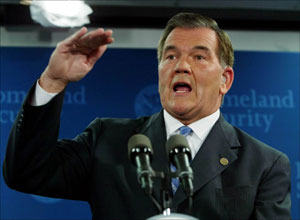
In a recent Pentagon press conference, Army Chief of Staff General Peter Schoomaker discussed the new challenges faced by the modern Army and some of the steps being taken to overcome them.
Here's the short version: 30,000 more soldiers and some new org charts.
I've been out of the Army for a long time and never served in combat. While I do take an interest in Army issues, my opinions are those of a grabastic civilian and colored by the sepia tones of old memories and forgotten hardship. But as best as I can tell, I see alot of problems with the modern force.
For starters, the Army spends too much time playing with org charts, and producing paper, and encouraging Powerpoint Rangers, than on ugly gritty reality of combat as reflected through training. This was true even in my time, and the proliferation of powerful computers and software has magnified the problem. A friend once joked that if we really wanted to be rid of the Iraqi army, just drop them some laptops with Powerpoint and let nature take its course- they'd be crippled with busywork in a matter of weeks.
I know that the Army is serious, in theory, about training as we fight. And I know that the NTC, CMTC, Grafenwoehr, Wildflecken, etc etc are truly ugly gritty places. I mean, it literally doesn't get grittier than having to shit in a hole scratched out of the desert floor, and it doesn't get uglier than training so hard that real people get really killed (Businessweek, 28OCT02 reported 2,487 deaths from accidents, across all service branches, from 1990-92). The Army goes to great expense to make its training areas and scenarios as realistic as possible.
I think the bigger problem is at the basic training level, when recruits are first taught the fundamentals of soldiering. When I took basic training my unit spent about 3 weeks out of 8 on basic rifle marksmanship, or BRM. So even though we were taught about Bastogne, and told that every soldier is an infantryman first, we spent less than half our training time learning marksmanship, the fundamental skill of the infantryman. Since then, there is less effort to demonstrate the mental challenges that come from being under duress, ie by screaming and yelling at trainees. Training units are co-ed. New soldiers take diversity and sensitivity training. All told, there should be alot more emphasis on the shooty bits, and a lot less on soldiers' feelings about it.
And that all feeds into General Schoomaker's plans for Army restructuring. He wants to oversee turning a relative few heavy Army divisions into a few dozen independent brigades, and there's something to be said for that. He wants more soldiers across the board, to better staff those units and make deployments easier all around, and that makes sense.
But until the Army goes back into the business of training warriors, drawing out new soldiers' nascent martial instincts from day one, the good General's reorganization is simply a logistics exercise.
[wik] This bit from Stars and Stripes explains a little more clearly what General Schoomaker has in mind. He doesn't want to break up divisions into beefier component brigades, but create 15 or so entirely new units, manned with his 30,000 more troops.
But then came this quote, and I see what the problem may be in attempting communication with the general. I'm totally lost in the haze of pronouns:
This war, as unfortunate as war always is, provides momentum and focus and resources to transform that you might not have outside of this, Schoomaker said. And what we are able to do, as we rotate forces, as we reset them, is this momentum and focus allows us to reset them for the future, not reset them as they were in the past. And so this has given us a great forcing function to allow us to do it.
Clear as an azure sky!



 on
| § 3
on
| § 3