

 Ministry Archive: Buckethead
Two more conservative heavyweights have, uh, weighed in on the Miers nomination. On both sides.
Newt Gingrich tells us to trust the President. For liberals, this presents something of a conundrum. They already don't trust the President, so does that mean the nominee will be a Souter or an Anti-Souter? Fear or relief? For conservatives, the problem is less stark, but still a problem. The core of Gingrich's argument is this: Bush ran as a conservative, and has held true to that over the last five years. He assembled a team of conservatives. He said that he'd appoint conservative judges, and has consistently done so to the dismay of many liberals. Miers is the one who helped him do this, and he's known Miers for years. Trust George. As far as the conservative judges go, 'ol Newt has a point. But Bush has not been consistently conservative, though I'll buy mostly conservative. But the spectre of steel tariffs, the prescription drug entitlement and other misteps haunts.
So far, this is the strongest argument I have seen in favor of Miers, aside from Patton's point that the Constitution says that the President can pick whomever he damn well pleases.
Charles Krauthammer has a rather different take. In an essay entitled, "Withdraw this nominee," the Kraut says - and I quote at length:
There are 1,084,504 lawyers in the United States. What distinguishes Harriet Miers from any of them, other than her connection with the president? To have selected her, when conservative jurisprudence has J. Harvie Wilkinson, Michael Luttig, Michael McConnell and at least a dozen others on a bench deeper than that of the New York Yankees, is scandalous.
It will be argued that this criticism is elitist. But this is not about the Ivy League. The issue is not the venue of Miers's constitutional scholarship, experience and engagement. The issue is their nonexistence.
Moreover, the Supreme Court is an elite institution. It is not one of the "popular" branches of government. That is the reason Sen. Roman Hruska achieved such unsought immortality when he declared, in support of an undistinguished Nixon nominee to the court, that, yes, G. Harrold Carswell is a mediocrity but mediocre Americans deserve representation on the court as well.
To serve in Congress, or even as president, there is no requirement for scholarship and brilliance. For good reason. It is not needed. It can even be a hindrance, as we learned from our experience with Woodrow Wilson, the most intellectually accomplished president of the 20th century and also the worst.
But constitutional jurisprudence is different. It is, by definition, an exercise of intellect steeped in scholarship. Otherwise it is nothing but raw politics. And is it not the conservative complaint that liberals have abused the courts by having them exercise raw super-legislative power, the most egregious example of which is the court's most intellectually bankrupt ruling, Roe v. Wade?
The President has a right to choose the nominee. But I have a right to carp and whinge that it is not a good choice. And I don't think that this one is a winner, not when there are so many other clearly distinguished candidates.
 on
| § 2
on
| § 2

Quite a few things have been happening on the space front over the last week. Of interest to anyone in the DC area, Burt Rutan’s SpaceShipOne is now ensconced in the Smithsonian’s National Air and Space Museum, right next to the Spirit of St. Louis. I had intended to go over and pay my respects today, but seeing as it is raining a bit (3” expected over the next 24 hours) I think I’ll wait until next week.
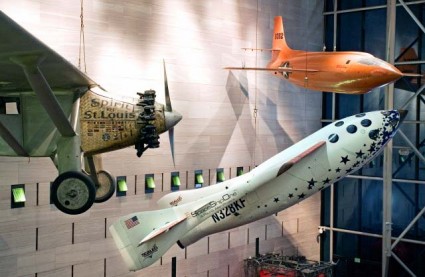
Rocket Jones noted this and even came up with a cool title, but I can’t leave it to him entirely.
A private group of rocketeers has banded together to create the Rocket Racing League with aims at blurring the line between competitive racing and human spaceflight. Their vision: A fleet of at least 10 stock rocket planes flown by crack pilots through a three-dimensional track 5,000 feet above the Earth.
This is just too cool for words. The RRL will conduct its races at Los Cruces, NM, where League co-founder Peter Diamandis (also founder of the X-Prize) is holding his X-Cup festival this month. The first races are scheduled for next fall, and should prove to be very interesting. These races aren’t going to be like drag races, where the fastest rocket wins. It will be more like formula one racing, or even yacht racing. Each rocket plane will have to stay inside a defined path, make turns, and complete the course in the fastest time. Since the burn time on an XCOR rocket plane is only about four minutes, pilots will need to strategically start and stop their engine, combining powered flight and judicious gliding to win the race. And since the kerosene/LOX rocket will have a bright orange plume, this race should be visually spectacular.

Back in the early days of aviation, one of the chief means of stoking public interest in and acceptance of airplanes was air races. As airplanes evolved, so to did the races. Here's a brief outline, adapted from the Society of Air Racing Historians:
Air Racing Eras
Gordon Bennett Trophy Races: 1909-1920
This first important era of air racing brought to public attention the likes of Glen Curtiss, Maurice Prevost and Jules Vedrines who flew Bleriots, Curtiss, Wrights and Deperdussins.
Schneider Trophy Races: 1913-1931
These great seaplane racers were the fastest aircraft in the world. They brought true speed to aviation, thanks to pilots like Jimmy Doolittle, Mario de Bernardi, John Boothman and David Rittenhouse. They flew planes built by Curtiss, Supermarine, Macchi, Gloster and Sopwith. Aviation progress resulted from the use of huge V-12 engines and advanced streamlining.
Pulitzer Trophy Races: 1920-1925
These military pylon races brought the USA to the lead in speed, with pilots like Bert Acosta, Al Williams and C. C. Mosley flying Curtiss, VervilleSperry and Loening military racers.
LONG-DISTANCE RACES: 1920's 1930's
Some of the greatest races were over long courses from one country to another, such as the 1934 MacRobertson Race from England to Australia won by the deHavilland Comet racer. Others such as the ill-fated Dole Race from California to Hawaii in 1927, won by the Travelair "Woolaroc", revealed the true hazards of long-distance flying.
CLEVELAND AIR RACES 1929-1939
The "Golden Age of Air Racing" in which custom-built raceplanes ruled the roost. Lowell Bayles, Roscoe Turner, Tony LeVier, Art Chester, Steve Wittman, Harold Neumann , Jackie Cochran. Gee Bees, Wedell Williams, Keith Riders, Lairds, Folkerts and many others. These were the classic Thompson, Bendix and Greve Races.
POST-WAR AIR RACES 1946-1960
Unprecedented speed from cut-down, souped-up ex-military fighter planes: P-38 Lightnings, P-39 Airacobras, P-51 Mustangs, F2G Corsairs, Cook Cleland, "Tex" Johnston, Paul Mantz, Anson Johnson, Beville & Raymond in the Thompson, Bendix and Sohio Races.
RENO AIR RACES: 1964-???
The current era began in 1964 with Bill Stead’s experiment in the Nevada desert. Unlimiteds (Mustangs, Bearcats, Sea Furys and Yaks flown by Greenamyer, Sheldon, Lacy and Destefani) Formula Ones (Miller pushers, Cassutts and Shoestrings raced by Cote, Falck, Sharp and Miller) Sport Biplanes (Pitts, Starduster and Mongs flown by Christian and Boland) AT-6s (raced by Van Fossen and Dwelle) and Formula Vs (Sonerais and V-Witts raced by Dempsey and Terry).
If the new rocket races achieve any kind of media attention, they could fuel a lot of interest amongst the people for rockets and spaceflight.
And speaking of the X-Prize Cup, the first will be held this weekend. Among the highlights will be a test flight of the XCOR rocket plane mentioned above, a full on test flight of Armadillo Aerospace’s vertical take-off/vertical landing vehicle, and full scale mock-ups of several spaceships currently under development. Los Cruces is well on its way to becoming rockethead Mecca.
on
| § 3
Peggy Noonan on a larger issue hidden in the littler issue:
The headline lately is that conservatives are stiffing the president. They're in uproar over Ms. Miers, in rebellion over spending, critical over cronyism. But the real story continues to be that the president feels so free to stiff conservatives. The White House is not full of stupid people. They knew conservatives would be disappointed that the president chose his lawyer for the high court. They knew conservatives would eventually awaken over spending. They knew someone would tag them on putting friends in high places. They knew conservatives would not like the big-government impulses revealed in the response to Hurricane Katrina. The headline is not that this White House endlessly bows to the right but that it is not at all afraid of the right. Why? This strikes me as the most interesting question.
Peggy offers some possible answers, but I fear that it might be the last one, "Maybe he's totally blowing it with his base, and in so doing endangering the present meaning and future prospects of his party."
on
| § 5
A disquisition on the economics of bumvertising.
Bum + Advertising. Sweet!
on
| § 0
The Hall of Douchebags, with (as an added bonus) a shitload of brick walls. If you're in a band, remember: your band sucks.
on
| § 1
People of Mars, you say we are brutes and savages. But let me tell you one thing: if I could get loose from this cage you have me in, I would tear you guys a new Martian asshole.
...You claim there are other intelligent beings in the galaxy besides earthlings and Martians. Good, then we can attack them together. And after we’re through attacking them we’ll attack you.
...You keep my body imprisoned in this cage. But I am able to transport my mind to a place far away, a happier place, where I use Martian heads for batting practice.
...You may kill me, either on purpose or by not making sure that all the surfaces in my cage are safe to lick. But you can’t kill an idea. And that idea is: me chasing you with a big wooden mallet.
on
| § 2
The saying goes, you can indict a ham sandwich. Apparently, it has been revealed that Travis County District Attorney Ronnie Earle failed at least once to get an indictment against DeLay. Witness:
A Travis County grand jury last week refused to indict former U.S. House Majority Leader Tom DeLay as prosecutors raced to salvage their felony case against the Sugar Land Republican.
In a written statement Tuesday, Travis County District Attorney Ronnie Earle acknowledged that prosecutors presented their case to three grand juries — not just the two they had discussed — and one grand jury refused to indict DeLay.
Not that DeLay is supercool, and I want him to be godfather to my next child - but I think that this is all a bit of a witch hunt on the part of an overzealous and a tad bit politically motivated Mr. Earle.
on
| § 0
While I don't feel as Johno does that the recent appointment of Harriet Miers is some sort of presumptive ass covering, I am beginning to feel more strongly that this nomination should be stiff armed by the Senate. While Miers is no doubt a bright, pleasant and even (let us grant) deeply conservative person; I am not prepared to take on trust Bush's assertion that she is the best qualified candidate for one of the more important jobs in our republic.
A common refrain among Bush supporters, and one that I have on occasion used myself, is that Bush is right about the big things even if he occasionally commits some egregious pooch-screwing on the little things. This, however, is a big thing. One of the bigger things. Possibly the biggest, short of the war on terror itself. My stepmom voted for Bush second time around despite her deep opposition to the war for this reason alone. She wanted conservatives appointed to the big bench, and as we have seen Bush is having many opportunities to do so, and might have yet more.
Roberts was a suitable candidate. He is widely respected in the legal profession, adn is clearly as conservative as Rehnquist, who he is now replacing. But this nomination is the real big one, because we are replacing O'Connor - a swing vote.
George Will hits several very good points in his most recent essay. First is this:
Senators beginning what ought to be a protracted and exacting scrutiny of Harriet Miers should be guided by three rules. First, it is not important that she be confirmed. Second, it might be very important that she not be. Third, the presumption -- perhaps rebuttable but certainly in need of rebutting -- should be that her nomination is not a defensible exercise of presidential discretion to which senatorial deference is due.
It is not important that she be confirmed because there is no evidence that she is among the leading lights of American jurisprudence, or that she possesses talents commensurate with the Supreme Court's tasks. The president's "argument'' for her amounts to: Trust me. There is no reason to, for several reasons.
He has neither the inclination nor the ability to make sophisticated judgments about competing approaches to construing the Constitution. Few presidents acquire such abilities in the course of their prepresidential careers, and this president, particularly, is not disposed to such reflections.
Furthermore, there is no reason to believe that Miers' nomination resulted from the president's careful consultation with people capable of such judgments. If 100 such people had been asked to list 100 individuals who have given evidence of the reflectiveness and excellence requisite in a justice, Miers' name probably would not have appeared in any of the 10,000 places on those lists.
This gets back to the argument against cronyism from Federalist 76. Were I president and nominating a candidate for the Supreme Court, I could select my cousin Chris for the job. I can be certain that Chris would be reliably conservative for the next several decades and ensure that the court goes in a way that I want. That doesn't make Chris a bad person, but neither would it convince anyone that he was the best candidate for the position.
There are so many talented, respected conservative candidates that it is almost insulting that Bush should pick Meirs.
Will moves on and brings out the big, spikey bat:
In addition, the president has forfeited his right to be trusted as a custodian of the Constitution. The forfeiture occurred March 27, 2002, when, in a private act betokening an uneasy conscience, he signed the McCain-Feingold law expanding government regulation of the timing, quantity and content of political speech. The day before the 2000 Iowa caucuses he was asked -- to insure a considered response from him, he had been told in advance he would be asked -- whether McCain-Feingold's core purposes are unconstitutional. He unhesitatingly said, "I agree.'' Asked if he thought presidents have a duty, pursuant to their oath to defend the Constitution, to make an independent judgment about the constitutionality of bills and to veto those he thinks unconstitutional, he briskly said, "I do.''
This gets to the heart of the matter. Bush clearly either lacks comprehension or conviction on the issue of constitutional responsibility. The Congress has been lacking this for most of a century, and large parts of the Supreme Court for decades. If we had a President who got it, we might redress some of the damage that has been done. The Constitution is the contract we all live by, and you can't go violating the terms of it without storing up some bad karma. The Constitution includes means for amendment, and that should be exercised rather than bending the Constitution out of all recognition.
Will continues:
The wisdom of presumptive opposition to Miers' confirmation flows from the fact that constitutional reasoning is a talent -- a skill acquired, as intellectual skills are, by years of practice sustained by intense interest. It is not usually acquired in the normal course of even a fine lawyer's career. The burden is on Miers to demonstrate such talents, and on senators to compel such a demonstration or reject the nomination.
Under the rubric of "diversity'' -- nowadays, the first refuge of intellectually disreputable impulses -- the president announced, surely without fathoming the implications, his belief in identity politics and its tawdry corollary, the idea of categorical representation. Identity politics holds that one's essential attributes are genetic, biological, ethnic or chromosomal -- that one's nature and understanding are decisively shaped by race, ethnicity or gender. Categorical representation holds that the interests of a group can only be understood, empathized with and represented by a member of that group.
The crowning absurdity of the president's wallowing in such nonsense is the obvious assumption that the Supreme Court is, like a legislature, an institution of representation. This from a president who, introducing Miers, deplored judges who "legislate from the bench.''
I can't really add to that.
This nomination is not an abomination that should be resisted to the last breath. But it is a bitchslap to the face of the body politic. I disagree with ideologues using the Senate to enforce litmus tests on candidates for the courts, or indeed for other positions of responsibility. But the Senate does have a responsibility - detailed in Federalist 76 and elsewhere - to weed out the sick, the weak and the incompetant. A sort of Darwinian control on Presidential appointments. John Tower was a drunk, and was rightly bounced for secdef. Abe Fortas was righteously bounced for being a crony of LBJ. Bork was wrongly bounced for ideological reasons when everyone knew that he was more qualified in terms of constitutional acumen than anyone then on the bench.
There are plenty of good candidates. Alito, McConnell and Luttig right off the top of my head. Maybe we should wait and see if we can do better.
on
| § 4
When I first heard rumors that Miers was on the list of potential Supreme Court nominees, I thought to myself, "Myself, given Bush's propensity to promote loyalists - a propensity that verges on, nay tapdances on the line of cronyism - she's going to be the one. You just watch."
Myself had no real arguments against this kind of solid reasoning. And lo and behold, there it is. A person with no notable qualifications for the position save a near fanatical devotion to the President is nominated. A person who, it seems, used to be a Democrat and once donated money to Al Gore's presidential campaign. To be sure, that was the earlier, saner Gore. Not the more recent android replicant Gore of 2000. As a conservative I have nothing but Bush's assurance that this is the real deal, a full octane strict constructionist. Someone who, once on the court, will not do a Souter and list dangerously to port. The list of conservative commentators irritated by this nomination is longer than you can shake a stick at, plus the stick. People are righteously pissed that qualified, solid conservatives were passed over for Miers.
Maybe it will all work out. Maybe there is some dastardly Roveian scheme at work. But Sen. Reid is already saying she's cool even before the oppo-research lads have gotten a crack at her. That, to me, is a very bad sign, seeing as he voted against Roberts.
This is the Bad Bush at work. We've been seeing a lot more of him lately. And I'm frustrated.
Clinton pursued what was in effect a scorched-earth strategy so far as the rest of his party was concerned. Whatever success he achieved was not transferrable to the party at large, and yet they were saddled with all of his negatives whether they deserved them or not. This was largely a function of his narcisism and ego.
The flap over DeLay, and lingering questions about Rove and Plamegate will not bother the electorate a year from now. But if Bush continues on this track, he will be doing to his party through stupidity and blind reward of loyalty what Clinton did to his through priapism and perjury. The Republicans are not doing anything right now to make their base happy. And unhappy bases do not go out and vote in mid term elections.
on
| § 15
The new Hurricane Forecast for October calls for continued high levels of activity. Tropical Storm Stan is expected to grow to Hurricane force before slamming into Mexico this week. And that is named storm #18. The record is 21, back in 1933, with 21. Just four more to set a new record, and also for the first time completely run through the list of names set aside every year. Personally, I think that seeing Hurricane Alpha would be sweet, so long as it doesn't hit where I live. I want to see it on the weather channel, not outside my house.
Of couse, this is all just another sign of Bush induced global eco-apocalypse. Unless of course, global warming is caused by, I don't know, the Sun.
on
| § 0
This page on the Cleveland Plain Dealer lays out the possibilities for the tribe catching a ride to the playoffs this year. Here are the details:
- If the Indians sweep the White Sox, they win the wild card
- The earliest the Indians can clinch is on Saturday, provided they win Friday and Saturday and the Yankees take the first two from Boston
- If the Indians drop the first two games of the series with Chicago and win on Sunday, the best they can hope for is a one-game playoff with the Yankees (at Jacobs Field) or Red Sox (at Fenway) on Monday
- Also...
- If Indians go 2-1 and Boston goes 2-1: Boston and New York play Monday in a playoff for the AL East with the loser playing the Indians for the wild card on Tuesday
- If Indians go 2-1 and Boston goes 1-2: Then Indians win wild card
- If Indians goes 2-1 and Boston goes 0-3: The Indians win wild card
- If Indians go 1-2 and Boston goes 2-1: Then Red Sox win wild card
- If Indians and Boston go 1-2: Then Indians, Red Sox play one-game playoff at Fenway
- If Indians go 0-3 and Boston wins at least one: Then Red Sox win wild card
- If both Indians and Red Sox go 0-3: Then Indians, Red Sox play one-game playoff at Fenway
Much as I like the Red Sox and hate the Yankees, I will have to be rooting for the team of evil to further my own team's chances of getting that last playoff berth.
on
| § 3
A plethora, a cornicopia, a myriad of links about the wonderful things waiting for us to catch up to them in the future, all in one easy to digest post here at the carnival of tomorrow.
My favorites:
A quick summary of nanotech basics.
Apollo 18!
and...
Rand Sindberg describes NASA's new Lunar plan as Apollo 2.0
on
| § 1
In an article for Wired News, Bruce Schneier writes of the challenges the Supreme Court will face in the future as a result of our swiftly advancing technology.
Recent advances in technology have already had profound privacy implications, and there's every reason to believe that this trend will continue into the foreseeable future. Roberts is 50 years old. If confirmed, he could be chief justice for the next 30 years. That's a lot of future.
Here are some examples. Advances in genetic mapping continue, and someday it will be easy, cheap and detailed -- and will be able to be performed without the subject's knowledge. What privacy protections do people have for their genetic map, given that they leave copies of their genome in every dead skin cell that they leave behind? What protections do people have against government actions based on this data? Against private actions?
Should a customer's genetics be considered when granting a mortgage, or determining its interest rate?
Surveillance is another area where technological advances will raise new constitutional questions. I've written about wholesale surveillance, the ability of the government to collect data on everyone and then search that data looking for certain people. We're already seeing this kind of surveillance by automatic license plate readers and aerial photographs.
In the future, this will become more personal. New technologies will be able to peer through walls, under clothing, beneath skin, perhaps even into the activity of the brain. Sen. Joseph Biden (D-Delaware) rhetorically asked Roberts: "Can microscopic tags be implanted in a person's body to track his every movement.... Can brain scans be used to determine whether a person is inclined toward criminal or violent behavior?" What should be the limits on what the police can do without a warrant?
These issues will be coming to the court in less than a decade. Even more outlandish issues will follow quickly on their heels. In the not to distant future, computers will attain the raw computational power of the human brain. If we create a machine intelligence is it a citizen, and subject to the same rights as you and I, or is it merely subject to copyright law? Neuroscientists and programmers are working to reverse engineer the brain. If you scan your brain, is it you, or are you you? What rights does a simulated animal have - we are working on that right now. If you unplug a simulation of a cat, can the SPCA come after you?
Beyond the world of artificial intelligence, steroid use will seem on a level with steam engines compared to advanced genetic engineering. If you reengineer your nervous system and musculature for greater strength and speed and hti 200 home runs, do you get an asterisk next to your name in the record books?
And what happens when advanced materials technology arrives? Even short of actual, full-on replicating assembler nanotechnology, it is not hard to imagine that home fabricators could become as common as home laser printers. Will the free hardware movement be distributing open source specifications for material goods? What happens when all property becomes intellectual property, and you can have any physical good with merely the software specifications and a pile of dirt? If the cost of materials becomes functionally zero - as it already is for text, software and media - intellectual property disputes will determine the nature of our entire economy.
Further, specifications for weapons and explosives distributed over the internet could allow miscreants to "print" guns, bombs or whatever right from their home fabricator.
Computer and information technology shows no sign in slowing down, in fact even the rate of increase is increasing. With computer power doubling in just over a year, every year, how long before ubiquitous monitoring, in real time, is possible? Can you outwit a million supercomputers with sophisticated and self-learning pattern matching software? Probably not.
These are only a few of the issues that will be before us in the next two decades. The pace of change is accelerating, and the world of ten years from now will be more strange than the world of a hundred years ago. It's going to be a wild ride.
on
| § 1
This came out Monday, so excuse my tardiness. A lot of people have linked to it, but if I can't be redundant here, where can I be? Christopher Hitchens is without doubt my favorite liberal. He is also the only well known liberal that I have ever personally met. He is much shorter in person. He had this to say about the recent demonstration in Washington:
To be against war and militarism, in the tradition of Rosa Luxemburg and Karl Liebknecht, is one thing. But to have a record of consistent support for war and militarism, from the Red Army in Eastern Europe to the Serbian ethnic cleansers and the Taliban, is quite another. It is really a disgrace that the liberal press refers to such enemies of liberalism as "antiwar" when in reality they are straight-out pro-war, but on the other side. Was there a single placard saying, "No to Jihad"? Of course not. Or a single placard saying, "Yes to Kurdish self-determination" or "We support Afghan women's struggle"? Don't make me laugh. And this in a week when Afghans went back to the polls, and when Iraqis were preparing to do so, under a hail of fire from those who blow up mosques and U.N. buildings, behead aid workers and journalists, proclaim fatwahs against the wrong kind of Muslim, and utter hysterical diatribes against Jews and Hindus.
Some of the leading figures in this "movement," such as George Galloway and Michael Moore, are obnoxious enough to come right out and say that they support the Baathist-jihadist alliance. Others prefer to declare their sympathy in more surreptitious fashion. The easy way to tell what's going on is this: Just listen until they start to criticize such gangsters even a little, and then wait a few seconds before the speaker says that, bad as these people are, they were invented or created by the United States. That bad, huh? (You might think that such an accusation—these thugs were cloned by the American empire for God's sake—would lead to instant condemnation. But if you thought that, gentle reader, you would be wrong.)
This is not to say that there can't be meaningful criticisms of the war, or of the way it is being conducted. But that is not what these people are about. I saw a car Saturday - likely on his way down to the big fashion meet - with an upside down flag hanging from the antenna. I am a peaceful man, but I wanted to run that asshole off the road, and then beat him senseless with a baseball bat. Far to many of these sub-morons simply do not understand, well, anything. About what America is, or what the terrorists are, or about what liberty might actually mean, or what many have sacrificed to preserve and extend it. And how they expect to convince others with their asinine slogans and offensive theatrics is completely beyond my comprehension.
on
| § 0
These folks think that Google is not living up to its corporate motto: "Don't be evil." Here, they explain the evils of gmail. I don't think they'll find a large audience given the near reverence most people feel for Google. I can see that some of what they say is cause for at the very least theoretical concern. But the utility of gmail is simply to amazing for me to want to give it up.
Just one aspect of google's mail interface was enough to sell me - the way it aranges emails by conversation. The fact that I don't have to delete emails, and the ease with which I can sort them is enough to make me a satisfied user. And the spam filtering is the best I've ever seen. All my email accounts now direct their output at on gmail account, where I can archive and search all of my email. Unless we start hearing stories of abuse, I think I'll just be reckless and keep using Big Brother Google's email, map, search and news features.
On another computer security issue, this bit on samizdata is fascinating. The comments have a lot of info about computer security that is worth reading.
Widescale use of computers is really still in its infancy. Privacy, security and fraud issues are only going to get more complex, dangerous, and opaque as time goes on.
on
| § 1
Be aware that there is a new, and fairly clever identity theft scam being perpetrated on the unwary. The security officer here at work (I'm a contractor for a tendril of the Department of Justice anemone) sent everyone this email:
In this scam, the scammer calls the residence or office number of the victim and identifies themselves as an officer or employee of the local court of jurisdiction. The scammer announces to the victim, that he/she has failed to report for jury duty, and that a bench warrant was issued against them for their arrest. The victim's reaction is one of shock and surprise which places them at an immediate disadvantage, and much more susceptible to the scam. The victim will rightly deny knowledge of any such claim; that no jury duty notification was ever received.
The scammer shifts into high gear, reassuring the victim of the possibility this is all "just a misunderstanding" or "some sort of clerical error" that can be straightened out on the phone. All they need to do is "verify" their information with a few simple questions. Any reluctance on the victim's part and the scammer will threaten that the failure to provide the information will result in an immediate execution of the arrest warrant. The scammer obtains names, social security numbers, dates of birth, and will solicit credit card or bank account numbers claiming these will be used by their credit bureau to "verify" the victim's identity. Family members who receive these calls are especially vulnerable to coercion. Threats against the victim's career, should he/she be arrested and now have a criminal record, are frightening and persuasive.
Employees and their adult family members must be made aware of this threat to their personal information and identities. Legitimate court employees will never call to solicit information, and would send any official notification by standard mail delivery. Any person receiving such calls should record the scammer's phone number (if Caller ID is available) and immediately report the contact to law enforcement officials.
I believe that most of our readership is fairly savvy, techwise, and not exactly prone to being duped by this sort of thing. Nevertheless, forewarned is forearmed.
on
| § 0
It may be a lame, pollyannaesque effort on my part to see some good in this; but there is a part of me that actually feels hopeful after reading this:
The space shuttle and International Space Station — nearly the whole of the U.S. manned space program for the past three decades — were mistakes, NASA chief Michael Griffin said Tuesday.
Well, duh. Space advocates have been saying that for decades. Three of them, in fact.
Some other choice bits:
Griffin said NASA lost its way in the 1970s, when the agency ended the Apollo moon missions in favor of developing the shuttle and space station, which can only orbit Earth.
"It is now commonly accepted that was not the right path," Griffin said.
Only now is the nation's space program getting back on track, Griffin said. He announced last week that NASA aims to send astronauts back to the moon in 2018 in a spacecraft that would look like the Apollo capsule.
Joe Rothenberg, head of NASA's manned space programs from 1995 to 2001, defended the programs for providing lessons about how to operate in space. But he conceded that "in hindsight, there may have been other ways."
So, NASA admits that we're hitting the big red reset button and going back to somewhere in the neighborhood of 1975. It's a do-over. Never mind the fourteen deaths and $150 billion we wasted on the shuttle, and the $100 billion wasted on a nearly useless ISS.
There were several major problems with NASA development programs over the last three misguided decades. First, doctrinaire approaches to design problems. Pick a solution and make it fit, regardless of other considerations. A procrustean space program. Second, an unwillingness to use traditional design methodologies. The design/test/build/repeat cycle is almost entirely absent from NASA programs, except for a few aeronautical research projects. Build early and build often is how you figure out how to do things. Repeatedly spending millions to billions on empty paper designs that are never built is job security for government drones.
Change these things, and even the decision to go with the Shuttle could have been redeemed. The basic architecture of the Shuttle system is more or less sound. Certainly not much less sound than other launch vehicles. Large rockets do have a tendency to explode. But where was the experimentation? We never tested other configurations or cargo versions of the base shuttle stack. We never lofted the fuel tanks into orbit to see if they could be used as habitats We never added hardware to the system, incrementally modifying the orbiter - let alone experimented with new orbiters that could be used with variants of the shuttle stack. We never tinkered. Nothing was done. We simply kept using the same configuration until it blew up. Then we kept using it until it blew up again. Then we started using it again. What's that definition of mental illness? Doing the same thing over and and over but expecting different results?
The tragedy of the death of the Apollo program is that those clever rocket scientists who got us to the moon had thousands of clever ideas for what to do with the hardware we'd developed. Skylab was just one of them, and that got into orbit more by inertia than will. But we scrapped all that, and went with the shuttle. There have been many ideas for what could be done with shuttle hardware, but none have been pursued. And now we are on the verge of scrapping this system without even having a follow on just like we did in the late seventies.
Given that the people at NASA are actually rocket scientists, this behavior is hard to explain.
on
| § 0
Somewhere, in the murky, storm-tossed depths of the Gulf of Mexico lurks a killer. Intelligent, highly trained, and equipped with an arsenal of high technology weaponry. Trained to kill without mercy. And now free to hunt.
Who is this watery angel of death?
The United States Navy seems to have "misplaced" three dozen highly trained dolphin assassins thanks to the recent hurricanes. These friendly cetaceans have been used for decades for a variety of military missions since the cold war. Other dolphins have been trained to protect submarines in harbor, and a detachment was used for mine clearance in the Persian Gulf. The navy trained this particular batch of dolphins to hunt down and kill terrorists with lethal toxic dart guns attached to their snouts.
The hurricanes breached their compound, letting them escape into the Gulf. So if you are diving in the gulf, don't pet the dolphins. It may be the last thing you ever do.
However, if these are really smart dolphins, the first evidence of their depredations might be mysterious disappearances of tuna-fishing ships...
on
| § 1
Last night, while watching some random documentary, I heard the narrator say that of the 700 million privately owned guns in the world, 230 million are in the US. That is so cool.
on
| § 1
The Senate has changed the law allowing NASA to buy Russian space hardware and services necessary to keep the ISS operational. Hertofore, NASA was prohibited from paying cash for Russian space tech by the Iran Nonproliferation Act of 2000 that bars U.S. purchases of Russian human spaceflight hardware as long as Russia continues to help Iran in its pursuit of nuclear know-how and advanced weapons technology. Russia is obligated under treaty to provide one more gratis Soyuz launch - that one will carry two crew members and a tourist up to the space station at the end of the month.
After that, though, we get to pay through the nose for forty year old soviet space capsules. Which in some respects is better than paying hundreds of billions for brand new forty year old American space technology over the next fifteen years, but seeing as we'll be doing that anyway, this seems like... not a good deal.
This is so entirely pathetic. Not the Russians, because they have, against great odds and enormous obstacles maintained a space program through the collapse of government, ideology and economy. Good for them, and they keep trying. We, meanwhile, screw around designing endlessly while never actually, you know, building shit.
on
| § 1


