

 Ministry Archive: Buckethead
In light of my earlier post about the inaptly named Walrus airship, I had to post about this one.
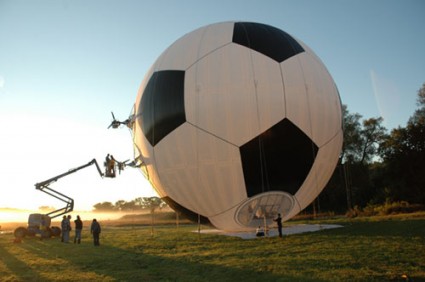
Canadian company 21st Century Airships has completed initial testing of this prototype spherical airship. What you see above is a 19m diameter, two-man dirigible airship. That four engine craft is a test bed for a planned 40m diameter craft that the company intends to use to set the world record for longest duration flight by any type of aircraft. Around the world in two weeks, covering 28,000 miles without stopping once for a piss break, refueling, or cheeseburger.
Aside from the soccer ball livery, they've also made versions up to look like baseballs and globes. Just imagine one of those babies, done up in yellow with a smiley face and armed with very large electric gatling guns, or maybe some nasty missiles. At the very least, you could use something with that kind of endurance for all sorts of things - ecological research, communications, espionage, whatever. And, as an added bonus, it's the only airship in the world that can land on water. You could really have fun chasing whales with this thing...
 on
| § 4
on
| § 4

Live science has a top ten possible US disasters list. Here it is, with some commentary.
10. Pacific Northwest Megathrust Earthquake The fault line up there by Seattle is apparently a lot like the one that caused the Christmas Tsunami in the Indian Ocean.
9. New York Hurricane Hurricanes very rarely get this far north. But when they do, it’s bad. 1938 was the last time one hit, and 600 people died. There’s a lot more people there, and given the unpredictability of hurricanes once they head north, warning times might be in hours.
8. Asteroid Impact Depending on where it hits, and how big the rock is, this could range from annoying to devastating. An asteroid like the one that created the meteor crater in Arizona could easily take out a city if it hit the wrong spot. Given the way that earth-crossing asteroids can sneak up on us out of the sun, like the red baron, there might be no warning whatsoever.
7. Los Angeles Tsunami Another goddamned tsunami. Imagine the big one, the earthquake we all know is coming, combined with the flooding of Katrina.
6. Yellowstone Supervolcano I don’t know why this is ranked six, seeing as if this one lights up, we are all done for. A super volcano once knocked humanity down to under a few thousand people. This one, at the very least, would gut the entire middle of the country.
5. Midwest Earthquake This one would also gut the middle of the country. If the New Madrid fault slips, all those non-earthquake resistant cities in the heartland will fall over. St. Louis, Kansas City, Memphis, Vicksburg… All gone. Plus, flooding as the Mississippi evades centuries of Army Corps of Engineer constructed restraints.
4. Heat Waves We all felt a bit of schadenfreude when the French were unable to cope with a heat wave, and thousands died. It could happen here, but even if we avoided that, a serious, long term drought would cost a shitload of money.
3. East Coast Tsunami This list posits an asteroid impact as the root cause of an East Coast Tsunami. But there is another possibility, a little more down to earth. There is a volcano on the Canary Islands that, should it rip, could drop twenty cubic miles of dirt into the Atlantic. Given the westward facing alignment of this slab, it’s like a shotgun aimed at the East Coast of the United States. Regular Tsunamis are limited in the scope of their destruction because an earthquake is only going to move so much – thirty feet in the case of the Christmas Tsunami, and that becomes an upper bound on the size of the resultant waves. But when you drop large amounts of stuff in the water, there’s no limit. If all that rock dropped in at once, you could have 150 foot waves from Savannah to Boston. Of course, it might not all drop at once.
2. Gulf Coast Tsunami I didn’t know about this one, but apparently only the north coast of the United States is safe from tsunamis. This would probably do a lot more lethal damage on the islands, but it’s not like it’d be a picnic on the mainland.
1. Total Destruction of Earth This takes you back to a list of ways the whole shebang could go up in flames. Makes any run of the mill, regional disaster seem a little small.
on
| § 8
A directory of uavs. Cool.
on
| § 0
NASA has released its bold plan to send mankind to the stars. Well, to send a few people to the moon sometime in the next century, anyway. When President Bush promised in 2004 to do in sixteen years what we did forty years ago in eight, I was underwhelmed. I am now subunderwhelmed. Check out a few groundbreaking details:
NASA has been working intensely since April on an exploration plan that entails building an 18-foot (5.5-meter) blunt body crew capsule and launchers built from major space shuttle components, including the main engines, solid rocket boosters and massive external fuel tanks.
Meaning that using components that in large measure we have already invented and already used, in 13 years we can be back on the moon. And as an added bonus, the crew capsule will be disposable!
NASA's plan, according to briefing charts obtained by Space.com, envisions beginning a sustained lunar exploration campaign in 2018 by landing four astronauts on the moon for a seven-day stay.
That will be somewhere around the 45th anniversary of the immediately previous seven day moon mission.
NASA's plan envisions being able to land four-person human crews anywhere on the moon's surface and to eventually use the system to transport crew members to and from a lunar outpost that it would consider building on the lunar south pole, according to the charts, because of the regions elevated quantities of hydrogen and possibly water ice.
So we’re considering building an actual outpost. Sometime around 2080, I imagine. By the time NASA gets around to building that, they might have to rent landing space from Branson’s Virgin Galactic Lunar Amusement Park.
One of NASA's reasons for going back to the moon is to demonstrate that astronauts can essentially "live off the land" by using lunar resources to produce potable water, fuel and other valuable commodities. Such capabilities are considered extremely important to human expeditions to Mars which, because of the distances involved, would be much longer missions entailing a minimum of 500 days spent on the planet's surface.
Hey that’s a great reason. Prove you can live off the land, using a hundred billion dollars worth of lowest-bidder equipment. That’ll show the Chinese.
NASA's Crew Exploration Vehicle is expected to cost $5.5 billion to develop, according to government and industry sources, and the Crew Launch Vehicle another $4.5 billion. The heavy-lift launcher, which would be capable of lofting 125 metric tons of payload, is expected to cost more than $5 billion but less than $10 billion to develop, according to these sources.
$10 billion dollars. That’s not a lot of money. Of course, that’s just to develop the vehicles. Then we’ll actually have to buy them. Maybe one or two, so we can make one Lunar voyage per year and still have launch capacity to service the ISS and Hubble. I should think that by using pre-existing hardware, you’d be able to actually, you know, save money.
NASA would like to field the Crew Exploration Vehicle by 2011, or within a year of when it plans to fly the space shuttle for the last time.
Or put another way, no less than a year after Rutan wins the $50 million prize for first reusable private orbital vehicle
Development of the heavy lift launcher, lunar lander and Earth departure stage would begin in 2011.
By which time, all the manufacturing plants developing the shuttle components will be closed, and using those parts will no longer be possible, seeing as we’ll probably lose another shuttle sometime in the next six years.
By that time, according to NASA's charts, the space agency would expect to be spending $7 billion a year on its exploration efforts, a figure projected to grow to more than $15 billion a year by 2018, that date NASA has targeted for its first human lunar landing since Apollo 17 in 1972.
$7 billion a year. Just imagine what smart people could do with that sort of cash.
on
| § 1
According to Silfay Hraka (originators of the Carnival of Vanities and this), it is Jesse Jackson. I'd be hard pressed to find a better candidate. There are more virulent and less pc racists in quantity, but none possess the oily charm, press credibility and ability to rhyme of Jackson. Money Quote:
Of course, U.S. Army Lt. Gen. Russell Honore, head of the military task force overseeing operations in the three states, is black. And competent, Jess, as if that matters to you. But it doesn't, because what Jesse Jackson sees in people begins and ends with the pigment in their skin. He is this nation's most prominent racist.
It's more than that, though. Jesse Jackson is in the racism business. If racism did not exist, Jackson would have to invent it.
Racism most assuredly exists, but not in sufficient quantity to support Jesse's tailored suits and comfortable lifestyle. Thus, he must create racism where none exists. ...
Thanks, Jesse. Thanks for making America just a little bit worse with every word you speak. Racism is your business, and you're making sure business is good.
Jesse Jackson is all about making racism pay - for him. A few threats of publicity, and most large corporations will make large donations to the rainbow coalition fund and set aside some business for Jackson's cronies. I feel for the pain of Jackson's wife, but the period immediately after Jesse's adultery scandal was so relaxing simply because of his embarrassed absence.
on
| § 0
I can't remember how I ended up there, but I found this amusing cartoon at Russ Nelson's blog:
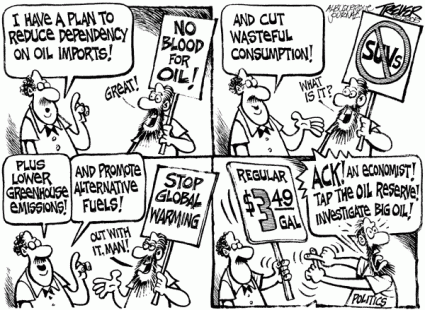
(The cartoonist is John Trevor, and he's got other cartoony goodness here.)
Although the cartoon pretty much says it all, that won't stop me from saying more. Market solutions are often invisible, or at least camouflaged. It's not all deregulation and privatization. Since the rise of the computer and internet age, a growing portion of the population (though still small) has come to realize that prices are not just amounts of money, but information.
The reason why price controls and so on don't work is that they are basically lies. Lies on a grand scale. They so distort the information that market prices are trying to transmit to both buyers and sellers that no one can operate normally. Black markets are in one sense back channel efforts to find the truth of what things are worth. Honesty is the best policy.
on
| § 2
Murdoc links to an article by the infamous Instapundit regarding the repeal of the even more infamous seventeenth amendment. Which one is that, you ask? Is that the one that gives the vote to chicks? Or is it the one that says Vice Presidents don’t have to be elected, except when a plurality of the congress is not in session or whatever that one was?
No, the seventeenth is the amendment that dictated that from that moment on, moronic senators would be chosen directly by the people, rather than by state legislatures. Many would argue that this makes no difference whatsoever. If anything, we’ll at least have more photogenic senators. And since most people think that America is a democracy, well this direct election thing makes that delusion more palatable.
Neither Glenn nor Murdoc know what to make of this. Glenn links to an article on the National Review by Bruce Bartlett. Old Brucie has some interesting thoughts on the matter:
The Constitution originally provided that senators would be chosen by state legislatures. The purpose was to provide the states — as states — an institutional role in the federal government. In effect, senators were to function as ambassadors from the states, which were expected to retain a large degree of sovereignty even after ratification of the Constitution, thereby ensuring that their rights would be protected in a federal system.
The role of senators as representatives of the states was assured by a procedure, now forgotten, whereby states would “instruct” their senators how to vote on particular issues. Such instructions were not conveyed to members of the House of Representatives because they have always been popularly elected and are not expected to speak for their states, but only for their constituents.
You can see the logic there. The people have their own direct representatives in the House. And of course, they have some influence on the choice of senators through who they elect to their state legislature.
Bartlett argues that the seventeenth amendment (and the never to be sufficiently damned sixteenth) inaugurated the explosive growth of big government.
The 17th amendment was ratified in 1913. It is no coincidence that the sharp rise in the size and power of the federal government starts in this year (the 16th amendment, establishing a federal income tax, ratified the same year, was also important). As George Mason University law professor Todd Zywicki has noted, prior to the 17th amendment, senators resisted delegating power to Washington in order to keep it at the state and local level. "As a result, the long term size of the federal government remained fairly stable during the pre-Seventeenth Amendment era," he wrote.
Prof. Zywicki also finds little evidence of corruption in the Senate that can be traced to the pre-1913 electoral system. By contrast, there is much evidence that the post-1913 system has been deeply corruptive. As Sen. Miller put it, "Direct elections of Senators … allowed Washington’s special interests to call the shots, whether it is filling judicial vacancies, passing laws, or issuing regulations."
So the new style Senators elected by the people wouldn’t stand up to federal power like the old senators did. But I think that Bartlett has the cart before the horse. The passage of these amendments was evidence that the growth of federal power was already happening. They are effects, rather than causes. To be sure, the new wimpy direct elected senators probably did grease the wheels of big gubmint. That trend would have won out in any event.
The logic of large scale industrialism had a huge influence on politics, and of course business. But not just in the obvious ways. The idea that things can be managed, and that a sufficiently bright or well informed group could manage things like, say, the government was very appealing to the predecessors of idiot statists like Mitt Romney, discussed in the previous post. This logic dominated American politics for a century, and still does. Its major success was winning the Second World War through industrial means, and its downfall was arguably Vietnam, where a bunch of systems analysis mooks like McNamara allowed the most powerful country in the world to be defeated by small people in pajamas.
Since then, the small has made a comeback, in a number of surprisingly dissonant ways. You have the small government conservatives and the libertarians telling people to get small. You have technologists in the open source movement talking about small networks of people accomplishing amazing things, and you have artsy liberal types wanting to live small, with hand crafted cheeses made by authentic third world cheesiers. I think that in some important ways, this is all related. It’s post industrialism without the postmodernism. We, inoculated with irony and sarcasm, are unable to buy into the industrial age slogans. They seem at best silly, and typically rather pathetic to us. We are a small minded people.
We’ll never see the repeal of the seventeenth. Even though it might be a good idea. For one thing, given the explosion in gerrymandering, it’s the only national elective body that is democratically elected. Rotten boroughs and safe seats are the norm in the People’s house. For another, there’s no compelling evidence (comparable to senate seats empty for years thanks to state house logjams) that the current system is in any way broken. Chris Dodd, Joe Biden, Ted Kennedy, and Rick Santorum don’t count as evidence.
Maybe we need to create another house of congress. The senate would go back to the old style, where senators get appointed by the states. The House would continue to represent the political parties and special interests. But a new house would have members selected by a new method. Anyone who can get a million verified signatures from registered voters is in. Voters can remove their names from a list at any time. Anytime a candidate falls below a million names, he’s out. Voters can support more than one candidate. In an internet age, this is possible.
Whiners and complainers want more public participation in politics. This would get it. The new House would share many of the powers of the other two. Any bill has to pass all three houses before becoming law. But lets give the new house something special. The Senate has the whole advice and consent thing, and the House has control of the budget. This new house would have the power to cancel existing laws by a simple majority vote. It could remove from office anyone not confirmed by the Senate by a two-thirds vote.
That would make politics fun again. But we need a cool name.
on
| § 15
I love DARPA. They are the Ministry of Science Fiction Gadgets. They are "Q" Branch on steroids. They will be the ones who will defend us from our would be robot overlords, unless they are the ones who invent our future robot overlords.
This particular gadget is, strickly speaking, not new. But it appeals to the alternate history lover in me. A world where the silly Nazis didn't build inflamable airships, and the skies were full of graceful and majestic dirigibles wafting passengers around the world in unparalleled comfort and elegance.
Instead, what we have is Jim Carrey in burn makeup saying, "Oh the humanity!" and this:
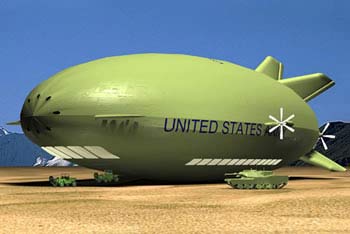
DARPA is shelling out millions of dollars to two companies for development of prototype military cargo airships.
The Walrus operational vehicle (OV) is envisioned to have the primary operational task of deploying composite loads of personnel and equipment (for example, the components of an Army Unit of Action) ready to fight within six hours after disembarking the aircraft. Walrus will operate without significant infrastructure and from unimproved landing sites, including rough ground having nominal five-foot-high obstacles. It is intended to carry a payload of more than 500 tons 12,000 nautical miles in less than seven days at a competitive cost. Additionally, Walrus will be capable of performing theater lift and supporting sea-basing and persistence missions to meet a range of multi-Service needs.
By way of comparison, the C-5 Galaxy can carry about a hundred tons 3000 miles without refueling. An airship would not be as fast as a cargo jet, but the ability to carry five times as much cargo and land it anywhere without need for airstrips is a really big plus. One of the chokepoints in our ability to project power globally is our logistics capability, and within that chokepoint is an additional chokepoint - the ability to rapidly move very heavy gear.
Airlift as we know today can move light equipment and troops nearly anywhere in the world in a matter of hours. However, heavier equipment can only be moved by the largest of planes or by ship or rail. Rail transport has a problem in that most of the world is under water, or not connected to the US rail system. Sealift is cheap and commodious, but rather slow. If you want to get stuff like an M1 tank to Eastern Outer Mongolia in a hurry, you are severely limited in options. You can transport them via C-5, but in doing so you sacrifice the ability of the C-5 to move massive amounts of other stuff, and you only get two tanks per flight. The opportunity cost of using the C-5 for this is thus very high. Ammunition, another important goody, also tends to be very heavy.
Air Logistics planners have a very difficult job. How do you get the best mix of lots of light stuff, and enough heavy stuff to the front quickly. Sealift is easier, but it can take thirty days or more to make one trip to a combat zone, and not all combat zones are on the coast. Like Afghanistan.
The walrus, or something like it, would be of incredible value. More than another new fighter, attack helicopter or destroyer. An efficient airship with a five hundred ton cargo capacity would increase our logistics throughput enormously, even if it is slower than a jet. And the flexibility granted by not needing an airstrip is almost beyond price. And once we have a few of these babies operational, other uses could surely be found for them as well. ASW, AWACS, in-flight refueling - in fact any function that requires long duration flight and cargo capacity but not speed. An airship might be slow, but no one expects an AWACS plane to be dodging missiles.
I say, lets get a couple hundred of these.
on
| § 19
on
| § 0
Last week, I had an epiphany of sorts. I was working on creating a document at work. To get to the finished product, I had to refer to and poach from several other documents. I had to edit several sections, and to bounce back and forth between sections to ensure that I was maintaining consistency of subject matter and voice. I needed to include several images, but I wasn’t sure until near completion exactly what order I wanted to use them. The beginning of the document needed a chunk of boilerplate text modified to fit current needs. Finally, there was some new text that needed to be created, and linked to existing documents in a meaningful way.
This is in most respects a typical work project for me, and for any technical writer. And Microsoft Word is uniquely unsuited for this sort of work. As is every other word processing application. What I am doing is not processing words. I am processing ideas, or at least concepts. Certainly, at a low level, there is a lot of word processing going on, but it is not the primary activity. I could just as easily use notepad for the word processing.
My frustration with the tools at hand led me to think. (Some of these ideas go back a ways, but the totality of the thing hit me like a bat to the head.) One can imagine a word processing spectrum running from notepad to pagemaker. At the one end, you find a rudimentary text entry application with minimal editing functionality. It exists merely to accept words, fiddle with them in a limited way and save them to a file. At the other end are desktop publishing applications such as Adobe Pagemaker. Programs such as this are awkward at best for purposes of creating text, but have truly remarkable abilities to format, arrange and prettify already extant text. They serve to prepare text for publishing.
Other programs exist on or near the spectrum between these two endpoints. UNIX text editors like vi and emacs take the notepad concept and take it to its logical conclusion. Their purpose is not merely text entry, but to control text files. Their search and editing capabilities are very powerful, but only for manipulating pure text – not for any sort of formatting. However, they have been specialized for use as coding tools. Word and other high-end word processors improve upon the text manipulation tools of notepad, but only slightly. What they add is a significant portion of the formatting powers of the desktop publishing software in an easy to use form. You can see what a letter will look like in Word, and print it. Word offers nifty templates for letters and other forms of business correspondence. It is designed for use by secretaries, though it has been adopted by nearly everyone else.
All of these applications either manipulate text, or its appearance, or some combination of the two. This is all very useful, but does not address the problems involved in creating any piece of writing larger than a letter or memo. The process of authoring is larger than the either the manipulation of text, or its appearance. When an author, screenwriter, technical editor, journalist, pundit or anyone writing anything more involved than a memo begins to write, they very rarely dive in and create a complete piece of work in one sitting. Often there is research. Notes about characters. References and citations. Background notes, or drafts.
All of this either exists in one large and unwieldy word doc; or in many, many collectively unwieldy smaller docs. In the former case, all the information is crammed together, and the larger the doc, the more complicated the task of quickly locating the desired information. Scrolling through tens or hundreds of pages of notes to find one thing is time consuming. The search capabilities of word are entirely inadequate to the task. If instead the author has broken his information into many smaller docs, the ease of use depends on how cleverly he has named and organized the documents. Any failure of attention may lead to crucial information being in a misleadingly named doc, or filed in the wrong place, or put in the wrong doc. This leads to exceedingly tedious opening and closing of word docs to find that little tidbit.
Neither situation is conducive to effective research or writing. Microsoft OneNote and a couple writing tools address some of these needs. But while OneNote can organize notes and information reasonably well, it does not make it easy to write. Software like the Writer’s Dreamkit help you keep track of certain information like characters and timelines, but are still poor interfaces for writing. And the help they provide in organization are strictly limited to specific types of writing.
What is needed is authoring software. Software that allows easy and intuitive organization of information as it is entered and easy and intuitive access to that information during the writing process. Software that provides a comfortable and powerful but not unwieldy text-entering interface. Software that allows searching your information and the web right from the text, with minimal interruption in the flow of writing. Software that does what you want but doesn’t get in the way. Software that I’d call the Octopus. Imagine a clever, friendly octopus logo.
This software would not provide full formatting and desktop publishing functionality. But it would be much more than a mere text entry device.
The primary enhancement would be a meta-interface. Imagine an octopus stretched around an invisible globe. Each arm would be a directory tree. On the arms, documents would hang like suckers. Click and grab the globe to spin the octopus in any direction. Docs near the center of the screen would be larger than those farther away – and the larger the doc, the more information in it would be displayed in this interface. Running the mouse over a doc would cause it to pop up to a larger size, so you can see what’s in it. Clicking on a text nugget would bring it to the front semi-permanently – allowing easy movement between several active windows. Text could be drag-dropped from window to window.
The octopus interface would allow easy, intuitive management of information. Assume that you’re writing a screenplay. You fire up the software, and create a new project – a new octopus. It starts as a simple node in the middle of the screen. What do you want to do first? Perhaps some notes about the characters that will be in your movie. You right click on the central node, and select create new arm. A short arm will appear to the side of the central node. You name it “characters.” You right click on that arm, select new nugget. A text window, full sized, appears. Here you enter background information for your hero, Bob. But what about Alice? Right click and select spawn new nugget. Another window appears where you can enter information about Alice. If you minimize the text windows, you will see two nuggets on the arm that you created. But what about locations? Right click on the central node and create a new arm, and a new nugget. Make some notes about where you want to film, and what sorts of sets will be needed. Another arm for more general notes. But hey, you realize, this is all background. Create a new arm, call it background, and simply detach the other two arms and reattach them to “background.” Now, you have a branching arm.
Now that you’ve sorted that out, you need to start writing. A new arm, script. A new nugget, scene one. Start typing. Move on to scene two by spawning a new nugget. Or you’re not sure what’s going to happen in scene two, but you do know how it all turns out. Don’t worry, you can always add a new nugget between scene one and scene three.
Wait! You’ve got a complicated plot, and you need to keep track of where everyone is at all times. Spawn a new arm off of screenplay, timeline. Write your timeline – but whenever you get to an event mentioned in your timeline, you can create a direct, internal link from that point in the screenplay to that entry in the timeline. If you make alterations in the timeline, you can easily track down where you need to make changes in the screenplay. Later, as you are considering casting, images of potential actors could be added in a string of new nuggets, or embedded in the character arm.
Or say you’re a historian, conducting research for a new book. Information you gather from your reading can be entered and automatically organized as you collect it. Bibliographic information can be recorded as individual nuggets on a reference arm – and linked when that source is cited in the text. Auto footnotes. Say your history is of the Second World War, and you’re discussing events surrounding the Battle of the Bulge. What was going on in the Pacific theatre? If you’ve organized your information as you entered it, you can go to the octopus navigator and skim over to pacific theatre arm, and quickly locate by context the information you need, copy some of it, move back to your active window, and continue without the hassle of a tedious search.
Better, say you can’t remember where that one tidbit is. Unlike word, the Octopus would have powerful search capabilities. Grep for terms, and a search window will pop up displaying results ranked by relevance. Each will link to that location in the appropriate nugget.
As your project becomes more complex, you can navigate the interface by dragging the octopus around. Bring the part you wish to focus on to the front, and those parts will become bigger. Move out a level, and you can navigate through all of your projects the same way. Import your old documents into the system automatically, and easily arrange them into sensible structures by clicking and dragging one arm to another, or one doc into another tree. The Octopus manages your creation. As you create, you create your own intuitive organizational structure. Octopus’ interface allows you to easily navigate your information.
The other major improvement is in writing. Word and other word processors have minimal editing and searching capabilities. And most of what they have is focused on editing format, and simple search and replace. Why not include all the powerful text editing capabilities of vi or emacs? They use basically the same concepts, but different commands to do them. Include both. For all the wonders of the GUI interface in general, when you’re typing you need two hands. Unless you happen to be a motie, you don’t have a third hand available to use a mouse. Building a comprehensive set of keystroke commands in allow you to keep typing.
The most powerful writing tools ever developed are the dictionary, the thesaurus and Google. Word 2003 finally made one of these directly available – right click on a word, and synonyms appear write there in the context menu. (I didn’t know about this until I actually looked, after I got the idea myself. At least they got something right.) But all of this should be available. Right click on a word, and the dictionary definition should appear in the context menu. Along with synonyms, antonyms, related words, and so on. Select a word or phrase, and right click to dump that into Google search as a search string. Dump the results into a new text nugget for later consideration. Build in writing and research tools. Templates for references and citations. Writer’s thesauri. Quotation libraries.
Right from the interface, you should be able to search the software’s onboard libraries of dictionary and thesaurus entries, quotes, grammar rules, and so on. You should also be able to search all of the text nuggets in your current project, and all your other projects. The search engine should be more powerful than the basic search in Word – something more along the lines of the grep tool from the UNIX world. Full on regular expression searching, once you get the hang of it, is very powerful. And finally, you should be able to search the web. Google is currently the best tool for that, and most people don’t use it to it’s full capacity. You could embed some of the more abstruse search capabilities of Google directly into Octopus’ search tool.
Once you have finished your creation, simply select the nuggets that you wish to include in your final draft. Octopus will convert those into a single file readable by Word, WordPerfect, PageMaker or any other software so that you can add the formatting before sending it off. That’s what those applications are good for – not for the process of creation.
Octopus thus has two key advantages over any other word processing application. First, it manages the totality of information connected with your project. All of the information, text, data that you have gathered is almost automatically organized in an easy to use structure. And Octopus’ interface allows you to quickly, intuitively and easily navigate that structure to locate the information you need, when you need it without interrupting the creative process.
Second, it offers powerful tools to manipulate and search the text as you create it. The tools of UNIX text editors like vi or emacs are available as keystroke commands. Regular expression searches of your data, and Google-style searches on the internet are available with a single click. Links between different nuggets, and the information within them are easily created with a single click and point. Built in dictionaries and thesauri display definitions and synonyms with a single click. You don’t have to leave what you’re doing to find the information you need.
I write professionally, creating software manuals, process documentation and so on for IT projects. On the side, I write screenplays, short stories, and novels that are getting almost readable. I also write non-fiction history. Every one of these projects would be made easier with software on these lines. Technical writers, authors, scholars, historians, scientists, journalists, and screenwriters could all use software like this. I described my idea to a developer friend of mine, and he said it would be very useful in organizing code and development projects. Anytime you need to not merely write, but keep track of what you write, the Octopus would be invaluable.
If any of you are developers (Ross…) I will work with you to develop this. Productivity software doesn’t have the same kind of overhead as games. No graphics except for making the UI slick. (Very slick.) Mostly, it’s just code. It could be done, and a lot of the tools are already out there, they just haven’t been assembled. If it were done right, this could be a hit. Because it would be useful, and cool.
on
| § 1
Here, for your reading pleasure, are several ideas for new t-shirts. These are complicated, front-and-back designs so pay attention:
Shirt Number One, Front:
Skateboarding is not a Crime
Shirt Number One, Back:
But it is fucking annoying
Shirt Number Two, Front:
Hurting you is the last thing I want to do
Shirt Number Two, Back:
But it is on the list
Shirt Number Three, Front:
I'm not staring at your tits
Shirt Number Two, Back:
But I glanced at them long enough that I could pick them out of a lineup
on
| § 0
As I mentioned earlier, I had some doubts on the veracity of the geek test that geeklethal found and posted.
So, I found some other tests, and took them. Here are the results:
- The hundred question nerd test: I have 50.0% nerd in me
- The five hundred question nerd test: I have 61.2% nerd in me
- The Ludicrous Speed nerd test: 59.523809523809525% nerd blood flows through my veins
- The blessedly short nerd test: my score is 7, straddling the nerd/non-nerd border
- A geek test: I have 49% geek in me (though only 6% have more)
- The geek purity test: I have 30.2% geek in me
- An English geek test: I am 65% geek in me according to this wanker
- And finally, This geek/nerd/dork test which assigns you to one category. I am a nerd, a little bit of a geek, and not really a dork at all.
Weighting the five hundred question test double due to its length, my average nerd score is 58.9%.
on
| § 9
For what it's worth, I scored pretty high on the test. I have some issues with the construction of the test, but will forego a full out analysis as that would be a bit geeky. I will note, however, that the test is a bit skewed by the emphasis on computer stuff. The fact that I work in the IT bidness had a dramatic effect on my score. That and my ability to recognize old, dead scientists and obscure chemical elements. A proper geek test would focus on mindsets as well as skillsets. And would include probing questions about geekly matters like Star Wars v. Star Trek, LoTR and velvet tiger art.
on
| § 13
No, really. From this nifty and cleverly named job predictor thingy I picked up from Rocket Jones I learned that I could, even should have been a Brain Surgeon. Sadly, when I enter my actual, full name rather than my admittedly goofy nom de net it tells me that my true vocation is Circus Freak. Playing around a bit, I confirmed my suspicions about my long detested middle name:
Walter, your ideal job is a Rear End of Panto Cow
I don't know exactly what a Panto Cow is, but it can't be good.
To avoid any potential shyness on the part of my coworkers, here is what they should be doing:
- Johno, your ideal job is a Office Gopher. Strangely, that is very similar to what he actually does. This thing is good!
- Patton, your ideal job is a teasmaid. I'm not sure what that is precisely, but it sounds vaguely gay.
- Geeklethal, your ideal job is a Dentist. I am sure what that is precisely, and it sounds vaguely gay.
- Ross, Your ideal job is a Professional Tramp. No doubt about it, a bit swish. And slutty, too. I wonder if they've nationalized tramps in Canada?
Well, there you have it. Three fags, a gopher and a brain surgeon. That's us in a nutshell.
on
| § 7
I would like for Cindy Sheehan, the Environmental Minister of Germany Jürgen Trittin, Islamic whackjobs and this fucktard to go drink a large, steaming mug of shut the fuck up.
Hurricane Katrina was not the fault of George Bush, the Republicans, American environmental policy or a vengeful Allah.
on
| § 4
Hurricane Katrina has left in her wake devastation and suffering. Thousands may be dead, and those remaining in New Orleans and the worst-hit portions of Mississippi and Alabama are in dire need of assistance. The first and simplest thing to do is to donate money to those who are trying to help. The Red Cross has a convenient web page where you can donate money via credit card. Over $11,000,000 has already been donated, and that just scratches the surface. Give all you can.
After giving to the Red Cross, consider other, more targeted aid. Instapundit has an immense and still growing list of organizations that can translate your money into help for the refugees of Katrina. I might also suggest The IOCC, the International Orthodox Christian Charities. They have low overhead; they focus on providing aid that doesn't merely ameliorate immediate needs, but that wil help prevent future need as well.
Tell your friends and family to give.
Spread good ideas, like this one from Donald Sensing. He suggests that printing and dropping leaflets over the affected areas would provide much needed information for those cut off from the outside world.
And pray for those who have died, for those who have been saved, and for those awaiting help, for the brave soldiers, firemen and police officers risking all to help others, and especially for those who have resorted to looting and violence.
on
| § 0
This is fascinating and disturbing. Those who think that China is a "strategic partner" should think again.
on
| § 5
Malaysia has announced that they plan to be on the moon by 2020. If a third rate nation like Malaysia is even contemplating a manned moon mission in the near term, it is high time that we get our asses moving. Bad enough that we can imagine a Chinese-dominated space future, but a Malaysian one is beyond the pale.
on
| § 2
A research team has succeeded in producing a recon drone that flies like a bird. At least in some respects. It's not an ornithopter - it doesn't use the flapping of wings to generate lift. But it can rapidly change the shape of its wings to achieve much greater flight control and maneuverability. The flight control system is modeled after the wings of the common sea gull, and will allow the drone to complete three barrel rolls in a minute - an F16 can only do one without incapacitating the pilot.
"If you fly in the urban canyon, through alleys, around parking garages and between buildings, you need to do sharp turns, spins and dives," said project leader Rick Lind, an aerospace engineer at the University of Florida. "That means you need to change the shape of the aircraft during flight."
If all this tinkering pans out, the result will be a highly maneuverable drone for looking in on enemies in built up areas. As long as they don't add a guano-bombing module, I think its a good idea.
on
| § 2
Minister Geeklethal cued me in to an interesting article from the English-language Arab News, "The Middle East's Leading English Language Daily." In this opinion piece, the editor holds forth on the proper mindset for beating your wife.
The beating which is only prescribed in the case of disobedient wives is intended to serve as a remedy in an unusual situation. If the husband feels the wife is behaving in a disobedient and rebellious manner, he is required to rectify her attitude — first by kind words, then gentle persuasion and reasoning. Beating as a last resort must never be understood to entail using a stick or any other instrument that would cause pain or injury.
A rebellious woman who is not moved by kind works, persuasion and admonition is a woman of no feeling and must therefore be punished by beating. Psychiatrists tell us of people, including women, for whom a cure lies in beating.
The controversy over the beating of disloyal and rebellious women is part of the campaign against Islam. If beating disobedient wives was advocated by Western scientists, it would have been widely supported by the same people who criticize Islam and special centers would have been set up all over the world to train husbands on how to beat their wives.
Our scholars should focus on explaining to people, especially the young, the real teachings of Islam in order to avoid causing uncertainty and confusion.
It is good that the interpreters of the religion of peace realize that there are two kinds of beatings, and forbid at least one of them to husbands. Instructional beatings at least have the saving grace of providing instruction - whereas run-of-the-mill, smack the bitch for shits and giggles beatings just leave bruises.
Back in Ohio, we would occasionally run across people who clearly "need beating." I now understand that what we were feeling there was a divine inspiration to administer instructional beatings. If only we had read the Koran, we would have been empowered to act on that nudging from the almighty rather than let cretins run around untutored.
It is good for my safety that I am a Christian, seeing as any attempt to deliver admonitory beatings to Mrs. Buckethead would result, not in her adopting a more humble and obedient posture, but in me getting a grade A tae kwon do ass whuppin'.
on
| § 1