

 Ministry Archive: Buckethead
Most Americans are unaware of how, exactly, their government works. At best, most of our citizenry has a hazy conception of the actual operation of Congress based in large part on vague recollections of schoolhouse rock’s “I’m just a bill.” This is a good and bad thing.
On the one hand, it is bad because liberty in a republic depends on the wise and considered participation of an informed citizenry. Warmed over and fuzzy memories from high school civics layered with factoids from USA Today and CNN do not an informed electorate make.
On the other hand, it is good, because if the good citizens of this nation actually understood, really knew, what goes on in, say, the stygian depths of the House Rules Committee room, they’d invite the British back to finish what they started in 1814. Leaving our fair capital a smoking wasteland would be infinitely preferable to facing the horrifying reality of dysfunction and corruption at the heart of our system.
On a related but tangential track, there’s Sam Cohen. You’ve likely never heard of him, but he’s the dude who invented the atom bomb. The peacemongers and hippies all painted the neutron as an even eviler version of an irredeemably evil weapon. It was the ultimate capitalist bomb – a nefarious device that killed people while leaving their property intact. This is in stark contrast to the actual mindset that led to Cohen to invent the bomb and to declare for decades that it was the most moral weapon ever devised.
Cohen’s logic was that in war, people will use weapons. Weapons are designed to kill. So, it makes sense to design weapons that kill efficiently while doing as little else as possible. If a neutron bomb doesn’t kill you outright, you will live on with out appreciable aftereffects. The infrastructure that you need to survive after the war will be intact – not blasted apart or poisoned with radioactivity. The bomb doesn’t maim, it only kills. Cohen, from his position at RAND, lobbied for years for his concept, only to be rejected by five successive administrations and a military that wanted only bigger bombs, not more efficient ones.
Cohen’s story has some – interesting – accounts of the wrong-headedness of those in charge of our nuclear strategy. But they aren’t as far fetched as they might seem at first. Remember that the depiction of cold war strategic reasoning in Dr. Strangelove is barely exaggerated from the realities of game theory informed strategy used by RAND and the military up until the fall of the Soviet Union. (The takeover of grand strategy by the mathematicians starting with RAND in the late forties is responsible for much of the incredible weirdness of the Cold War, the counterintuitive reasoning, inflexible response postures and bloodthirsty retaliation schemes. Also, the fascination with throw-weight, CEP, megadeaths, and finely-wrought calculations of the effects of nuclear war.) And also that those responsible for setting policy had (with the possible exception of Eisenhower) none of the special aptitude or training one might think necessary for figuring out what to do with city-destroying weaponry.
Knowledge is good, as the Faber college motto tells us. But it doesn’t always make it easier to sleep at night.
 on
| § 1
on
| § 1

Via Pejman, this glorious post. Excerpt:
THEME (By the Kronos Quartet with vocals by ABBA)
Just the good ol' boys
Filled with guilt and ennui
They're bored, racked with discord
Just hangin' by the fjord
Scarred emotionally
Masking their pain
The only way they know how
Just a bit more existentialist
Than their souls will allow
Just them good ol' boys
Wouldn't change if they could
Psychically crippled
Like two planks of Danish teak wood
Yee. Ha.
SCENE 1
Interior shot of a backwoods cabin in rural Georgia. The room is tastefully decorated with Bruno Mathsson lounge chairs, Eero Saarinen side tables, a rebel flag and moonshine still. An old bearded man lies on a vintage midcentury Alvar Aalto death bed.
NARRATOR (Gunnar Biörnstrand)
Just plumb about everybody in Hazzard County has a story to tell 'bout them Duke boys and their existential auto-didactism. This one starts back at the farm, where Bo 'n' Luke are about to find out that Uncle Jesse has a little surprise in store for 'em...
UNCLE JESSE (Max Von Sydow)
Bo, Luke. Come to my side, nephews.
(Cousins Bo and Luke, scions of Uncle Jesse's crumbling moonshine dynasty, enter.)
LUKE (Börje Ahlstedt)
What is it you want, Uncle?
(Bo and Luke exchange long, blank glance; a Hans Wegner clock ticks on a far wall)
UNCLE JESSE
Death.
BO (Ashton Kutcher)
Your despair has shaken our complacency. I shall bring your jug.
LUKE
It is the same Blomvo jug that Aunt Bessie long ago bought for you at Ikea... when you were young and happy.
UNCLE JESSE
Its design is elegant; yet, like life, it brings me no joy. I am compelled to smash it, like my own existence.
BO
But you must live, Uncle.
UNCLE JESSE
Why must I live? Life is a meaningless parade of pain, and loneliness, and revenuers.
(Bo and Luke stare; close-up of ticking clock)
on
| § 1
The Watergate scandal typically overshadows Nixon's one real accomplishment - peeling the Chinese off the Soviet Bloc. Rather than a monolithic communist world united in opposition to the good 'ol US of A, after the early seventies, you had a much friendlier duolithic communist world; one where the Sovs had to seriously worry about the billion hungry Chinese and the longest land border on Earth. All was hunky-dory until the unraveling of the Soviet colossus through decades of political calculation out the window.
A period of happy innocence followed, followed by a rude awakening in the form of fanatical Islamofascists blowing up our buildings. But this, too has skewed our geopolitical reasoning. For all that terrorists and their state sponsors do pose a threat, it is not an existential threat. We need to take action, certainly, to defend ourselves, and the best defense is usually a good offense. Nevertheless, there is no way that Islamic legions will be landing on the Jersey shore anytime in this or any other century. Islamic bomber fleets will not rain destruction down on our cities, unless they somehow manage to get a five finger discount on the one of our air forces.
The only real potential (for now) existential threat is China. The Soviets, god bless them, were evil. But they were evil and stupid. We had the great good fortune that our greatest enemies saddled themselves with the most backward, inefficient and retarded economic system ever devised by the mind of man. This was more than a little help in a half century of Cold War. The Chinese communists are just as evil, but have jettisoned the worst of the economic stupidity of the command economy. Evil and smart puts me more in mind of say, Germany in 1936 rather than the USSR in 1980. An evil leadership, with a vibrant and productive economy, and with a distinctly (not to say xenophobic or fanatical) nationalist ideology is not a good thing to have in the world's most populous nation.
Germany was outnumbered by each of its three major opponents in the Second World War. This will not be the case in any hypothetical confrontation with China. And China is clearly laying the groundwork for confrontation with the US. This whole rant was sparked by this article which describes the increasing cooperation between the Russian and Chinese militaries. The Chinese are now the senior partner in a solidifying strategic alliance that embraces the majority of Asia's landmass.
Here's a prediction: if the Chinese invade Taiwan, the only people on our side will be Great Britain, Australia, New Zealand, Japan and South Korea, and India. And of course, the Taiwanese. Russia will be soldily in the Chinese hip pocket, and the Europeans will sit on the sidelines and condemn everyone. But they'll only mean it when they say it to us.
on
| § 2
In an article entitled, "Gamers turn cities into a battleground," the New Scientist explores the possibilities now unfolding in the world of urban gaming. Urban gaming makes use of cell phones, GPS and other technological gimcrackery to create virtual games played in actual meatspace. It's a fascinating article, and evidently some serious skull sweat has been expended to develop something that I have no interest in whatsoever. Undoubtedly, thousands will soon thrill to the prospects of playing a spy in a game based in DC, and I will have one more thing to contend with on my commute home. As if the tourons weren't bad enough.
However one aspect of this urban gaming seems rather disturbing and frankly, fraught with peril:
Games console makers are also embracing the trend. Portable console maker Gizmondo is soon to launch Colors, a gangland game where players play a conventional arcade game to earn credits and money. These are then used to buy turf in the real world - Soho in London, say. Walk into a Soho cafe and attempt to play Colors, and the GPS embedded in the console might tell you you're playing on another gang's patch, and you need to beat them in a virtual fight to claim the turf and continue.
How long do you think - in hours - after the launch of this game before someone gets knifed?
on
| § 3
We are warned that Global Warming is real. We are warned that such warming presents a real and imminent danger. All sorts of things have been proposed - from the reasonable to the ridiculous to the draconian - to deal with the warming. And all of this is to prevent the onslaught of a temperature rise of about one degree over the next century or so.
However, what would happen if the global temperature went up by several degrees, and the what if the oxygen content went up by 50%? What if the CO2 content of the air quintupled? Surely, all life would come to an end! Either that, or the Earth would just be a bit more like it was in the Cretaceous Period, when life did come to an end as a result of global warming, leaving the Earth a barren and sterile wasteland inimical to all future life. Like New Jersey.
on
| § 1
Via Murdoc, and Blackfive, this heartwarming photo from the frontlines:
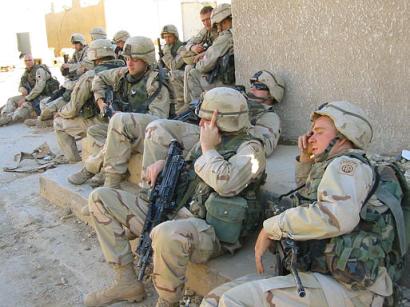
The armed forces are always willing to display their undying respect for the media. From another recent Blackfive post, this quote is also apropos:
"Do not fear the enemy, for your enemy can only take your life. It is far better that you fear the media for they will steal your honor."
- Bobby McBride, Crew Chief, 128th Assault Helicopter Company, RVN 1969-1970
If I were ever to be thrown back into the middle ages, and needed to design a heraldic emblem, I would either use the finger, argent, on a field sable; else just use the bat symbol.
on
| § 0
...but remorseless robotic cunning goes straight to the bone. The sad litany of race traitors is ever-lengthening. We are informed that certain researchers of the Japanese persuasion have been laboring mightily to endow our future robotic overlords with skin.
This is not a the forerunner of some sort of mundane, Terminator-style nightmare. This new robotic skin does not mimic the mere appearance of human skin. It will not allow humaniform, remorseless hunter-killer androids to infiltrate our Ministry end-times bunker. This robotic skin replicates the capabilities of human skin.
Japanese researchers have developed a flexible artificial skin that could give robots a humanlike sense of touch. The team manufactured a type of "skin" capable of sensing pressure and another capable of sensing temperature. These are supple enough to wrap around robot fingers and relatively cheap to make, the researchers have claimed.
The researchers explain how pressure-sensing and temperature-sensing networks can be laminated together, forming an artificial skin that can detect both properties simultaneously.
This may not seem like a giant leap forward in the growing field of rendering humanity an endangered species. And if no further developments were planned, it probably wouldn't amount to much. But attend:
And they [the evil researchers] add that there is no need to stop at simply imitating the functions of human skin. "It will be possible in the near future to make an electronic skin that has functions that human skin lacks," the researchers write in Proceedings of the National Academy of Sciences. Future artificial skins could incorporate sensors not only for pressure and temperature, but also for light, humidity, strain or sound, they add.
So this will allow our future robotic overlords to "feel?" Not the way these self-deluded researchers think. Covering a humaniform, remorseless hunter-killer android with a seemless skin of sensors is condemning any future human resistance movement to death. If the HRHKA can only track our scared and under-armed descendents with vision, IR and sound, they might stand a chance. But a fully functional sensor skin that can detect movement by say, sensing air pressure differentials like a fly we're truly doomed.
Enough sensors will make any conceivable stealth system transparent.
on
| § 2
I have recently discovered that the Ministry is no longer a lone Cassandra scrying doom for humanity lurking in the rapid advances in the fields of artificial intelligence and giant fighting robots.
There is another lonely voice vainly urging a somnolent humanity to awake. Chris, of Adventures in Capitalism, also sees the threat in gifting intelligence to our tungsten-alloy armored creations and then giving them guns.
on
| § 0
Over the last couple months, I’ve run across several clever and even snarky ideas for redirecting the firehose of public expenditure from the bottomless pit of government bureaucracy into the arid and brown uplands of sensible ideas in dire need of irrigation. I posted about one of these a while back, aimed at the stinking miasma of public school funding. Yesterday, I ran across two more, from Dr. Jerry Pournelle.
The first is an idea I’ve had for a while, but which the good doctor was rude enough to write up first. Gazing at the billions spent annually on the nearly moribund Shuttle Program, Jerry thinks some thoughts:
NASA spends a billion and can't fix the problem of foam dropoff. Give me a billion and 3 years (and exemption from the Disabilities Act and some other imbecilic restrictions) and I'll have a 700,000 pound GLOW reusable that will put at least 5,000 pounds in orbit per trip, and be able to make 10 trips a year for marginal costs linearly related to the cost of fuel.
…Now, as a backup in case single stage is the wrong way to go -- and I can be convinced that it is -- hand another $1 billion to Burt Rutan and let him try his air lift first stage approach. Then have a flyoff. Hell, go mad: give me a billion, give Burt a billion, hand a billion to each of the remaining big aerospace companies, and give a billion to NASA. That's $5 billion, less than the annual cost of the Shuttle program -- have you noticed that the program cost is independent of the number of Shuttle launches? NASA will waste its billion, the two aerospace companies will futz around with studies that end up requesting $20 billion each and produce nothing but paper, but you may be sure that Rutan and I will both have some flying hardware.
Is it arrogant to put myself in the same league with Burt? Sure, but then we all know I won't actually try to manage the program; that's for younger people. My job will be to take the heat while they get the work done. And if you don't fancy me as the competition to Rutan, pick someone else. I can think of at least three small outfits I'd give long odds can spend a billion with far more return to the American people than the two big aerospace outfits and NASA, so if you want to do the program right, you may need $8 billion because you aren't going to do anything without bribing NASA and the big boys; and an $8 billion program looks like money so the big aerospace outfits will want larger bribes. (They'll take bribes to stay out of the way, because that's a sure return and they don't take chances any more; but they're good at the political game and for $8 billion they will smell money in the water and go into a frenzy; but be sure that whatever they get they won't produce anything useful for it. Not any more. And we all know that including the engineers who work for the big outfits.)
Now, Dr. Pournelle once worked in the space bidness, and I’m sure that I couldn’t do quite as much with a billion as he. But I’m sure that I could do more than NASA.
If you scroll up a bit from the NASA bit (which you should read in full) you’ll find another interesting spending proposal. Jerry links to an article in the Washington Post which reports on the findings of the liberal think tank the Center for American Progress. This group of fuzzy-headed liberals determined that the cost of giving the boot to our estimated ten million illegal aliens is in the neighborhood of $41 billion a year, and running to nearly a quarter trillion dollars over five years. In coming up with this large number, the CAP assumes government standard procedures for dealing with wetbacks. That is, that it would cost about $28 billion per year to apprehend illegal immigrants, $6 billion a year to detain them, $500 million for extra beds, $4 billion to secure borders, $2 million to legally process them and $1.6 billion to bus or fly them home. In short, government numbers, and a permanent lifetime employment plan for those who would manage, but not solve the problem of illegal immigrants.
The good doctor has a different idea:
As many have pointed out, that's less than the cost of the Iraqi War; which would you rather see the money spent on? Of course I doubt the $41 Billion/year to begin with. In Los Angeles a great deal of the cost would be borne by local police once they were freed of the restrictions on checking citizenship and residency status -- and in Southern California at least $2 billion a year would be saved instantly by relief of public institutions such as hospital emergency rooms from the burden of providing services for illegal immigrants. Other such savings come to mind.
And of course some of the job could be farmed out to bounty hunters. At ten million illegal immigrants, what could we afford to pay bounty hunters per individual delivered at a Border Patrol station or INS Detention Center? At $1000 a head it would cost $10 billion to round up all of them, leaving another $20 billion for actual cost of detention and deportation, and still saving $11 billion for the first year. Spend that $11 billion on border control, and the next year there would be, say, only 5 million, so the cost is now $15 billion for the second year plus the $11 billion for border control. Surely we would be down to a million in five years, so our cost would be $3 billion for bounty hunters and deportation, plus the $11 billion for border control. We could then look at streamlining the border control operations, having spent $55 billion on it; one supposes that cost could be got down to half? We are now at $10 billion a year, possibly forever.
But if they are right, and it will cost $40 billion/year forever, it will still be affordable. We can afford the Iraq war, can't we?
As I’ve said many times before, I have no problem with immigrants, provided they come here legally. I am open to almost any plan for numbers of legal immigrants allowed into the country. I think we should reform the immigration process so that it is in most respects easier to get into and stay in this country – at least in terms of paperwork, red tape and bureaucracy. I think that we should adopt a new status for citizens of nations like Great Britain, Canada, Australia, New Zealand and other friendly places, whereby they could come to this country with an absolute minimum of fuss, to work, study, or travel for any period of time.
It’s one thing to invite someone into your home. Show them hospitality, even let them stay for extended periods of time. If you invite them. But if someone breaks in and takes up residence in your basement, they get the door or a bullet regardless of how inexpensively they could clean up the kitty litter.
We are in the third millennium now. We should be able to begin thinking about new ways of doing things that have been traditionally been managed poorly if at all by government bureaucracies. These are just a few, and I’m sure there are plenty of others.
on
| § 1
Via Spoons, we are informed that the inevitable has finally happened. Ever since the introduction of cellphones, I have been waiting for this moment:

This can be your new cell phone. It won't make you cool like Kirk, or smart like Spock, but indulge your inner geek. It really has been a mystery to me that this has taken so long to arrive on the market. Even short of a full-on communicator replica case cell phone, why no cell phone company has equipped a flipphone with a spring loaded opener is a complete enigma. Those things, while generally convenient, are a pain to open one handed. A Trek style opener would have been an enormous improvement even in a regular looking phone.
While looking for the image above, I also found this:

Vocera's communication badge works like the communicators on ST:TNG. Press the button and say a name, and - assumming the person you wish to speak to is on the network - you'll be patched in via Voice over Internet Protocol. Pretty sweet.
Now all we need are wrist phones a la Dick Tracy, real video phones like the Jetsons, and of course jet cars and vacations on the moon.
Speaking of which, that last is one step closer to reality. At least, if you have a hundred million dollars burning a hole in your pocket.
Space Adventures, a company based in Arlington, Va., has already sent two tourists into orbit. Today, it is to unveil an agreement with Russian space officials to send two passengers on a voyage lasting 10 to 21 days, depending partly on its itinerary and whether it includes the International Space Station.
A roundtrip ticket will cost $100 million.
The space-faring tourists will travel with a Russian pilot. They will steer clear of the greater technical challenge of landing on the Moon, instead circling it and returning to Earth.
Eric Anderson, the chief executive of Space Adventures, said he believed the trip could be accomplished as early as 2008. Mr. Anderson said he had already received expressions of interest from a few potential clients.
Given NASA's recent history of accomplishment, I think this is more likely to happen than a US Government mission back to the moon. Who'd have thunk, in 1969 after the momentous triumph of the Apollo landings, that the next visit to the moon would be by American millionaires flying on forty-year old Russian rockets? The world, she is an effed-up place.
on
| § 0
Here's an interesting recap of the last ten years of the internet. You forget how quickly all this really happened.
on
| § 0
A couple military history items caught my eye over the last week.
The first is a book review by Mac Owens. In it, he examines two books by Richard Sorley - Vietnam Chronicles: The Abrams Tapes, 1968-1972 and a related, earlier book - A Better War: The Unexamined Victories and Final Tragedy of America's Last Years in Vietnam. The first book is transcriptions of audio tapes made while General Abrams was in command of American Forces in Vietnam, and is the raw material from which the second book was created.
A Better War makes the case that in the wake of the Tet Offensive and General Westmoreland's replacement, American forces were winning the war on the ground in Southeast Asia while it was being lost in Congress and at the peace talks.
Sorley's argument is controversial, but I find it persuasive. The fact is that most studies of the Vietnam war focus on the years up until 1968. Those studies that examine the period after the Tet offensive emphasize the diplomatic attempts to extricate the United States from the conflict, treating the military effort as nothing more than a holding action. But as William Colby observed in a review of Robert McNamara's memoir, In Retrospect, by limiting serious consideration of the military situation in Vietnam to the period before mid-1968, historians leave Americans with a record "similar to what we would know if histories of World War II stopped before Stalingrad, Operation Torch in North Africa and Guadalcanal in the Pacific."
Colby was right. To truly understand the Vietnam war, it is absolutely imperative to come to grips with the years after 1968. A new team was in place. General Abrams had succeeded General William Westmoreland as commander of the U.S. Military Assistance Command-Vietnam in June 1968, only months after the Tet offensive. He joined Ellsworth Bunker, who had assumed the post of ambassador to the Saigon government the previous spring. Colby, a career CIA officer, soon arrived to coordinate the pacification efforts.
Far from constituting a mere holding action, the approach the new American team followed constituted a positive strategy for ensuring the survival of South Vietnam. As Sorley wrote in A Better War, Bunker, Abrams, and Colby
brought different values to their tasks, operated from a different understanding of the nature of the war, and applied different measures of merit and different tactics. They employed diminishing resources in manpower, materiel, money, and time as they raced to render the South Vietnamese capable of defending themselves before the last American forces were withdrawn. They went about that task with sincerity, intelligence, decency, and absolute professionalism, and in the process they came very close to achieving the goal of a viable nation and a lasting peace.
The contrast between the two phases of the war are enormous. Max Boot, in The Savage Wars of Peace, also discusses how the American effort was finally beginning to work - thanks to new strategies like the Marines' CAP program for pacifying the rural south. Abrams, in the larger war, moved away from Westmoreland's ill-conceived large unit "sweep and clear" and "search and destroy tactics.
Abrams's approach focused not on the destruction of enemy forces per se but on protection of the South Vietnamese population by controlling key areas. He then concentrated on attacking the enemy's "logistics nose" (as opposed to a "logistics tail"). Since the North Vietnamese lacked heavy transport within South Vietnam, they had to pre-position supplies forward of their sanctuaries before launching an offensive. Americans were still involved in heavy fighting, as illustrated by two major actions in the A Shau Valley during the first half of 1969: the 9th Marine Regiment's Operation Dewey Canyon, and the 101st Airborne Division's epic battle for "Hamburger Hill." Most people don't realize that, in terms of U.S. casualties, 1969 was second only to 1968 as the most costly year. But now North Vietnamese offensive timetables were being disrupted by preemptive allied attacks, buying more time for Vietnamization.
...The 1972 Easter offensive [the first full scale invasion from the North] revealed the fruits of Abrams's efforts. This was the biggest offensive push of the war, greater in magnitude than either the Tet offensive [conducted by Viet Cong guerillas] or the final assault of 1975 [Another invasion from the North.] While the United States provided massive air and naval support, and there were inevitable failures on the part of some South Vietnamese units, all in all, the South Vietnamese fought well. Then, having blunted the Communist thrust, they recaptured territory that had been lost to Hanoi.
The terrible thing is that even as late as 1975, the Vietnam war could have been won. Had we lifted our heads from the Watergate scandal a little bit, and sent the military supplies and air support we promised, the South likely could have resisted the 1975 invasion. But short of ammunition and all other critical supplies, the South lost, and millions ended up refugees, or worse, sent into reeducation camps.
Another look at military history second guessing is Victor David Hanson's look at the atomic bomb sixty years after their only wartime use. There are some who still debate the utility of dropping the bomb. But the case is pretty clear that in that case, at least, the atom bomb was far preferable to the alternative.
The alternative to 300,000 killed in two atom bomb attacks is this:
Not a pretty picture. War is often about terrible choices - and about taking the least bad option.
on
| § 1
Well, not really. Tomorrow morning, if you look to the Northeast before sunrise, you should be able to see the Perseid Meteor Shower. Sadly, the peak of the shower will happen during the day, so best viewing is Friday and Saturday morning before the sun comes up. Meteor counts in a dark sky should be on the order of 50-60 per hour.
There is very, very little chance that any of these will bean you on the head, since they are typically no bigger than a marble and have the consistency of cigar ash and burn up in the upper atmosphere.
on
| § 4
As of 9:30 am yesterday, Texas is a majority-minority state. The white overclass is now a minority in the very home of redneckdom. Texas follows California, New Mexico and Hawaii into this unnatural state of being. I'm sure that God is laughing that most of the states in greatest danger of falling prey to this syndrome are in the ex-Confederacy.
I guess the only place that a self-respecting bigot can go is North Dakota, Iowa, West Virginia, Vermont, New Hampshire, or Maine.
on
| § 11
Note to self: if you're driving a semi filled with 35,000 pounds of explosives, don't flip the truck.

The explosion left a 60 foot wide crater in the road, and the truck was "pretty much vaporized."
Really?
on
| § 1
The recent wave of intelligent design advocates arguing for the inclusion of creation science into the curricula of high schools throughout our counry has aroused stiff resistance from the advocates of evolution, science and those with more than three neurons to rub together. This was to be expected, since most of us thought that this issue had been resolved round the time of Scopes and his infamous monkey. (Not infamous that way, you pervert.)
However, these are not the only people upset by the biblical intelligent design advocates. Some people are upset because their creation theory is getting short shrift thanks to all the greedy god botherers pushing the Genesis account.
In an open letter to the Kansas School Board, these oppressed individuals are making their case for an intelligent design theory that, on first glance, seems far more probable - and explains a lot more than what we've been used to so far. Witness:
I am writing you with much concern after having read of your hearing to decide whether the alternative theory of Intelligent Design should be taught along with the theory of Evolution. I think we can all agree that it is important for students to hear multiple viewpoints so they can choose for themselves the theory that makes the most sense to them. I am concerned, however, that students will only hear one theory of Intelligent Design.
Let us remember that there are multiple theories of Intelligent Design. I and many others around the world are of the strong belief that the universe was created by a Flying Spaghetti Monster. It was He who created all that we see and all that we feel. We feel strongly that the overwhelming scientific evidence pointing towards evolutionary processes is nothing but a coincidence, put in place by Him.
Having made their case for a fair hearing, they proceed to give us some details of their rich and inventive belief system:
Some find that hard to believe, so it may be helpful to tell you a little more about our beliefs. We have evidence that a Flying Spaghetti Monster created the universe. None of us, of course, were around to see it, but we have written accounts of it. We have several lengthy volumes explaining all details of His power. Also, you may be surprised to hear that there are over 10 million of us, and growing. We tend to be very secretive, as many people claim our beliefs are not substantiated by observable evidence. What these people don’t understand is that He built the world to make us think the earth is older than it really is. For example, a scientist may perform a carbon-dating process on an artifact. He finds that approximately 75% of the Carbon-14 has decayed by electron emission to Nitrogen-14, and infers that this artifact is approximately 10,000 years old, as the half-life of Carbon-14 appears to be 5,730 years. But what our scientist does not realize is that every time he makes a measurement, the Flying Spaghetti Monster is there changing the results with His Noodly Appendage. We have numerous texts that describe in detail how this can be possible and the reasons why He does this. He is of course invisible and can pass through normal matter with ease.
I’m sure you now realize how important it is that your students are taught this alternate theory. It is absolutely imperative that they realize that observable evidence is at the discretion of a Flying Spaghetti Monster. Furthermore, it is disrespectful to teach our beliefs without wearing His chosen outfit, which of course is full pirate regalia. I cannot stress the importance of this, and unfortunately cannot describe in detail why this must be done as I fear this letter is already becoming too long. The concise explanation is that He becomes angry if we don’t.
But don’t make the mistake of thinking that this is mere hand-waving and ridiculousness. They have evidence:
You may be interested to know that global warming, earthquakes, hurricanes, and other natural disasters are a direct effect of the shrinking numbers of Pirates since the 1800s. For your interest, I have included a graph of the approximate number of pirates versus the average global temperature over the last 200 years. As you can see, there is a statistically significant inverse relationship between pirates and global temperature.

You can also see the beautiful iconography developed by this heretofore unknown sect:

We need to embrace this new faith.
We need to be touched in our hearts by His noodly appendage.
You can also buy tshirts and mugs.
on
| § 5
Burt Rutan is a brilliant designer, a technological innovator, and a genius of the first rank. He is not, however, nearly as clever at coming up with clever names for things. He and eccentric British billionaire Sir Richard Branson have teamed up to form - wait for it -
Inelegant naming conventions aside, this is wicked good news. The new company will be co-owned by Rutan's Scaled Composites and Branson's Virgin Galactic. It will license the rocket and reentry technology first used on SpaceShipOne from Paul Allen's Mojave Aerospace, and will own the designs for White Knight 2 and SpaceShipTwo now under development at Scaled Composites.
The new model mother ship and space ship will have greater range and payload capacity than the originals (which will be installed at the Air and Space Museum this fall - I need to bug Dad to get me into that event.) Virgin Galactic wil recieve two of the WK2's and five of the SS2's, with options on future production; guaranteeing them at least a 18 month monopoly on private spaceflight.
All the crying about NASA's inability to figure out what's wrong with the space shuttle - in both the particular fuel sensor and detaching foam as well as the general why are we spending so goddamned much money on thirty year old technology - maybe turn out to be whining about safety standards for buggy whips a hundred years ago. Private industry could very well make NASA (with the exception of the deep space probes) completely moot, and soon.
on
| § 2
Dick Cheney apparently now has the power of life and death over Helen Thomas.
on
| § 2
A little while ago, I related a charming and heartwarming story of willful and persistant stupidity in the face of the concerted efforts of cluefull to avert disaster. Sadly, I must inform you all that - at least in this instance - evil and the forces of dimness have tirumphed.
My acquaintances inform me that after a meeting involving high level and well paid representatives of their client, as well as their own CIO, it was decided to implement option "a" of the two methods I described in my earlier post. Now these proud and competent programmers have to write code that will propagate this retarded and blinkered parody of good accounting practice. When it comes to bad accounting, at least the Enron people were clever and stole money. These idiots should by rights be toothless and banjo-picking somewhere decent people are afraid to go.
on
| § 0
Hilary Clinton recently addressed the DLC in Columbus, Ohio (the heart of the heart of it all) calling for party unity in the face of backward time-tunneling Republican trucksuckers. Predictably, a call for party unity resulted in fratricidal infighting. Much like the Scots, the Democratic party is locked in mortal combat with its eternal enemy, the Democratic party.
The infamous McQ, over at Q and O, has a thoughful and, uh, infamous post up on that very topic. After ably and efficiently reviewing the background (go read) he gets to this point:
She walked into an ideological buzzsaw and now is trying to stitch the effort back together. Look, if the Dems are going to have any chance in '08, they are going to have to settle their internal dissonance. They are going to have to come up with a unified strategy and a candidate who is capable of carrying it through. The sort of in-fighting being witnessed now is how it will be done. But based on the reaction to Clinton's speech, she may not be as strong a candidate for that position as many on the left would like to believe.
To be sure, infighting will not help the party gain electoral victory. We saw infighting on the left last time around, and there is no reason to suppose that it will be better next time. But look at what the result of that infighting was: the party nominated a Massachusetts liberal. Sure, they didn't pick Dean, but Dean removed himself from the running with some ill-considered vocal performances. It's as if the Democrats, seeing Bush, thought the Republicans were triple-dog-daring them to prove that, yes, they could pick a worse candidate. The only sensible Democratic candidate was Lieberman. But he was as welcome as a red-headed stepchild. The influence of the DLC and other centrist organizations within the party had never been lower.
Overall, I think McQ's analysis is spot on. But he concludes:
I'll watch with interest how this all lays itself out, but suffice it to say, the more radical left is making its play for the soul of the Democrat party.
And that's where I'd have to disagree.
The left won the soul of the democratic party back in 1972. The DLC and similar efforts have been fighting a rear guard action ever since. They managed to sneak Clinton in, but the left of the left has generally prevailed at all national levels - and the result has been the alienation of the leftish center - the Reagan democrats, the DLC, Blue Dog Democrats or whatever you want to call them.
Both democratic presidents since that date have been anomalies. Carter nearly didn't get elected despite the fact that the incumbent administration was heavily tarred with the watergate scandal. Clinton would never have won without Perot splitting the center/right vote. In neither of his victories did he get a majority of the vote.
An incumbent vice president couldn't quite manage to win, despite the fact that Bush Jr. is arguably one of the weakest candidates the Republicans ever nominated. And they couldn't defeat him the second time, despite the quagmire in Iraq and the Bush's flat-out abysmal job approval ratings.
And, they've progressively (sorry) lost ground in both houses of congress, even in off year elections where the opposition usually gains seats. Even if Hilary wins the nomination singing DLC chops, she won't have a chance unless the world blows up or the Republicans nominate another W. She won't have a sufficiently large base, and she'll have to do too much to appease the left that is the strongest part of her party.
on
| § 13


