

 Ministry Archive: Buckethead
Over at Oliver Kamm's excellent blog, I found a delightful attack on Noam Chomsky. Here is a choice excerpt:
If Chomsky's normative judgements are perverse, his empirical ones are - I search for the most neutral word I can find in the circumstances - ahistorical. He asserts, for example:
Kennedy invaded Cuba and then launched Operation Mongoose leading right to the missile crisis which practically destroyed the world.
...This type of thing is typical of Chomsky's work. To those who are unfamiliar with history, Chomsky's political writings might seem a rational and informed case. Yet when you strip away the invective you're left with little but heroic assumption, tendentious assertion, egregious omission and even outright fabrication. Unfortunately, historical literacy is an increasingly scarce condition, and Chomsky has managed to build a large constituency on the strength of it among those of college age.
The whole article, indeed the whole blog is informative and well written. Joe Bob says, "Check it out!"
 on
| § 0
on
| § 0

The Kansas City Star is reporting that while Dean has attacted much support from young whites, his success in attracting minorities has been rather limited. The report goes on to detail how minorities are less lekely to be internet users than whites, and that this shows that Dean's internet fundraising is therefore inherently racist.
Just kidding.
Apparently, Dean's stances on gun control and gay marriage are limiting his appeal to blacks.
But this is all nonsense, since blacks and minorities will vote in huge majorities for whomever the Democrats put on the ballot. Jews and Blacks have historically voted as much as 9 to 1 in favor of Democrats.
Blacks have long been taken for granted by the Dems, and have suffered the most from Democratic policies on the national and local levels. They won't increase their electoral clout until there is some perception that their votes are up for grabs. Blacks used to be traditionally Republican, before the evil Goldwater pissed off Martin Luther King. If blacks in significant numbers, even as small as 25%, started voting Republican, the Democrats would lose the key bloc that allows them to maintain parity with their opponents. They'd have a very hard time keeping seats in Congress. That should make Black leaders more willing to negotiate for what they want, rather than remain the lackies of the Democratic Party.
on
| § 0
The latest "Know Thy Enemy" installment is up on IMAO, and today the focus is Hamas. Among the many facts we learn are these jems:
Frank even thinks Aquaman can beat Hamas.
on
| § 0
Over at Yahoo, we hear that the RIAA is planning to sue another 261 music enthusiasts. The RIAA back in August said that it would only persecute the most egregious file sharers. In a further gracious move, the association offered an amnesty program - anyone afraid of being sued could admit in writing that they illegally traded music online and vow in a legally binding, notarized document, to never, ever do it again. Of course, the amnesty does not apply to anyone the RIAA already has subpoenaed for information regarding file swapping.
"We're willing to hold out our version of an olive branch," RIAA President Cary Sherman said. At least he noted that it was their version of an olive branch. About 57 million Americans use file-sharing services, according to Boston-based research firm the Yankee Group. We'll see how much of an olive branch the RIAA extends to them - they're only a fifth of the US population.
on
| § 0
Reuters is reporting that U.S. District Judge Robert Sweet has bounced the plaintiff's revised attempt to sue McDonald's for poisoning the wells and making Bic Macs from the blood of... I mean, sue for using misleading advertising to lure children into eating unhealthy foods that make them fat.
I don't know about you, but there was never any doubt in my mind what those fries and burgers were doing to me. Even after they switched to vegetable oil. McDonald's? Unhealthy? Retards. How could you appear in public, with your face hanging out, and claim that you were duped by the fiendish ad campaigns of a fast food restaurant? I would die of shame if I ever signed onto that lawsuit.
Thank God the judge has some connection to reality. We need more judges like that, and less assholes trying to game the system for easy money.
on
| § 1
Over in the comments to Johno's health care post, I started talking about poverty. I have been hit by the accelerating catastrophe machine in the past, and know what it feels like. The fear of acquiring lifelong debt for an injury. Having everything come due on the same day, and then have the car break down. But...
We are approaching something unprecedented in human history. A time when all but a very small fraction of Americans are poor not by any absolute standard - but only in relation to other Americans who have more money. It won't take anything miraculous, just the continued moderate growth of the economy. The poverty line in this country is orders of magnitudes larger than the per capita incomes of most nations. There is no starvation in this country. We are in the middle, if you will believe the media, of a nationwide epidemic of obesity. And there do seem to be an inordinate number of lardbodies out there. This is not the sign of a subsistance economy.
The people on the left end of the bell curve here have it hard, but only by comparison to richer Americans. Poverty in the traditional, historical sense is gone.
I think that in the future, when we are richer (and barring insane socialistic or Al Gore presidencies, we will be) we can afford more services for the poor. But on one condition - we don't do it the way we have for the last seventy years.
Instead of providing a nightmarish singlepayer system like in Canada, or nationalized health care like in Britain, why don't we just give insurance vouchers, to preserve the free side of the system? Why don't we give huge tax benefits to those who set up medical savings accounts? (Fuck you money immune from taxation.) Why don't we let people save the money that they pay in Social Security taxes? Benefits yes, but in every case the choice for how to use them should be in the hands of the citizen, and out of the hands of the government.
on
| § 0
Over at the Spoons Experience, Spoons discusses some interesting news about GOP priorities. The Manchester Union Leader had a talk with Ed Gillespie, RNC Chairman, and described the result:
No longer does the Republican Party stand for shrinking the federal government, for scaling back its encroachment into the lives of Americans, or for carrying the banner of federalism into the political battles of the day.
No, today the Republican Party stands for giving the American people whatever the latest polls say they want.
The party's unofficial but clear message to conservatives is: Where else are you going to go? To the Democrats? To the Libertarians? They dont think so.
This relates to another thing I read over at the National Review, by Jay Nordlinger, one of the few remaining good things at that online magazine:
I was saying to a friend the other day, "Look, I'm a partisan Republican a terrible partisan. More partisan than I would like to be, really, or feel comfortable being. But I don't like it when an entire party, in our two-party system, goes wacko. It can't be good for the country... The Democratic party is in the grip of something sick."
And my wise friend responded, "Yes, and another problem is that, when the other party goes nuts, you have no leverage over your own party, or your own president. You certainly have no place else to go. You're stuck."
True.
That is true, indeed. With the Mudville Nine generally either off in lalaland, or unelectable, or both; the Republicans at the moment are on bedrock because they are doing something about the war on terror. No Democrat except Lieberman has any credibility on this issue, and he'll never make it through the primaries. Given this situation, conservatives have no leverage on the party.
We have seen spending skyrocket, and most of it is not for defense, where we most need it. The size and scope of government is increasing under Bush - from unfunded mandates in education, to prescription drug handouts for the old, to the Patriot and Victo acts, to damn near anything except more troops - the only government expansion I could conscience. The deficits are rising, which is not as bad as some claim, but not good either.
If the administration and the lickspittle Republicans in Congress think this will win them votes, well, okay it probably will. But, Jeebus, what do you think Republicans are here for, to be Democrats with the urge to kill foriegners? Conservatism, as I have tried to demonstrate here on this webthingy, is more than polldriven political tacking before the wind, and is more than rhetorical posturing on conservative issues.
Small government is good because it preserves liberty. If the government is not involved, then it is not infringing on your rights, or your freedom. It is not restricting your choices through hidden regulatory obstacles, tax incentives, or coercion. Small government does not consist of a balanced budget and ten percent less government employees. It is a state of mind, a principle that leads toward eliminating unnecessary government interference in our lives, while attending instead to the duties that are proper to a government - national defense, etc.
The Republicans don't have to listen to the conservatives, because the Democrats aren't even in the game.
on
| § 0
I've been thinking about the prospects of the mudville nine, and wondering a bit about typical primary politics.
How often does the early frontrunner end up getting the nomination? Dean has taken a solid lead over his opponents - where is the juice coming from? He has raised a solid amount of cash, and his poll numbers are good in New Hampshire. (Compared to Dennis the Menace Kucinich, who is polling at 0%. Zero! Department of Peace, my ass. Sorry.)
I see Dean as benefitting from a sort of McCain effect. He is an outsider, of sorts. He seems plainspoken, a trait that most Americans admire. He talks tough, in a Democratic sort of way. But I think what's happening is that he has become the acceptable candidate for those who can't stand Bush. Large numbers in the Democratic Party want to oppose Bush, often from visceral dislike. It's not so much that Dean has a lot of inherent pull, but that the other candidates are in some way unacceptable as a focus point for their feelings.
What I've read of Dean shows typical populist democratic nostrums for our ills. I don't agree with them when they come out of his mouth any more than I do when they come out of McCain, Buchanan or William Jennings Bryan.
It is typical for a party to tack to its base during the primaries, and toward the center in the general election. The trick is to go far enough out to lock in your support, but not so far that you become unelectable. Dean hasn't skirted the line yet, but his campaign has yet to face its first crisis. He may have peaked too soon. And despite what Democrats may believe, no one will beat Bush unless they are to the right of him on the war on terror, and there certainly is plenty of room over there.
on
| § 2
Hey, get a new T-Shirt.
on
| § 0
This Fox story informs us that California will allow illegal aliens to get driver's licenses.
The legislation, by Sen. Gil Cedillo, D-Los Angeles, would help undocumented immigrants get drivers' licenses by allowing them to submit a federal taxpayer identification number or some other state-approved form of identification to the Department of Motor Vehicles instead of a Social Security number. (emphasis mine.)
I think that California is quite purposefully ignoring something very important here, as their euphemistic description of illegal aliens indicates.
These are illegal aliens, for chrissake! We can have a meaningful and interesting debate over all the issues surrounding immigration except for this one. Access for foriegners: easy or hard? How long can they stay, and what can they do while they are here? How many immigrants a year, from what countries, and with what skills? How quickly can we assimilate them, and how should we do it? What requirements for naturalization? Reasonable people can differ on these issues, and I've heard good arguments for many sides of the argument.
But, illegal immigrants do not deserve the benefits we extend to our own citizens, and to those who have moved here legally and dealt with the insane bureaucracy of the INS. They are here illegally. If caught, they should be immediately deported. Any "undocumented immigrant" who shows up at a CA DMV should be instantly shown the door, and warned not to come back.
I am prepared to welcome any citizen of any nation regardless of race, creed, color, or hairdo - provided that they come here in accordance to the laws of this nation. Otherwise, get the hell out. It is ridiculous to extend to them taxpayer funded benefits when their very existence in this country spits on the laws we live by. And amnesty for illegals is a slap in the face to all the immigrants who did jump through all the hoops to get here legitimately.
They don't need an ID. They need a bus, ship, train or plane ticket home.
on
| § 5
In response to Johno's recent post, I have this to say:
What kind of commie, pinko, terror-loving, raghead son of a....
Wait, what I meant to say was that he is exactly right.
David Brin has talked a lot about this, as well. Not so much about the Patriot Act in particular, but about what the most effective defense is. He believes, as I do, that an empowered and informed citizenry is the most effective defense. A distributed defense far more effective and responsive than anything the goverment could create by restricting our freedom. One might even say it would be... a general militia.
Two things - the events on flight 97 on the day, and the sniper madhunt in DC. The passengers on flight 97, in 90 minutes, used advanced communications technology and their own initiative to discover the intentions of the hijackers, formulate a plan, and foil the plot. Their example has made it unlikely that any American airliner will ever be hijacked again. Sadly, they lost their lives, but the principle still holds.
In the DC sniper situation, the police attempted to withhold critical information. The snipers were only caught when information accidently leaked, and a citizen put it all together and the suspects were arrested while sleeping in a rest area.
We are the first line of defense. In a terror war, we are on the front lines. Things like the Patriot Act are reprehensible not so much for infringements of our liberty, though they are guilty of that, but because they are ineffective. They get in the way of a proper defense. They try to sustain the myth of government omnicompetence.
We should not be reporting information to be collected in government deebees, there to be pondered by "experts," classified, and never to see the light of day unless the information gets in the hands of the DEA and some pot grower gets arrested.
The government should be releasing information to us. Websites tracking the activities of suspected terrorists should be published. The same monomaniacal geeks who engage in anal retentive fact checking of Michael Moore movies or Wolfowitz speeches could go nuts. Instead of a few government experts, you'd have thousands of people examining the data, weeding out the chaff, and forming consensus on the rest.
And if those fuckers ever come here, their faces would be all over the web.
These ideas would provoke horror in the minds of most bureaucrats. But stuff like that will be necessary, before too long. And in the long run, its the only way we can preserve our liberty and our security.
on
| § 1
The cover story of the recent issue of the Economist completely agrees with my scheme for reworking NASA - that it should focus on exploration and research, and that private industry should take over Earth to orbit transportation. Money quote:
"Indeed, if private enterprise can create astronauts with only millions of dollars, what might it achieve with a fraction of NASA's wasted billions? The Space Station is a mere 240 miles above the Earth. That is about four times further than any of today's private suborbital craft are trying to reach. But, if NASA were a customer, and not a competitor, in the business of building spacecraft, companies might have the incentive to extend their craft all the way into orbit.
...Meanwhile, the existence of the shuttle doubtless inhibits the development of a private space industry and the new private companies face regulatory restrictions that do not apply to the shuttle. Remove some of those barriers, scuttle the shuttle, and a private industry may bloom... And NASA could explore the real frontier."
You heard it here first. In related news, Slashdot has a roundup of links discussing the business case for reusable launch vehicles. There are a lot of interesting tidbits there, but I have been thinking that there may be some value in going back, at least for a little while, to usable rocket launchers.
While rockets are expensive, the shuttle is ridiculous. It is reusable in only the most restricted sense. If we really needed to get stuff into space, disposable launchers - maunfactured in quantity - could be substantially cheaper than operating the shuttle. The shuttle requires immense sums of money to launch, and more to be reconditioned for the next flight. Depending on disposables would eliminate at least one whole category of shuttle expenses.
The two current disposables in our inventory - the Atlas and the Delta, were both at one time man-rated. They could be again. And if we were making lots of them, they would cost less. We could put a two man glider like the Dyna-Soar (yes, aerospace engineers can have a sense of humor) we designed in the sixties on top of it. I'd be curious to know what their ground crew needs are. And we can always use the disposable shuttle pieces as a cargo lifter, as I have mentioned before.
With a little money and design work, the demise of the shuttle would not put us out of the space game, and could in fact increase our capabilities. Disposable launchers do not have the long turn around times of the shuttle - just order a new one and launch it. Cheap two man orbiters would not be the technological nightmare that the shuttle is, and not a single point of failure. The shuttle-based cargo lifter would have more cargo capacity than anything since the Saturn.
AND NONE OF IT REQUIRES A SINGLE DAMNED NEW PIECE OF TECHNOLOGY. All it takes is a little money, and a couple free weekends for the engineers at Boeing and Lockheed.
on
| § 0
I apologize for depriving you all of the blinding light of my reason, the psychic kick to the head of my astounding insights, and the guilty titter that my unique brand of humor induces. However, the capitalist monkey on my back insists that I finish the renovation of my townhome so that I may rent it and so destroy the future and credit rating of some poor worker. This is all justified by the comfortable foam padding it will add to my bottom line.
So, all the paint fumes that I have inhaled over the long labor day weekend while my wife and prog sipped Mint Juleps on the porch have stunted my mental capacities. (Considering how low on the scale you started, have you considered whether mental capacities can go negative? -ed.)
While I make a last dash for the light at the end of the tunnel, praying that it is not an oncoming train and hoping that I can finish the damn house by next weekend, reread all of Johno's excellent posts while I laboriously handknit a couple posts in my limitless spare time.
on
| § 1
on
| § 2
My response to Trish's fears in my recent big brother post was lighthearted. But when I think about the real problems of increasing surveillance, out of control federal agencies, the erosion of civil liberties and the prospect of ubiquitous law enforcement I oscillate between long periods of complacency punctuated my moments of extreme paranoia.
On the one hand, the traditions of the republic are still strong, as witnessed by the consensual freak out when poindexter revealed the TIA with its ubercreepy eye-in-the-pyramid logo. There are well funded organizations that fight the good fight in our stead, like for example the EFF.
Libertarians and others fear that the erosion of liberty is a ratchett effect, where there is an ever tightening grip of law and regulation and surveillance, and that every liberty lost is nearly impossible to regain. I have sympathy for this position - for example, the RICO statutes have proved impossible to remove, despite their manifold flaws, and their frequent abuse.
There are legitimate security considerations to be weighed - we should not ignore reasonable measures for the sake of protecting against a minor infringement. Its hard to enjoy liberty when you're dead.
I think that we should in the interest of protecting liberty use the following criteria to evaluate any new security legislation:
I am an optimist though, and think that if we could repeal Prohibition, we can unpass some laws.
on
| § 0
This article about John Carmack (developer of Doom and Castle Wolfenstein) and his efforts to get into space hits at one of the key problems we've had in space development over the last forty years:
Testing is key for Carmack, who doesn't want to work for months only to find out a rocket doesn't work. He believes the more testing done, the faster the crew can work out any kinks.
"Some people have commented that I am trying very hard to make aerospace like software, and that's the truth," he says. "If we looked at what we do in software, if we could only compile and test our program once a year, we'd never get anything done. But that's the mode of aerospace."
Only one space program since the end of Apollo has used a rapid development process, and that was the DCX. Typical NASA programs involve millions of dollars and years of testing before there is even an attempt to cut tin and actually construct a prototype. Aerospace engineering is not so cut and dried that we can make a perfect design on the computer, build it, and expect that it will fly.
Cost overruns, failed expectations and cancelled programs are the result of this design centric philosophy. The key to success is to build early, test early. Lessons are learned quicker, and applied easier through a regime of rapid prototyping and testing. Just like in software development. In a matter of months, the DCX team went from a standing start to a 1/3 scale flying prototype. And spent a fraction of the money that was ultimately spent on the X-33 which replaced it, and which never once flew.
The growing provate space industry is largely funded, if not actually run by successful software magnates. They seem to be applying the lessons they learned in developing other technologies to the problems of space. They are expending effort where it does the most good - gaining experience in building spacecraft. Even if the first, second, third attempts fail, at the end they will have a wealth of experience that NASA has lost in the days since Apollo. NASA has not designed a new working vehicle in almost thirty years. They have forgotten how it was done in the golden age, for what was the sequence of Mercury, Gemini and Apollo but a series of prototypes and testbeds to gain the practical engineering skills to reach the moon? Test early, test often.
What would have happened if NASA had spent the period between the launch of Yuri Gagarin and Apollo 8 designing, redesigning - on paper - the perfect launch vehicle? A giant explosion, most likely. And that is why I am certain that of the twenty teams now competing for the X-Prize, at least several will have successful flights by the end of next year.
on
| § 1
Loyal Reader #0008, Trish, emails with concerns over the growth of big brother and the erosion of liberty in this nation. Perfidy is nothing if not responsive to its readers, so after some googling and random clicking on the interweb, we have found some solutions.
Here we have a counter-tips program, where we the free citizens of the republic can keep track of nosy neighbors, narcs and informants.
Here we see the efforts of RSA Labs to develop RFID blockers to keep big brother out of our undersclothes.
Enjoy Protection Services Incorporated's Hospitality Weekend, where you can learn to defend yourself with a wide range of firearms, and learn about guarding against surveillance.
The Big Brother Awards keep track of what bad people are doing to our privacy. Naturally enough, Poindexter's TIA won this year. Here is the award:
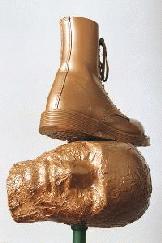
To fight back, and set up your own surveillance networks, you can go to spyville.com.
For some background on the surveillance and freedom arguments, these articles are good places to start.
For those who need more fuel for their paranoia, this story about MIT's efforts to develop a RFID tag replacement for the barcodes in current use will help. A barcode could handle different codes for different brands of rice. A 96 bit code, this new development could have a unique code for every songle grain of rice on the planet.
Finally, when nothing else seems to work, there is always the tin foil hat.
on
| § 0
The AP is reporting that North Korea has announced to the six nation conference that
"it has nuclear weapons and has plans to test one, a U.S. official said Thursday. However, other participants said delegates agreed on the need for a second round of talks. The remarks by North Korean Deputy Foreign Minister Kim Yong Il set a negative tone at the conference and raised questions about the success of the negotiations"
Well, no shit.
U.S. officials say they believe North Korea has one or two nuclear weapons, and experts believe it could produce five to six more in a few months.
While I have been saying on this blog that we should wait, and let them collapse - if they test a nuke we might want to step it up a little.
The psychotic regime in Pyongyang is a threat to everyone.
on
| § 1
I have just recently read two comments on the coming lack of attention to the anniversary of one of the worst days in American history. I commented on Robert Prather's Insults Unpunished that I want to remember what happened that day. Johno's post hit me, and reminded me about why we should be remembering.
I want to be reminded of the shock of the planes hitting the towers. I want to remember the horror I felt when I realized people were jumping from the top of the towers. I want that for many reasons.
But the reason I can never forget is that for months after the Eleventh, I drove by this every day on my way to work and back:
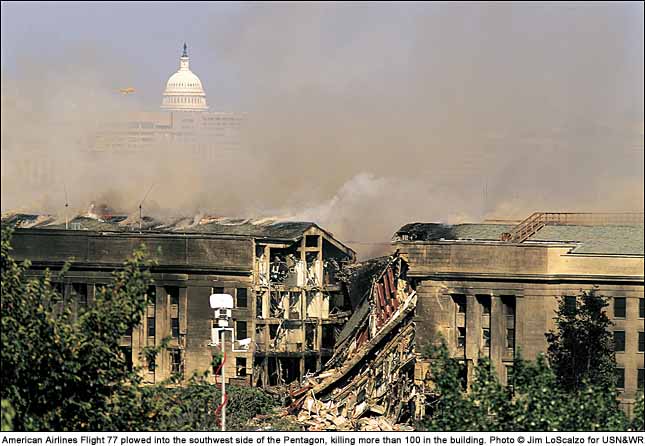
Every day I would turn the corner on Rt 27 and see that, and every day I'd get a knot in my throat.
I felt anger, and one of the few bright spots in the days right after the attack was the point-counterpoint article in the Onion - should we retaliate with blind rage or measured, focused rage? It helped a little to put it in perspective.
On the day, I was in my office a block from the White House and blissfully unaware of events. I walked by the conference room and saw everyone gathered around a 3" B&W TV. The first tower had been hit. As I watched, the second plane hit.
Astonishment, disbelief. Fifty thousand people work in those buildings. Over the next hour, we heard that the Pentagon was hit, and rumors that there was a bomb at the State Department. Six planes were unaccounted for. Eventually someone did the math, and the decision to evacuate was made. Everyone was kicked out of the government offices downtown. Everyone figured that one of the missing planes was coming for the White House or for the Capitol.
The metro had already closed, and the streets were gridlocked with federal workers and cars. The cell networks had crashed - but I had managed to get a hold of my dad at the Air and Space Museum on a landline before we were told to leave.
I started walking toward the mall. Every few feet I'd see someone dial a number on their cell phone, hold it to their ear, then say, "Shit." Cars were barely moving.
Ten blocks later, I got to the mall. I was never so relieved as when I looked to my right and saw the Washington Monument, and to the left and saw the Capitol. Both were still standing. Except for the panic, it was as beautiful a day as you ever get in swampy DC.
I got to the museum, which had never opened, and sweet talked my way in. Dad and I watched the news on a small tv in the library for a couple hours. When we emerged, the city was deserted. No cars, no pedestrians. It was the eeriest thing I have ever seen. Bright, sunny, clear day in DC, and not a tourist in sight.
I finally boarded the reopened metro, and when we came above ground just before National Airport we all turned back and saw the plume of smoke from the Pentagon. It was still smoking when they reopened some of the roads around the Pentagon.
on
| § 0
David Warren, after a month long absence, is back with a wonderful essay on where we stand in Iraq and the war on terrah. This article does a good job of explaining what the administration seems unable to do - why we are where we are.
It should be obvious to everyone why we are fighting the war on terror. That this is a necessary conflict should be clear to even the most blinkered of liberals. As I stated in the comments to one of Johno's earlier posts, the first steps of the war were the obvious ones. Al Qaida hits us. They are in Afghanistan. We hit Afghanistan. Straightforward.
After Afghanistan, we entered the area where reasonable people might differ on how to prosecute the war on terror. However, most of the opposition was predicated not on the basis of "Iraq is not the right target" but on "No war for oil" and similar idiocies. The protracted argument over the invasion of Iraq was fueled by the administration's lack of clarity and inability to articulate what is to be done, and why.
Part of this muddle was due to the decision to go to the United Nations. This forced the administration to lean its arguments in one direction - WMD - and slight the other arguments for moving on Iraq. This gave further ammunition to those who opposed the war on terror.
Steven den Beste has argued that the administration cannot tell us what the plan is, because revealing the plan would spoil it. This is true on the small scale, but not the large. We should not reveal the exact timetables and plans for an invasion. That is not only stupid but treasonous. But the larger plan, the geopolitical master scheme should be open and above board.
The more I think about this, the more I am convinced that the administration is making a serious error in not taking the larger case to the public here in the US, and to the rest of the world. Various people, including Clueless and Trent Telenko over at Winds of Change have analyzed the minutia of reports from around the world, and concluded that see the signs of the master plan. I agree, and have talked about that plan here.
The American public can be trusted with this information. In fact, it must be. If we reveal that the heart of our strategy in the War on Terror is to remake the Middle East and transform North Korea, to set a real precedent that any nation that supports terror is responsible for it, and will suffer the consequences at the hands of the civilized world, what have we given away? Nothing. If we make the case, clearly and repeatedly that those who support terrorism will be put up against the wall, it will not allow our enemies to resist our actions any better than currently.
There would be benefits for doing this. By clearly stating the our specific aims, and in broad terms our methods, we build support domestically, and co-opt or isolate opponents. The opponents of the war on terror have two choices - argue against specific decisions on grounds of whether or not that action would advance the cause (which could only help the effort, as constructive criticism is always useful) or continue as they are, and make clear that they are against the war on terror in general.
Internationally, we would not have to make the kind of tortured arguments that many have criticized. We would not need to justify an invasion on WMD, or any other single criteria. We need merely fall back on the original justification for the war on terror - and explain how whatever nation is in our crosshairs will serve the cause of peace by ceasing to exist.
The argument for Iraq is much stronger when you add in all the other reasons besides WMD. The coherence offered by stating our strategy would reassure our allies and make clear who are opponents are, while forcing our opponents to be clearer about their motives.
But the best reason for doing so is because we are a republic, and the citizens of this republic have a right to be informed and to participate in the decision making in an informed manner. The columnists and bloggers who are speculating on America's strategy are doing their best to justify the individual decisions in the war on terror, but properly, this isn't their job - it is the job of our leadership.
on
| § 1


