Music Wonkery

Where we think deep, musical thoughts.

Your own personal Johno

This is one of the coolest things I've seen in a while - and proof that the internet doesn't always make you stupid. This miraculous webthingyasks you to type in an artist or song, and then recommends other artists and songs that are like it. And then it plays them for you in an audio stream. Your own personal internet radio! No longer will you need to depend on Johno for music suggestions. This will provide them automatically.

For example, I typed in "Gillian Welch" - the last thing I heard in the car on the way to work. Then it played for me:

  • "Miss Being Mrs." by Loretta Lynn
  • "Looks Like I'm Up Shit Creek Again" by Nora O'Connor
  • "Wayside" by Gillian again
  • "When You Left" by Melissa Ferrick
  • "Relax You Paranoid" by Kathleen Mock and finally
  • "Loom" by Ani DeFranco

It's not just picking stuff by genre. It's really effing cool. Check it out.

[wik] Thanks to Kathy, again, for the link.

Posted by Buckethead Buckethead on   |   § 11

Wtf is microhouse?

For those who are not like Ross, steeped in the ancient lore of electronic music, the byzantine relationships and convoluted structure of the movement are baffling. Here, then, is a map of electronic music:

Electronic Wanker Music

To play with the interactive map, go here.

Posted by Buckethead Buckethead on   |   § 1

Stop! Hesitate and listen!

I had a fascinating conversation at a party this weekend with a linguist (an, of course, cunning linguist) about the unrecoverability of the meaning of words as used in the past. These days policy wonks encounter that problem when fighting over Constitutional originalism or the like... for example, in asking what did "liberty" mean to that document's drafters? Given that historians can point to perhaps a dozen mutually distinct meanings of "liberty" as currently or then-recently used circa 1787, this is an important question. Unfortunately, that wisdom does and forever will remain, unrecoverable. This is, of course, a problem.

The problem gets worse when dealing with "Old English," which the aforementioned linguist maintains isn't English at all. (He is, by the way, a medieval literature scholar too, if that matters). The precise meanings of any word more complicated than "hill" or "tree" cannot ever be discerned, and who is to know whether "tree" didn't carry some tactit freight that the slender documentary evidence cannot reveal? As an example of how alien, how unEnglishlike Old English is, he pointed to the first word of Beowulf. The word is "Hwæt!," meaning "Pay attention! Listen up!" Today, it is meaningless except insofar as it reminds us of our own "what?" and related interjections.

I don't know whether "hwæt" is a cognate or a false cognate of our modern "what," but I do know one thing. That rap guy Li'l John is a canny deployer of anachronism.

Consider. In his productions, Li'l John frequently makes use of the interjection, "What!" At first blush, this and his other trademarks "Yeah!" and "Okay!" (as so ably parodied by Comedy Central's Dave Chapelle), seem to be pure solipsism, nonsensical sounds valuable for their noise and rhythmic utility only. Not so. In truth, every time Li'l John says "What!" he is really saying "hwæt!" in the finest bardic tradition, urging us the listeners to stop and pay attention to the story he has to tell. "Hwæt!" is the hook, demanding our attention. "Okay" and "yeah" are similiarly weighted, not merely noises but coming as they do on the heels of the grab for our attention, they become epistemiological affirmations of the mores of the replendently hedonic life Li'l Jon leads. Not for him, the 9-to-5, the retirement account, and the ten o'clock bedtime, and in the face of this powerful refutation of how most of us structure our lives, we cannot help but feel those lives a little poorer for the comparison.

Seen in this light, Li'l Jon's simple rhymes about women and clubs and skeeting transcend kitch and pop and slip across the transom of meaning into a dialectical relationship with Strunk & White linguistic proscriptivism. "Hwæt!," he says, "pay attention! For we of Atlanta have arrived and are determined to leave our lasting imprint on the culture and folkways of this great land!"

Walking the line between ludic and ludicrous, hysteria and history, metaphysics and mondegreen, Li'l John has ridden our unwitting and slippery relationship with our own unrecoverable linguistic history to the top of the charts, entreating our respectful attention with every "hwæt!" and grunt. Hats off to Li'l John, bard of the moment. In guttural interjections, he speaks for us all.

Please, take a moment to savor the interplay of sense and nonsense, the rich imagery, the complicated rhythms and rhyme scheme, and oh! those kennings!, in the Li'l John & The Eastside Boyz classic, "Get Low:"

3,6,9 damn she's fine give it to me sock it to me 1 mo time
Get low, Get low, Get Low, Get Low, Get Low, Get Low,Get Low
To the window(To the window), to the wall, (to dat wall)
To the sweat drop down my balls (MY BALLS)
To all you bitches crawl (crawl)
To all skeet skeet motherfuckers (motherfucker!) to all skeet skeet got dam (Got dam)

Shorty crunk so fresh so clean
can she fuck that question been harassing me, in the mind
this bitch is fine
I done came to the club about 50-11 times
now can I play with yo panty line
the club owner said I need to calm down
security guard go to sweating me now
nigga drunk then a motherfucker threaten me now

And then more like that, except profoundly unprintable. "Hwæt!," indeed.

Posted by Johno Johno on   |   § 4

Root Down

If there is one hip-hop group that sorely needs a catch-all beginner's guide, it is Philadelphia natives The Roots. For fifteen years they have been putting out challenging, often cerebral albums in a wide variety of styles to great critical but limited commercial success. But, sort of like the catalogs of other challenging artists, say Bob Dylan or Frank Zappa, it helps to have a roadmap before you dive in. Is John Wesley Harding or Blood on The Tracks right for me? Hot Rats or The Yellow Shark? If you start in the wrong place, you might end up turned off to the whole enterprise and your life will be just a shade poorer for the lack of it.

To this end, the band have just released Home Grown! The Beginners Guide To Understanding The Roots, Vol. 1 & 2. The two volumes of Home Grown! don't manage to do the one thing that any introduction to the Roots needs to do: sum up the group's main accomplishments in a way that is easily accessible and at least somewhat logical. Instead, the group have given us a brilliant mess of mostly rarities, b-sides, live tracks and alternate takes that takes repeated listens to warm up to.

There is a lot to admire about The Roots. Their single-minded devotion to doing things their own way means that they don't have a single Ma$e moment in their catalog - no point at which their scene tips over from vitality into clumsy and cartoonish self-parody. Coming from Philadelphia, long considered a hip-hop hick town, they have had to create and nurture their own scene and keep their own career alive. If for no other reason than still being around making records after fifteen years, the group deserves a nod. But if integrity is all it takes then Jimmy Carter would have been our greatest President. Luckily, they have far more than that to recommend them (though if one of them had a brother to name a beer after, that'd be cool too).

In fact, the Roots are a top-shelf assembly of talent. Never forget- this is the band that insists on playing everything live. They have in the past taken this to extremes - the liner notes to Home Grown! tell how how for one early track a member repeated the phrase "RockinonthemicrophoneIdothiswell" more than a hundred times into a microphone rather than sample it once. And although this might seem absurd on the face of it, those years spent trying to sound like a machine have resulted in a crew who are tighter than tight. Listen to those old Herb Alpert recordings and try to count the horns. You can't! They sound like one horn. Then listen to The Roots and try to catch them slipping the groove.

Drummer Amir "?uestlove" Thompson has a mile-deep groove and a metronomic sense of time, and the rhythms he lays down with bassist Leonard "Hub" Hubbard are chewy and satisfying. (For my money, they too frequently undermine their funk by keeping their albums bone dry - if they'd see fit to turn Hub up a little and lay some room sound on ?uestlove's kit, it would all be for the better.) Special mention should go also to keyboardist Scott Storch (AKA Kamal) and human beatbox Rhazel, underrated contributors to the group's sound who get their own on the live tracks included on Home Grown!. Finally, frontmen Black Thought and Malik B have grown from fairly limited MCs into masters, riding or pushing the beat with tangled and forceful bunches of thoughtful rhymes.

Generations of critics have already done the live-hip-hop-band angle to death, but I would be remiss if I didn't mention how The Roots' live show is reputed to be among the best around. Indeed, the few live tracks scattered across Homegrown! hit hard, with rhymes and beats locked together under a groove like they were the lords of Funkadelphia.

However, the focus on live playing and jamming means that as their sound evolves, each Roots LP ends up very different from the last. Their debut, 1993's Organix, was a loose assembly of tracks that captured the band before they figured out quite who they wanted to be. 1995's Do You Want More?!!!??! tightened up their sound, managing to sound at once acid-jazz and old-school as the band unfurled long jams, and Illadelphia Half-Life refined that sound further. 1999's Things Fall Apart is a carefully constructed, conceptually tight and angry record full of close spaces, loopy tracks, and confrontational and hard-hitting rhymes. That same year the band also released The Roots Come Alive, which finally captured on disc some of their legendary live show. On Phrenology the group experimented with genre and structure, delving into rock, hardcore and sound collage while also adding hooks to their songs. Last year's The Tipping Point honed those advances into a new version of their original jamming, just thicker, deeper, and more organic.

So far, the results have been generally good to great, with Things Fall Apart and Phrenology standing as two legitimate classics of hip hop and all the other albums having moments of excellence.

If Home Grown! is the band's attempt to provide a single graceful point into this wildly diverse and often daunting catalog, it's a dud. So much of a dud, in fact, that the first two drafts of this review were arguments that the Roots are wildly overrated. It's a good thing I changed my mind, but that it took a music geek like me who has been a fan of the band for twelve years nearly a dozen runs through the collection to figure out what was really going on suggests that some opportunities to reach out have been missed.

What's wrong with it? Let's begin with the packaging. The two volumes of Homegrown! contain between them thirty tracks that count down from 29 to zero over the course of the two discs, which are only available for purchase separately. This is puzzling; either the two discs are intended to stand together as a unit or they are not. If they are, fine. But why charge buyers $28 to complete a two-disc set, when Volume 1 complements Volume 2? Musically the two volumes are not meaningfully distinct, which further blurs the reason for separating them.

The track selection itself doesn't make very much sense either. LP tracks are interspersed with b-sides, unreleased tracks, live performances, and rarities in a way that sounds, well, okay enough, but that jumps confusingly from era to era without much of a discernable plot. Is Home Grown! an introduction, or a fans-only love letter? If the former, why all the emphasis on alternate versions, remixes, and unreleased jams? If the latter, why the title?

The Roots’ main fault is a tendency to navel-gaze. Case in point: the liner notes to Home Grown! run to twenty pages per volume, which for that length ought to include an exhaustive detailing of how each songs came to be. This is true to a point. The notes for "Essaywhuman?!!!!! (Organix version)" tell the story of how the Roots got started, and the notes to the Eve/Jill Scott version of "You Got Me" (the Things Fall Apartalbum cut featured Erykah Badu) are a hilarious story about how Eve now hates the band.

But the notes also include loads of in-jokes and shout-outs and "too much has already been said abouts," enough to make newcomers (and some twelve-year fans) wonder what they aren’t getting. Moreover, at no point in the twenty pages does either set of notes get around to listing what track came from where. Anyone but hardcore fans will need to consult the internet to decide whether a given track is old, new, unreleased, or what, which is a drag. So much of the music is very fine, and so many of the rarities are worth having, that it's a shame that the way they are presented doesn't make any sense.

The music, which is and ought to be the centerpiece of this project, suffers from the same weaknesses. Though it's strange to say considering the wealth of amazing tracks collected, Home Grown! Volume 1 stumbles right out of the gate. After the blurry pleasures of the opening track, the acid-jazzy "Proceed 2" from Do You Want More?!!!?! the disc ambles from track to track aimlessly. When the hook to "Star" (from The Tipping Point) came along the first time, I wondered tiredly if the Roots had run out of ideas and were recycling Sly Stone hooks like the Beasties did with "Shadrach" way back in 1989!

It is only at track -20 (as it is numbered, actually track 10), the aforementioned alternate version of "You Got Me," that things come together. (Fascinatingly, Jill Scott's vocal doesn't sound all that much different from Erykah Badu's on the original version, though her backing ‘oohs’ round things out nicely.) Right after the warmth of “You Got Me” comes the rough "Clones" with guest rhymes by Philadelphia MCs MARS and Dice Raw, and a slamming version of "What You Want" which, to my knowledge, has only appeared as a single and in a live version so far.

After this, Volume 1 seems to catch fire, and the wild excursions between eras and genres start to work in the group’s favor. They even include - get this - a live alternate version of "It's Comin'," a song that has only ever before appeared on their 1993 European EP, From The Ground Up. Not that I noticed, particularly, even though that EP was my first introduction to the group. Nonetheless, it's a good version. For reasons like this, if not for that rough first ten, Volume I would be pure gold: just not for beginners.

Volume 2 fares better overall. In particular, it includes an incredible live medley of "The Seed/Melting Pot/Web" originally performed on Gilles Peterson's show on BBC Radio One that takes the band beyond hip-hop into JBs/Parliament/Miles Davis-circa-Live/Evil territory. As a testament to the band's abilities, you could not possibly do better than this medley. However again, if Home Grown! is an introduction to the group, the album version of "Seed 2.0" with Cody ChestnuTT would be nice to hear too.

Since less than half of the tracks on Volume 2 come in their present form from LPs it is in fact perfectly un-useful as a "Beginner's Guide." Considered as a rarities collection, on the other hand, Volume 2 is absolutely brilliant. ?uestlove turns in a furious mix of "Thought@Work" (originally on Phrenology) that bangs like Public Enemy, and alternate versions of some of their biggest hits are satisfying as well. Ferocious live versions of "Break You Off" (remixed into dub) and "Sacrifice" (both from Phrenology) could not be more different than the live "Essaywhuman?!!!!!" from Organix, which is a chronicle of a much groovier, jazzier Roots circa 1992.

In the end, for all the good music The Roots have put out over the past fifteen years, Home Grown! feels disappointingly like a wasted opportunity to put together a decent introduction to the band. Although most of the tracks selected for inclusion are brilliant, there is simply too much here for interested newcomers to get their head around. In the best case Home Grown! The Beginners Guide To Understanding The Roots, vol. 1 and 2 completely fails to live up to its title and goal. As a rarities collection though, it's pretty tight and totally worth having.

Every hip-hop and funk fan ought to have a little Roots in their life. My advice to beginners is to skip these compilations and ask a Roots fan about the best place for you to start.

This post also appears at blogcritics.org.

Posted by Johno Johno on   |   § 0

Chocolate Salty Gollum

It's safe to say that Isaac Hayes is an icon. Ask anybody on the street and that's just what they'll say: Isaac Hayes? Why, he's an icon!" Strange, though, that his iconic status is really for one breakthrough hit.

The wocka-wocka guitar introduction to the "Theme from Shaft" (stream in Windows Media / Real Player) is an indelible part of Americana, evoking on its own the full weight of Nixon-era black America in a way that nothing else can. Everything is in those three minutes: Afro puffs, bell bottoms, leather jackets, giant Cadillacs, endless tracts of run-down housing, pimp chic, Black Power, the Jeffersons, civil rights, Watts, runaway inflation, the defiant and vital parallel popular culture that was coming into its own, the whole enchilada from good to bad. Not many pieces of music can lay claim to carrying the weight of that much history without breaking.

And the "Theme From Shaft," as overplayed as it might be, really does encapsulate some of what made Isaac Hayes so vastly important to American music in the 1970s and beyond. His influence on rap and on popular culture in general is pervasive even if his career hopes now reside entirely in a poorly drawn cartoon Chef.

But in the end, Isaac Hayes is so much more than that funky guitar and heavy orchestration. Trained to sing and play music in church, he did time in the 1960s in the Mar-Keys and became one of the shapers of the Memphis soul sound as a house player for the Stax label, playing sax on various sides and co-writing a flotilla of songs made famous by Sam & Dave, Otis Redding, and others. When he struck out on his own with his 1967 debut, Presenting Isaac Hayes, he combined his gospel training with soul, funk, rock, and even psychedelia to craft a new sound that moved far beyond the concise two-minute verse-chorus-verse exercises he turned out for others.

By 1971 Isaac Hayes was on top of the world, filling stadiums around the country and rising up the charts with "Shaft." The politics of the time were right up Hayes' alley: he commonly appeared on stage dressed in a vest of chains and in 1972 would dub himself Black Moses, balancing the gospel, seduction, and street themes his music explored. He would even go on to star in the blaxploitation flick "Truck Turner." But as the 1970s burned themselves out in a morass of stagflation, malaise, and diminishing returns, so did Hayes' career.

Splitting with Stax in 1975, he founded his own label and saw some success with LPs like Chocolate Chip. However, after seven years of playing psychedelirocksoulgospel his creative well seemed to be running dry. He tried a disco cash-in. He did duets with Dionne Warwick. He turned to Scientology. And ultimately he settled in as a second-tier has-been, releasing albums of varying quality to little fanfare or success.

It took the off-the-wall proposition of voicing "Chef" on Comedy Central's South Park to return Isaac Hayes to the spotlight again starting in the late 1990s, advising four cartoon children in the ways of life and love and occasionally whipping out a song parodying his persona with titles like "Love Gravy" and "Chocolate Salty Balls." Then in 2000, he revisited his greatest success when he appeared in (and re-did the theme music for) a remake of Shaft. If he is not as ubiquitous as he was when a gallon of milk cost a buck, he at least seems to have returned from permanent obscurity.

Right about now would be a great time for a killer comp, a solid two discs with the high points from Isaac Hayes' iconic (yet ironically little known) career. Into the breach jumps Stax, now owned by the Concord Jazz label group, to release "The Ultimate Isaac Hayes: Can You Dig It?" But is this that killer collection?

Well, yes and no. While it's undeniable that most of the high points one could wish for are here, a few strange choices and intrinsic flaws keep this one from being the world-beater I wish it could be.

Let's start with the good. Disc 1 of Can You Dig It is good; very good; incredible. It is also, in a word, weird. The set opens (predictably enough) with the "Theme from 'Shaft'" we all know and love so well, three minutes and change of iconic funk, a universal anthem from a film few have ever seen.

But from there, things get weird fast. The very next track, "Precious, Precious" from Hayes' 1967 debut, is a good song - even a great one - but it has nothing in common whatsoever with "Shaft." In fact "Precious, Precious" sounds almost more like an early side by free-jazz pioneer Sun Ra than Isaac Hayes as we know him. Instead of slickness and lush orchestration, we get blurry production, cardboard-box drums, meandering and sketchy piano fills, and Hayes' own vocals floating over the landscape as a disembodied obbligato hum resolving into the repeated moan, "Oooh, precious... ooooh, precious" like some dark chocolate Gollum. Not that there is anything wrong with wierd. Quite the contrary; it's cool as heck. But the sharp left turn from the well-trodden path of "Shaft" to the frankly strange "Precious, Precious" underscores one main theme of this set: Isaac Hayes was one weird cat.

The very next track - if you are counting, this is track number 3 - is "Hyperbolicsyllabicsesquedalymystic" (stream in Windows Media / Real Player) from 1969's monumental Hot Buttered Soul. "HBSSDM," as I will heretofore call it, is a frankly bizarre ten minute funk workout featuring a six-minute experimental piano solo. Make no mistake, "HBSSDM" is one of my favorite Isaac Hayes tracks and the piano solo is pure gold (astute listeners will recognize the central riff from Public Enemy's "Black Steel In The Hour of Chaos"), but it's definitely off the wall.

Fans of Nick Hornby will no doubt be gobsmacked and shouting, "That's no way to make a mix tape!" And it's not. There are loads of rules, and the first one is that you have to follow up a killer first track with two slightly more intense ones before backing it off a bit to make sure you don't blow your wad in the first ten minutes. But the One Big Hit followed by two frankly experimental sides: that's not in the manual!

It might not be in the manual, but it is hugely fun. "HBSSDM" gives way to a series of excellent covers - the Jackson Five's "Never Can Say Goodbye" (stream in Windows Media / Real Player) redone as a slow pleading jam, a plushy velour version of "The Look of Love"; and of course Isaac Hayes' monumental classic cover of "By The Time I Get To Phoenix." On Hot Buttered Soul "Phoenix" was an eighteen-minute sermon in which Hayes told us the story of a man who fell in love with a woman only to find her in bed with another man. "Seven times! he left her... and seven times, he came back." Bit by bit, Hayes ratches up the tension and the pathos, all the time holding one dissonant chord on the organ, until finally he and the Bar-Kays dissolve into the lover's lament of the main song. Here, the running time is cut down to a more manageable 7:07, but the impact is only dulled a little.

The rest of the originals are mostly just as strong. The dirty funk of "Do Your Thing" and the gospel ghetto-news of "Soulsville" sit next to the Memphis-style soul of "Ain't That Lovin' You," testament to Isaac Hayes' reach across the entire span of black music in the 1970s.

But things do get a little rough. By the end of Disc 1 Hayes is already recycling material, in this case revisiting the confessional talking plus production number of "By The Time I Get To Phoenix" as "I Stand Accused." The second time around the results are merely enjoyable, not transcendent.

For this reason, much of Disc 2 is heavy going. Hayes is best known as a deep-soul prophet, the smooth seducer, a Black Moses taking lovers on to the promised land. The second half of "The Ultimate Isaac Hayes: Can You Dig It?" shows Hayes backing himself into a corner with this role, settling into a pleasant but numbing succession of heavily orchestrated gospel-tinged soul seductions replete with strings and backup singers. One or two are great; five in a row are less so, especially if they are only interrupted by such mildly interesting but definitely inessential additions as "Theme From 'The Men,'" and "Run Fay Run" from the soundtrack the film Tough Guys. Nonetheless, the live "If Loving You Is Wrong, I Don't Want To Be Right" (stream in Windows Media / Real Player) gives a clue to why he killed audiences in his heyday.

You can hear the change yourself. Disc 2 starts out with the towering and indispensible "Walk On By" (stream in Windows Media / Real Player) from Hot Buttered Soul, which on its own is amazing but in this post-Portishead world now sounds like God's own voice reading from Genesis I. It also includes the great "Joy" and "Chocolate Chip," (stream in Windows Media / Real Player) as well as the little heard but fun title theme from Tough Guys. But as the disc winds down we are treated to disappointments: two worn-out losers in "Disco Connection" and "Rock Me Easy Baby (Part 1)," and a live medley of "By The Time I Get To Phoenix" and Aretha Franklin's "I Say A Little Prayer" that builds a parallel narrative of heartbreak and hope which promises to be great but which never quite catches fire.

By the end of the second disc the innovations that were all over the first side; the raunchy funk grooves, the gigantic arrangements, the gospel moans and the bedroom cries, are played out in a way that sadly seems almost pedestrian. It is the same problem that plagues faithful retrospectives of James Brown, Sly & The Family Stone, and Parliament, too... their careers seem to burn much brighter if you avoid the last quarter or so, after all their big ideas have been done a couple times too many. Still, a rough third act doesn't dilute the greatness of the rest of the offerings here.

"The Ultimate Isaac Hayes: Can You Dig It?" manages to achieve two goals; to educate newcomers as to what made Isaac Hayes great, and to underscore why his career needed resucitation through the unlikely aid of "South Park." While newcomers would probably do just as well by buying his two essential LPs, Hot Buttered Soul and Black Moses, with the Shaft soundtrack close behind, "The Ultimate Isaac Hayes: Can You Dig It?" works fine as a broader overview of his career.

------------

The limited edition of "The Ultimate Isaac Hayes: Can You Dig It?" includes a DVD of videos, including a live concert performance of "Shaft" and the "Chocolate Salty Balls" sequence from South Park. If you are an early bird, this is totally worth having.

Included hereafter: the official recipe for Chocolate Salty Balls. Put 'em in your mouth and suck 'em!

Homemade Chocolate Salty Balls

1 cup graham cracker crumbs
¼ cup corn syrup
1 cup milk chocolate chips
1/8 tea spoon salt
3 tablespoons confectioner?s sugar

In a medium bowl, combine the graham cracker crumbs and corn syrup and mix well.
Using a spoon or a melon baller, shape the mixture into balls.

In the top of a double boiler, slowly melt the chocolate chips. Dip the balls in
the chocolate and set the dipped balls on a wax paper to set.

On a plate, mix together the salt and sugar. When the chocolate balls are set,
roll in the salt and sugar and mixture to lightly coast.

---------

For the uninitiated, here are a generous sampling of some of Isaac Hayes' best
work in streaming audio:

Chocolate Chip
Windows Media
Real Player

Hyperbolicsyllabicsesquedalymistic
Windows Media
Real Player

If loving you is Wrong (I Don't Want To Be Right)
Windows Media
Real Player

Never Can Say Goodbye
Windows Media
Real Player

Theme From "Shaft"
Windows Media
Real Player

Walk On By
Windows Media
Real Player

Posted by Johno Johno on   |   § 4

A Supposedly Fun Thing I'll Never Do Again (With Apologies To David Foster Wallace)

There is a passage in Irvine Welsh's Trainspotting that goes:

Spud turns and says something to Renton, who can't hear him above a song by the Farm, which, Renton considers, like all their songs, is listenable only if you're E'd out of your box, and if you're E'd out of your box it would be a waste listening to The Farm, you'd be better off at some rave freaking out to heavy techno-sounds.

New Orleans stoner-rock trio Suplecs are a bit like this. On one hand they are heavy and fast. On the other hand the guitars sound like they were recorded in a closet, their riffs are boring, and their overall vibe recalls all the million stoner-metal bands I've already heard. And for my money if you have to get high to appreciate something, there's no there, there in the first place.

For the most part this is the way I feel about stoner-rock in general, or whatever it is the kids are calling it these days. I remember a few years ago when the Queens of the Stone Age first came up hearing from all quarters how great and original they were, how great their songs were, how heavy they sounded and so on. Then I heard the band and they were ok, sure, but nothing to write home about. Then I realized that most of the people who had been crowing about QOTSA so hard were also habitual stoners: mystery solved. Since then a good handful of similar bands have crossed my path: Kyuss, Nashville Pussy, Fu Manchu, and Gov't Mule, just to name a few that come to mind. Some of them are really good no matter your chemical status, but I always have the sneaking suspicion that they would be better if you were too high to see: a bad sign, for my money.

Suplecs don't seem to have figured out yet what kind of band they want to be, and it shows. "Tsunami," the first song on their latest album, Powtin' On The Outside, Pawty On The Inside lifts its riff from an old Scorpions song. They even want you to know it, since the first word of each verse is "Blackout!" just like the Germans wrote it. The very next track, "Black Cloud" contains the stanza,

If life is a bowl of cherries, how come I'm in the pits?
If life is a bowl of cherries, smells like shit 'n' I'm eatin' it.
Cuz I've been feedin' it, now I gotta deal with it."

What? Are these guys kidding?

About two thirds of Powtin' is this kind of goofy thrash metal, but a few songs switch things up by including either sincere ('serious') angst-laden lyrics and metal screams or Gov't Mule style instrumental space jams. "Gotta Pain," alternates metal screams with generic impassioned teenage alienation, "End of Me" is a barstool blooze revved up to 200 RPM, and "Cities of the Dead" is a six-minute jam instrumental that builds and builds but never really comes into focus or gets anywhere. On "Welcome Home" and the finale "Meatballs and Spaghetti" the band combine all of these into one unwieldy whole.

After a half dozen listens I keep expecting the various ideas swirling around to take shape and turn into something with momentum, but they never really do. Choruses don't quite come together, drama never unfolds, and the ever-present sludgy riffs spin their wheels in the mud. The most compelling music on the album is the untitled bonus track, which is about three and a half minutes of fairly groovy jamming; nothing special in and of itself, but far more accessible and coherent than any of the ten official songs that came before.

If Suplecs figure out which thing they want to do well, they probably have one or two solid albums in them. But Powtin' On The Inside, Pawty On The Outside is nothing special, a half-baked (ooh! A pun!) mess of sludgy thrash, noodly jams, and odds and ends that sound too much like other bands to really make much of an impression. I don't really smoke the reefer, so I have no idea what changes if you were to get baked and give Powtin' a spin. But I do know that if that were to happen, there are many albums I'd much rather have around than this one.

This post also appears at blogcritics.org.

Posted by Johno Johno on   |   § 0

One Man's Playlist

Been listening to music, lately...and thought I'd share the list, because of the deep window this provides into my life.

  • Feeder: Pushing the Senses -- What can I say? Yet another masterpiece from the best rock band hardly anybody in the US has heard of. You must go straight to Amazon and spend crazy money on finding their CDs.
  • Let's Go: Let's Go -- Great straight-up melodic pop-rock. Handsome without the bitter metal.
  • Fluke: Puppy -- You might know track 3 from the last Matrix movie (remember the big dance/orgy scene prior to the big battle?). The rest of the CD is great, pounding rhythms and melodies, and some of the best arpeggiated electronics I've heard in a while. Closes with the unexpectedly beautiful Blue Sky -- a kind of electronic/gospel hybrid.
  • Coldplay: X&Y -- Yeah, me and everybody else. It's good enough to deserve it.
  • Mercuy Rev: The Secret Migration -- I've known this band to be a critic's favorite for a while but never picked anything up. Good, melodic progressive, with Zero 7 overtones in places.
  • Morel: Lucky Strike -- DC native (I think ;) Richard Morel creates another dark dance/pop thinker. Driving dance beats, brutal lyrics, Pink Noise (Deep Dish) production...there's much to like here. First listen makes you think it's just another dance record, but the unusually beautiful melodies hit you, and then the words hit you like a sledgehammer. Not for everyone, but it should be.
  • Royksopp: The Undertanding -- Simply brilliant electronica from these Scandinavian geniuses. They forge through new territory with this release (as with their last), but the results never stop being musical and never stop being accessible.
  • Orbital: Blue Album -- Orbital's last, so they say, and relatively satisfying. Can't say I'd give it top marks, but there are a couple of standouts that make the CD worth buying. In particular I love You Lot's sampled speech:

You, are becoming Gods. There's a new master of creation, and it's you! Unraveled DNA and at the same time youre cultivating bacteria strong enough to kill every living thing. Do you think you are ready for that much power. You lot ? You lot?! Cheeky b**tards. You're running around science like kids with guns, creating a new world, while you've got is stinking, but, hands up, hands up anyone who thinks you've got it right. Yea there's always one. I can see you. If you want the position of God then take the responsibility

Posted by Ross Ross on   |   § 3

Carnival of Music #19

Welcome to Carnival of Horror... No, Carnival of Gory Death... No, Carnival of Creep... No, Carnival of Music! Yes, that's it. Welcome to the nineteenth edition of the Carnival of Music. The Halloween edition, in fact.

Let's dive right in, shall we?

It's All Hallow's Eve

Wherein we learn about the use of music in film, and are subjected to butt-rock This edition of the carnival hits the interweb on Halloween. Therefore, it is only appropriate that we begin with some scary creepy stuff. Mark at Kaedrin has spewed forth a disquisition on music in horror movies, one with quotes and everything. People will start thinking he's serious or something. Along the same lines, but a bit outside the blog world is this survey of horror music by John Hübinette.

For all your horror music needs, one need go no further than right here. Of course, we will. Here is a collection, ripped straight from google, of low-rent horror metal bands. I think most of this is what Minister Johno would refer to as, "Butt-Rock." Suicide Solution, Dark Seclusion, The Others, Dark Autumn and of course, Rob Zombie. Lot of Darkness there. Not there's anything wrong with that.

Of course, the life of a horror metal band is not, to be sure, all sweetness and light. For some, it is misery and destruction. In this case, not self inflicted – everyone lend a hand to Antartica vs. the World, who lost all their gear in Hurricane Katrina.

The absolute best horror music link, I have saved for last. It Will End In Pure Horror. I have always been convinced that that is literally true. But if ending in pure horror meant being surrounded by this:
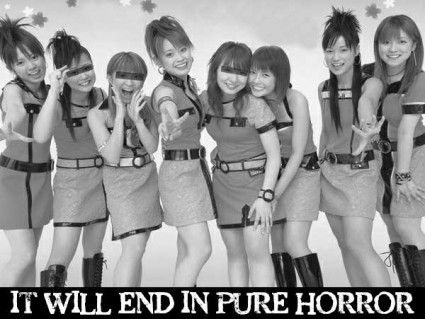
Horror Cuties

I might be a little more comfortable with the concept. I sent away for their free demo, Night of the Living Demo, and so should you.

Oh, and speaking of eldritch horror, what could be more soul-suckingly, achingly terrifying than cute thirteen year old singing Nazi twins?
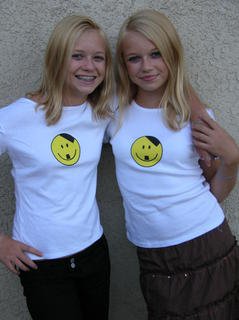
Nazi Cuties

Among a great multitude, my pal Murdoc offers some coverage of the Aryan Olsen twins.

Cronyism

Wherein the Ministry thrives on nepotism, and throws a bone to the little people

Because the Ministry not only supports, but actually thrives on nepotism, this section contains links to us, and to people we know. We'll begin with me. Mrs. Buckethead is one of three lead vocalists in a bluegrass/Americana/roots music/gospel/country blues band called Dead Men's Hollow. They recently released an album, which you can buy. It's funny, but ten years ago if you had told me that in the middle of the first decade of the twenty-first century that all I'd be listening to was death metal and hundred year old country music, I'd have laughed at you. Or hit you, depending on my mood. Yet here I am. Looking at the recently played list on my iPod, I see Doc Watson, Drowning Pool, Tool, Monster Magnet, Johnny Cash, the Kossoy Sisters (thanks, Johno) and "Oklahoma Stomp" from band called Spade Cooley and His Orchestra off a collection called Doughboys, Playboys and Cowboys that is mostly country swing from before WWII.

Dead Men's Hollow – well, let me let Johno do the music reviewing, because he's a professional:

DMH splits the difference between the ethereal rubato of the old timey singers and the in-time clarity of classical and good rock singers. However you're doing it, it's really freaking cool...I'll be putting it on my IPod immediately.

They're playing all around the DC area, so check the website to see when you can see them. And, in a few weeks, they'll be headlining a big show at Ft. Riley, Kansas for troops heading out to Iraq. I'll have more on this later, or again, check their site. And lastly, listen to this song.

Johno is the alpha music geek here at Perfidy. In fact we created a category just for him – Music Wonkery. Click that link to get access to hundreds of insightful, sage, and at times indelicate reviews. A lot of the musicians Johno writes of so knowledgeably, I had never heard of. Once I listened to their music, I wondered how I had ever missed them. Johno has produced two new reviews just for this carnival, you can see them here and here. Read them both. I have already ordered a copy of Cast King's album. It won't be the first album I've bought on Johno's recommendation, and it certainly won't be the last.

One last Johno note: over here, Johno has offered hand-crafted mix discs to anyone who reaches a hand into their pocket and comes up with $15 for charity. Johno's suggesting hurricane or earthquake relief, but I'm sure he'd accept anything short of a donation for the Free Katie Foundation.

Next up is Phil Dennison, founder and CEO of the blog November Musings. His band, the Fragments, is on a little hiatus thanks to their own personal stick in the eye to the zero population growth people. The band has recently spawned two kids, and another is on the way. So far, only Phil and bandmate Gene remain childless freaks. The Fragments play a heady style of power pop, and are well worth a listen. Phil, being the musician type guy that he is, has on occasion held forth on some musical topics.

Here is Phil peeking behind the curtain of Trent Reznor's musical past, complaining about the existence of Ashlee Simpson, and penning an encomium to fellow power-pop band, The Figgs. As an added bonus, here is Phil's Top Ten Underrated Guitar Solos List.

Phil also kindly recommends, for your reading pleasure, several music blogs, including Bob Mould's blog, Copy, right?, Fluxblog, Lost Bands of the New Wave Era and Mystery and Misery. Joe-Bob says check 'em out.

Next on our list of cronies, yes-men and yeasayers is Ted of the excellent blog Rocket Jones. Ted recommends the podcasts of the Simian Syndicate. Especially this one. Why? They'll tell you:

"We have a special treat in this show, something very unique, a recorded monologue by our buddy Stuart Swink. Stuart takes plenty of pictures for us and attends most of the Booze Monkey shows, he is a good friend. He created a monologue comprised entirely of Beatles song-titles. It is a very unique piece, and he graciously allowed us to share it, I hope you enjoy it."

That just can't go wrong. Simian's podcasts typically include music, typically of the bluesy nature. That, plus split your sides funny, is a hell of bargain when you consider that it's all free. Added bonus: Ted also recommends the blog RetroBabe

Princess Cat has run across an inspirational ditty from Ryan Shupe and the Rubber Band. A good band name, but not as good as my personal favorite band name ever, Special Ed and the Short Bus - who can be heard doing a great high speed cover of John Hardy over here.

Finally, another blogger with a band: Andrew Ian Dodge of the justly famous Dodgeblogium. I emailed Andrew to see if he had anything for the carnival (and to complain that he got a better logo from blogs in space than I did) and he replied in his unique idiom, "What jolly good timing. The band site has just had a face-lift (ala Joan Rivers) and the EP is finally f***ing finished!"

His band, Growing Old Disgracefully has only one snippet of music up, but hopefully we will soon be able to hear the EP, or even buy it from CD Baby. CD Baby, btw, is my personal favorite online music-getting thingies. Witness this email I received from CD Baby last time I ordered from them:

Your CD has been gently taken from our CD Baby shelves with sterilized contamination-free gloves and placed onto a satin pillow. 

A team of 50 employees inspected your CD and polished it to make sure it was in the best possible condition before mailing. 

Our packing specialist from Japan lit a candle and a hush fell over the crowd as he put your CD into the finest gold-lined box that money can buy. 

We all had a wonderful celebration afterwards and the whole party marched down the street to the post office where the entire town of Portland waved 'Bon Voyage!' to your package, on its way to you, in our private CD Baby jet on this day, Tuesday, August 27th. 

I hope you had a wonderful time shopping at CD Baby. We sure did. Your picture is on our wall as 'Customer of the Year'. We're all exhausted but can't wait for you to come back to CDBABY.COM!!

[wik] Returning as if from the dead, our own resident Canadian comes in with playlist a that has therapeutic overtones. 

Carnival of Submissions

Wherein we gingerly dip our toe into the wider world of music blogging

Barbara of Trying to Catch Up sends us a reminiscence of her time as a flute player, triggered by her son's taking up the saxophone.

BradRubenstein of Odd Quanta shamelessly plugs his own music festival. If you're in New York on Dec 4, check it the New York Festival of Song. Not music related, but he also links to a really cool idea for positional, rather than temporal, alarms. This can't be far, and whoever invents the killer app for this sort of thing will be rich, rich, rich.

The award for best blog name goes to Assimilated Negro. It's retro. It's PM. It's likely offensive to many. I dig it. Assimilated Negro blog is just over a month old, but he's already working the carnivals to get linkage. He's more assimilated than I am, as I just figured this out after two and a half years.

I will leave it again to Johno to provide the theoretical underpinnings and academic apparatus surrounding this. (Scroll to the bottom and press play. After you read the rest of the post, of course.) But hey, it was perhaps inevitable that blogs and hip hop were fated to collide.

Next week's host, Elisa Camahort, throws in a post regarding her iTunes music purchases. But it's not just a simple list, she provides us with reviews of the music, too. Check her other posts, too, she's got lots of links to cool music, like this one

Michelle of A Small Victory has given up the blog. We'll miss her music lists, though we can still follow her fiction, and the always amusing 100 Words or Less Nessman.

The Well-Tempered Blog (I just discovered what, exactly, well-tempered means just a month ago. From TV!) reports on an interesting thing: the Extensible Toy Piano.

And don't forget that Strongbad can sing.

Brian Sacawa has some thoughts on the effect of the web on music, especially of the classical variety.

Has anyone seen a trailer for the new Johnny Cash movie? I'm hopeful, and afraid.

Earlier, I mentioned that I recently learned what well-tempered means. I learned it from this series. Saw it on the Ovation cable network, they might show it again. Very well done series, and even my music education trained wife was impressed.

If you want to really get going on the music blog reading, go to the bottom of Carnival of Music #7. There's a big list that I am far too lazy to recreate.

Musical Perceptions has some interesting stuff on Singing Neanderthals, and trying to hear Bolero.

Here's an Online Mandolin Museum, courtesy of Lynn at A Sweet, Familiar Dissonance.

This guy maybe likes Batman too much.

And finally, if you really want to you know, delve, into the music blogging thing – go here.

The End

Wherein we blame the innocent, free the culpable, and frame the unwary

Thanks (from us) and blame (from you) should be directed to John of Texas Best Grok for allowing Perfidy to host this, the 19th Carnival of Music. Admiration and plaudits should go to previous hosts of the carnival, for we only see so far because we stand on the shoulders of giants. They can be found here, along with other needful and pertinent information regarding the Carnival of Music. Postdated thanks should also be directed to Elisa, who will host the next CoM.

I am turning on trackbacks for this post, so if you have a music related post, just do that thing, and I'll integrate it into the post. If it starts getting closer to next week, send submissions to Elisa so she has some material to work with.

Posted by Buckethead Buckethead on   |   § 4

The Past Is Always Present, Thank You Very Much

Everyone who knows me (and who doesn't know me? I'm the cat with a bazillion friends!) knows that I really dig emanations from what Greil Marcus called "the old, weird America." Whether it's the American Visionary Art Museum in Baltimore, the half-fried blues stylings of the late R.L. Burnside, or video footage of the great Bobby Rush taming the wild booty ooty ooty.

Cast King, a 79 year old native of Old Sand Mountain, Alabama - a place too small and remote to show up on maps readily available on the newfangled interweb - has been making music on his own for sixty-five years now. He toured extensively in the 1940s and 1950s with his band, "Cast King and the Country Drifters" and even recorded a few sides for Sam Phillips at the Sun studios in Memphis. But nothing really came of those sessions and King settled down to life on Old Sand Mountain, writing songs for the benefit of himself and those around him.

He was rediscovered, according to the presskit I have, when a musician named Matt Downer began making field recordings of local musicians in and around Old Sand Mountain, and on the recommendation of practically every other musician around tracked down Cast King and his "sackful of songs." Downer eventually persuaded King to sit down and record some of these in a shed next to his house, and the result is now an album, Saw Mill Man.

Cast King's debut is a interesting document, literally a transmission from the old weird America I treasure, something that sounds like a lost fragment of the Harry Smith or Lomax brothers collections. At 79, King's voice is soft and tremulous, which only adds to the fragility and plaintiveness of the songs he has written, every one of which is about drinking, death, heartbreak, or the futility of living on another day. (Now that's entertainment!) His homegrown style of songwriting has a great deal in common with the folk-infused country that eventually catapulted Johnny Cash to fame - a sound that has long transcended fashion and cliche to become part of the DNA of the American songbook. Some of the songs feature Matt Downer helping out on his Stratocaster to provide some ornament, but mostly they float past one by one, bouyed by the quiet strum of King's guitar and swaying lilt of his hoary voice.

Having developed over fifty years a unique conversational lyrical style, King has a knack for lining out a scene in a few well chosen words. Not every song is equally great, and some rely a little too much on cliche, but every so often an especially stark stanza reaches out of the speakers to smack you on the head. For example on "Numb," King sings

I don't care if your tears fall in my whiskey
I don't care if he hurts you more and more
I don't mind that drunken clown
Pushing that old man around
For I'm as numb as the knob on the door.

That's about as succinct as country weepers get. The best songs on Saw Mill Man hit with this same soft punch, especially "Cheap Motel," "Wino," and the miserable hard-luck song "Saw Mill Man." On "Long Time Now" and "Peggy," King raises the ghost of authentic rockabilly, the half-crazy kind that got kicked off the radio (or co-opted) by the rise of rock and roll. It's a hoot to hear a new recording in 2005 that could have come directly out of a Bobby Sisco session for Mar-Vel in 1955. Some, like the worst-party-ever vignette of "Wrong Time To Be Right" and the funereal murder ballad "Under The Snow" sound especially great in King's weary baritone.

Overall, what seems at first blush to be a slightly muddy set of moderately interesting old-timey country songs reveals itself after repeated listenings to be a set of archetypal country songs sung by a man who, if life had been just a little different, might have had a real shot at being on the Opry stage next to Carl Perkins and Buck Owens. I don't know if it's something in the water or something in the whiskey, but Cast King of Old Sand Mountain has made a bleak and affecting debut album. I hope there's more where this came from.

Cast King's Saw Mill Man is available directly from Locust Music

Posted by Johno Johno on   |   § 1

Don't Fight The Feeling

In January 1963, energized by a recent tour of Europe with former labelmate Little Richard, Sam Cooke took the stage at the Harlem Square Club in Miami to turn in an electric, electrifying set of sweaty, sanctified, manic and masterful soul music. The night was recorded for a live album called One Night Stand!: Sam Cooke Live at the Harlem Square Club which sat on the shelf for twenty years until it was released in 1985. Sony Legacy has remastered the album for a new reissue this year, and it is now obvious that One Night Stand completely overturns everything you think you know about the smooth and urbane maker of sweet soul music.

Along with Ray Charles, Sam Cooke arguably invented soul music with his great crossover hits of the late 1950s and early 1960s. Everything that came after owes in some measure to his alchemic blending of gospel, R&B, pop and standards, his bravura performances that split the difference between agape and eros. In his brand-new and excellent biography of Sam Cooke, Peter Guralnick lovingly details Sam Cooke's evolution from a young member of nationally-known gospel quartets to the urbane, good-looking, articulate, laid back and genial pop inferno that he became. Along the way, various personages from Atlantic Records' Jerry Wexler to singing peers like Harry Belafonte, Bobby "Blue" Bland, and Elvis Presley check in to attest to their admiration for Cooke's unbelievably facile voice.

And what a voice it was! Sam Cooke was blessed with a remarkable instrument, clear as a bell except when he wanted to make it gritty, high and proud and stunningly beautiful. His ability to use it to get right inside the most banal lyrics and project stark and affecting emotional content made him great, and once he figured out how to draw out the simplest words, "No-no-no-no," "I-i-i-i-i-i," in Coltranesque cascades of pure joy, nothing could stop him from killing an audience cold.

Live at the Harlem Square Club captures an amazing moment in Sam Cooke's career. Riding high off a nearly unbroken string of chart successes, he was yet to enter the great and terrible eighteen month perioud which would see his infant son die, see the recording of possibly his finest music, and end in his death. All that was in the future.

When Sam Cooke took the stage at the Harlem Square Club, it was with Little Richard's dirty sound in mind, the future out before him, and a songbook of pop, standards, and what we now call "soul." Imagine the scene: the big room sweating in the humid Florida night. Three shows, at 10:00, 1:00 and 4:00 in the morning. Sam Cooke, fresh off his European tour, with the rowdy King Curtis on sax beside him and a band of crack players behind him, energized, inspired, and ready to take the crowd as high as they want to go.

It is a little strange how dated some of Sam Cooke's songs sound today. With such strong roots in the pop of the 1950s, the I-vi-IV-V "ice cream" changes and uptempo R&B swing of his most famous songs tie him more securely to Frankie Valli and doo-wop than to his musical children like Al Green and Otis Redding. And surely, his clean-cut image was an artifact of his ambition, his intention to appeal to as many people as possible, white or black, rich or poor. But that night at the Harlem Square Club, Cooke strained against the urbane felicity and pop sheen that had made him famous and brought a roughness and grit to his voice that surely few in the audience had ever heard from him before.

In his biography, Guralnick dwells at length on the contraditions embodied in Sam Cooke. He was the American dream, a good-looking and well-mannered young black man singing music that transcended racial boundaries: he was "safe." He was the preternaturally talented, even arrogant architect of his own career, ruthlessly moving from one opportunity to another as he saw fit, leaving behind him a wake of disappointed compatriots and business partners. He was the most charismatic guy in the room, the ladykiller who made every one of them feel special, leaving behind him a wake of single mothers and dying hopes. That same charisma came through loud and clear on stage, on vinyl, and on camera, drawing audiences into the vortex of his personality through the sheer power and swing of his musical genius. He was the generous friend. He was the big spender. He was, from time to time, the source of towering rage and fury when his trademark savoire-faire was exhausted.

Every single one of these features of his outsize personality are on display on Live at the Harlem Square Club. The audience is delirious even before he takes the stage, and as Cook asks the crowd, "How are you doing out there? ... How ARE, you DOING, out THERE?" there is something powerful, smug, and almost cold behind his voice, as if he already knows the audience is his without even asking: he is really saying "you are mine." And so they were. As Guralnick writes,

There was nothing soft, measured or polite about the Sam Cooke you saw at the Harlem Square Club; there was none of the self-effacing, mannerable, 'fair-haired little colored boy' that the white man was always looking for. This was Sam Cooke undisguised, charmingly self-assured, "he had his crowd," said [guitarist] Clif White....

Indeed, everything Sam Cooke sang at the Harlem Square club took on weight. Lightweight teenybopper pop fare like Cooke's fad single "Twistin' The Night Away" becomes more serious, like the last party before Judgment Day. The lovely teen-romance crooner "Cupid" turns into an essay in joyous singing as Cooke takes flight all around the melody and sells the young love story it tells. Cooke calls on his gospel roots on the rowdy "Feel It (Don't Fight It)," riding the band hit by hit, exhorting the crowd higher and higher and walking a line between sanctified and sinful that conventional wisdom would maintain wasn't Cooke's to discover. The darker subject matter of Cooke's "Chain Gang" comes fully into its own with the band and backup singers digging into its groove, and Cooke bearing down on the chorus.

On the medley of "It's All Right" and "For Sentimental Reasons," you can hear the crowd singing along rapturously as Cooke scats in Coltranesque sprays of notes. In the liner notes to the album, Peter Guralnick (again!) writes about the importance of community to the chitlin circut, and this is where it all comes together. Cooke and the audience are one, trading energy, good humor, and the sweet melancholy of the songs between themselves fearlessly. By the time we come to the closer "Having A Party," a frantic five-minute workout, Sam Cooke and the band have transcended pretty, transcended slick, transcended easy, transcended everything Sam Cooke seemed to embody to the (white) public and taken the audience to a place blissfully like the white-hot crawl-on-the-floor frenzy of James Brown's classic Live At The Apollo.

The remastering has fixed the crowd noise at a level that is audible but doesn't get in the way of the incandescent performances of Sam Cooke, King Curtis, and the band. Between songs you can hear the crowd begging for mercy, begging for more. They, they cry, they scream for Sam Cooke to take them higher, and as the last notes of "Having A Party" fade into the smoky Miami night, you can hear them erupting in an ecstatic chaos that feels a little like afterglow.

Sam Cooke invented sweet soul music and then died too soon. In the years intervening, that mantle has passed to cofounder Ray Charles, to Al Green and Marvin Gaye, to the R&B crooners who I recently denigrated, and of course back to the world of gospel. Live At The Harlem Square Club is not only a very fine live album but a call for a drastic reassessment of Sam Cooke's legacy. With excellent and informative liner notes by Peter Guralnick (first written twenty years ago with a postscript added for this reissue), the entire package is a loving revival of an unjustly neglected moment in music history.

I really hate to say this twice in one week, but Live At The Harlem Square Club is one of the finest releases I have heard this millennium, worthy of standing next to James Brown's landmark Apollo Theater date (recorded just a month earlier) as one of the great moments in the history of soul music. Don't fight it, just feel it.

This review also appears at blogcritics.org.

Posted by Johno Johno on   |   § 0

Hurts So Bad I Did It Twice

There are some things I will never get. Scientology. Necco wafers. Feet as a food, be they pig or chicken. The Da Vinci Code. The enduring appeal of Jessica Simpson's music (the appeal of her butt I get).

One thing that constantly eludes my understanding is the continued success of modern R&B. Well, I understand why it's popular; it's good to have sex to, but I just don't get it. I try, oh God, I try. I frigging love funk, crunk, and hip-hop from Brooklyn, Compton, Houston, Atlanta, St. Louis, Chicago, Miami, Jamaica and France. I adore Chacka Khan, Luther Vandross, Marvin Gaye, Al Green, Mary J. Blige, and Beyonce. But a lot of the time, when the temp slows down, I get lost.

R&B has become an impoverished genre over the last twenty years. Although there are some signs of life, since the mid-80s it has been dominated by singers who oversing every line, make every word a payoff and every song a three-minute orgasm rather than laying back and establishing a groove, a melody that will support all the million melismatic notes that singers carelessly spatter all over the modern R&B landscape.

R&B duets are notable mainly for being an opportunity for two singers to circle each other, egging each other on past any sense of melody with moans, runs, and ad libs over an interchangably generic music bed (can't forget the windchimes!). Used to be, this was a hallmark of the gospel style, but years of overuse by thousands of talented but tasteless songbirds have blunted what impact it once had. The key insight is in a quote from blogcritics founder Eric Olsen, who wrote about Mariah Carey: "the essence of Mariah's problem and why she is doomed to suck is that she sings to serve her own ego, not the song: great singers respect the song above their own glorification." Of course, the best is still the best: Luther Vandross was and will remain the king of bedroom R&B. However, he practically invented the style, a distinct advantage over subsequent practitioners who seem bent on sucking all the life out of it.

What brings all this to mind is the recent release of a new Gerald Levert duets compilation, Voices. Gerald Levert is the son of O'Jays founder Eddie Levert and one of the longtime big players on the modern R&B scene. Voices collects duets from throughout his career, featuring guests like Kelly Price, Faith Evans, Vanessa Williams, Missy Elliott, Teena Marie, and Eddie Levert, Sr., as well as three new songs. Not being very familiar with Gerald Levert, I was optimistic that there would be something here I could get into.

Gerald Levert is an amazing singer, both technically gifted and emotive, with a voice that hits the spot perfectly when he remembers to exercise restraint. The trouble comes when he forgets. On the one non-duet selection on Voices, "I Like It," Levert sings the song halfway to straight, and the result is halfway to great. But in general he too succumbs to the showy, sugary tendencies of modern R&B. One reason, surely, is because without the oversinging, there would be nothing left of the songs. Without good material, all the crying in the world is just for show. I'm sure Gerald Levert and his guests would beg to differ, but the sad fact is that if you took the ego out of most of the performances here, the underlying songs are so trite and lightweight that they would just melt away. Whether it's with Faith Evans, Keith Sweat, Coko, and Missy Elliott on "All the Times" or with his father on "Wind Beneath My Wings," the sappy production and one-note (so to speak) vocal performances sometimes edge very close to self-parody, wasting a great deal of talent in the process.

The backing tracks are halfway to parody too: always with a snare drum burdened with miles of reverb, the synth piano, the canned strings, and the omnipresent tingly windchimes to announce every chorus. Sometimes there is a dash of hip hop, but in general there is little to dilute the sappy lyrics and cascades of unnecessary notes.

A few of the songs are okay enough taken individually, but when collected in one place they all smear together into a long numbing sugar coma. By the sixth song in, I'm checking to see if the disc has started over again, and by the tenth I never want to hear another windchime as long as I live. By the time we get to the cover of the omnipresent and overdone "I Believe I Can Fly," I'm running to dig out my Al Green records to see if I can still remember a time when they made good music to make love to your old lady by.

I know there's an audience out there for Gerald Levert's music, just like I know there's an audience for Dragonball Z, Tommy Hilfiger, and those street basketball videos they push on basic cable. Any members of that audience who happen past this review will undoubtedly try to persuade me with poor spelling and non sequiturs that I just don't get the genius. I'll save you the trouble, kids. I try to get it, given my tastes I probably should get it, but I don't get it and I don't care. Voices puts me to sleep, and on the only occasions I'd ever have cause to put this in, I, *ahem* really don't want to be sleeping. If Gerald Levert ever makes an album without windchimes, I'll check it out. But until that time, I'll have to content myself with worn out corny old R&B like "Sexual Healing" and "Here And Now."

Posted by Johno Johno on   |   § 0

I Have Been To The Mountaintop, Beavis. And It Was Good.

When soul legend Solomon Burke returned from obscurity in 2002 with Don't Give Up On Me, he was singing material by some of the greatest songwriters of the last half century: Dan Penn, Bob Dylan, Van Morrison, Elvis Costello, Tom Waits, and Nick Lowe among them. But with the exception of Van Morrison and Dan Penn, the names under the titles weren't exactly the first that come to mind when soul music is the topic. What elevated their offerings from genre exercises or curiosities to near-perfection were Burke's performances. His soaring gospel-soul tenor cut straight to the narrative heart of each song, making each a grand drama of loss, love, or tribulation. It was a thrilling return to fame for Burke, and especially surprising for how different it was from the gospel-infused soul rave-ups that he rode to fame in the 1960s. In a more expansive and sedate setting with a slate of (mostly) excellent new songs, we saw a new side of a great old artist.

It now seems that that album's success was due not only to Burke but to white-boy producer Joe Henry who picked the songs and helmed the sessions. Henry, who has also engineered and produced for quirky acts like Kristin Hersh and Jim White and has released numerous albums of his own, made Don't Give Up On Me a warm and cozy sounding album that put the spotlight right where it needed to be - on Burke's powerful tenor - and leaned instruments right up against that marvelous instrument where need be. Relying mainly on piano and organ, acoustic guitars, quiet kit drums, and hushed backup singers, Henry created a gorgeous, lo-fi old school vibe with the one-band/one-room sound that recalled the glory days of Motown, Memphis, and Muscle Shoals, but with a twist. Henry seems to have realized that trying to ape the sound of classic Stax or Atlantic sides is a sucker's game. Instead, he settled on a sparse, intimate production that sounded classic but was in reality all new and all his own.

Now Joe Henry is producer of the new compilation album I Believe To My Soul, a project which raises the stakes immensely on Don't Give Up On Me. For this album Henry recruited not one but five great voices of soul music: Ann Peebles, Irma Thomas, Mavis Staples, Allen Toussaint, and Billy Preston. All five, though not household names, are legends of Southern soul, among the greats of the genre. Together they bring their strengths in straight sanctified gospel, percolating funk, gritty R&B, New Orleans muck, and classic Memphis soul into one new creation that, although soul has been around for fifty years, sounds as fresh and new as if it were born yesterday.

It's like a ninja movie. Ann Peebles came out of the Memphis scene in the early 1970s and is best known for her hit "I Can't Stand The Rain," her powerful voice, and her mastery of Crane Style kung fu and judo. Irma Thomas, the Queen of New Orleans Soul (a title bestowed by the city), has been bubbling under for more than forty years, recording excellent sides that never achieved national success. Her secret weapons are her restraint, taking her performances from a whisper to a scream, and her deadliness with the katana. She is master of Dragon style kung fu. Mavis Staples is best known as the lead vocalist for the Staples Singers ("I'll Take You There"), and her mastery of rhythm and phrasing is without equal. Her weapon of choice is the matched sais and her kung fu style is Snake. Billy Preston has been playing professional music since the age of ten, and his abilities led him to be a session player on the Beatles' Let It Be and to later chart success with several 70's funk-soul hits. He is a master of stealth, poison, and Drunken Boxing. Allen Toussaint is the Master, a grey eminence of New Orleans music who produced Irma Thomas, the Meters, Lee Dorsey, Patti Labelle, and Doctor John, penned numerous hits, and has recorded several albums of his own. He is a master of Dragon style, t'ai chi, and the secret art of ninjitsu. Brought together by a mysterious warlord named Joe they are: The Soul Patrol. Cue theme music and flashy title sequence.

With incredible talent like this the best thing to do is to get out of the way. Joe Henry is smart enough to do just that, laying down low-key skeletal tracks embellished by Toussaint's keyboards, horns, well-placed guitar rhythms and perfectly done backup vocals. His vocabulary as a producer is deep, allowing him to support a song with old-style gospel backup or with Meters-inspired funk as the situation demands. The song selections range from old soul and gospel chestnuts to Bob Dylan, and Henry does his best to make that diversity work in his favor, showcasing each singer's particular strengths with the choice of material.

After all this buildup, I can say without exaggeration that I Believe To My Soul is the best new album I have heard this year, and possibly this decade. Every single song is an instant classic performance, thirteen black-belt exhibitions of the deepest, most beautiful, most sanctified soul music to be made since the golden era of the genre. Purists might sneer at the inauthenticity of Hardy's warm and intimate production and the Starbucks-readiness of the marketing campaign, but purists be damned. This is one amazing, transcendent, spectacular album that deserves to be in as many lives as possible.

If I had to pick one high point, it would have to be Ann Peebles' otherworldly reading of Bob Dylan's "Tonight I'll Be Staying Here With You," a performance so powerful, so beautiful, that it almost broke me down the first time I heard it, and keeps breaking me down every single time since. But that's practically an arbitrary choice. Billy Preston's burbling Philly-via-New Orleans "As One," Irma Thomas' gorgeous and plaintive "Lovin' Arms," Mavis Staples' intense "You Must Have That True Religion," or Allan Toussaint's unspeakably funky instrumental "Turvalon" are each candidates for 'best song,' and those four choices are ultimately arbitrary as well. How often does an original album come along that is composed of nothing but high points?

It's possible that I'm the only person on the planet moved in this way by I Believe To My Soul, but I'd bet against that. The liner notes to the album indicate that this is the first volume in a planned series of similar releases. Even if future installments fall short of this first one (and how could they possibly measure up?), Joe Henry is amassing a track record as a producer to watch, a true believer of rare talent and discernment. If he keeps it up, we might be able to say his name in the same breath as Jerry Wexler, Phil Spector, George Clinton, and Quincy Jones as producers whose names inspire awed reverence among a segment of the music-loving public. Keep it up, Joe.

A portion of the proceeds from sales of I Believe To My Soul will go to fund Hurricane Katrina relief efforts.

Posted by Johno Johno on   |   § 0

Party's Over

Turbonegro used to be such fun! Leather-clad (and sailor-suited) glammed up Norwegians (some of whom may or may not have been midgets) singing freaky songs influenced by Priest and the Crue and Kiss the Scorps and Slade and especially Tap with titles like "Rock Against Ass" and "Rendezvous with Anus," all delivered in slightly Continental English with not the slightest hint of a smirk. Their 1998 album Apocalypse Dudes is one of my absoluto favorito butt-rock albums of all time, a pitch perfect slab of 80s-glam-metal punk goodness spiked with equal parts tribute and irony.

Their name, by the way, is reputedly an un-politically correct anti-racist jab at Norwegian xenophobes. According to the band, "A turbonegro is a large, well-equipped, armed black male in a fast car, out for vengeance. We are his prophets." Okay, then. We have a band of ugly, ballsy, raucous anti-racists operating in Norway's famously messed-up freaky metal scene, singing big hooky songs about boobs and rock and sex and stupid crap like that. Take it from me: when they were on their game, as on Apocalypse Dudes, it was something like genius.

Then they broke up. Something about that breakup, short though it was, apparently blew out whatever strange chemistry made them work.Their reunion album, 2003's Scandinavian Leather was panned by the notably harsh critics at pitchforkmedia as "cliched," "exhausted," and as deep and satisfying as Europe's unfortunate musical turd The Final Countdown. Ouch.

I am sorry to report that their new album, Party Animals isn't much better. The hooks are rote, the choruses are stilted, and the funny parts are obvious, and not in a good-ironic way. If Apocalypse Dudes was Robin Williams in 1986, climbing the sets and ad libbing deranged fantasies in front of delerious audiences, Party Animals is Robin Williams in 2005, mugging and sweating and mugging and grimacing and mugging and begging with his eyes for you to love him! For a paycheck! For one more shot at subbing for Bruce Vilanch on Hollywood Squares!

Party Animals does contain a few bright moments. "Blow Me Like The Wind" is fun in a sub-Spinal Tap way, and "All My Friends Are Dead" does the same thing as Jim Carroll's "People Who Died" except without quite as much angst. But on the other hand there are tracks like "Wasted Again," which is pretty much a note-for-note ripoff of The Dead Boys' "Sonic Reducer," "If You See Kaye (Tell Her I Love Her)," a mere excuse to spell If-You-See-Kay over and over for two and a half minutes, and the stunningly dumb-in-the-bad-way "City of Satan." In general, it is difficult to tell what is meant as ironic skewering of 80s-metal cliches, and what is just tired acquiescense to same. Although the sounds are in general inoffensive enough, you will get far more bang for your buck out of your old copy of Love at First Sting or Holy Diver, and that's not to mention Smell The Glove. Moreover, the very idea of an inoffensive Turbonegro album should give you, dear reader, some idea of how very far they have fallen.

It's not that Party Animals is a particularly awful album; it's not. To be awful the band would have had to try much harder. But it's also not any good, and I can't see much point in Turbonegro having made it, either. Turbonegro deserve some sidelong praise for their past successes and for helping other Scandanavian bands get a break- the Hives apparently owe their careers in part to Turbonegro's help- but if they're in it for the thrill, I think the thrill is gone, and if it's for the money, the pity's gone too.

Posted by Johno Johno on   |   § 2

In Which The Original Rube Confronts The Notion of Ambiconstruable Art

Do you think the first culinary mavens to eat a dish prepared by a chef wielding a syringe and a foamer enjoyed it? Say it was duck breast injected with concentrated muskmelon nectar and then pan-seared and steamed over black tea and truffles and sauced with a foam consisting of lingonberry juice, lobster roe, bacon fat and lemongrass. Do you think the hardcore foodies who tasted this theoretical trainwreck of taste, texure, and cutting-edge technique really dug it for what it was, or just tripped out on the novelty?

I sort of suspect the latter. I am a big fan of "difficult" music (meaning everything from experimental noise rock to the mathematical compositions of Webern and Subotnick), but I do have to ask sometimes whether a particular example is more pretentious than good. Even leaving aside obvious rock-era eff-yous as Lou Reed's "Metal Machine Music" and the famous lost Van Morrison Contractual Fulfillment album, how many owners of legitimately musical yet hard to listen to albums by the Boredoms, Big Black, Captain Beefheart and Cecil Taylor give them a spin very often?

Oh, I know, some people really really can't get enough of Steve Albini or skronky free jazz, but on the whole... how does one tell Shinola from the other stuff? How do you distinguish "weird but kinda good" from "weird for the sake of weird?" Sometimes, sophisticate that I am, I feel like the Original Rube standing on a tiled floor in an art gallery asking passers-by about that Duchamp piece, "am I supposed to admire this, or am I supposed to pee in it?"

I raise this question thanks to the Sleepytime Gorilla Museum. Consisting of five Bay Area musicians who, all veterans of various avant-garde projects, the Museum present themselves as the travelling roadshow for the fictitious institution in question (no humans allowed!), a group of musicians "unified in [their] various crafts by the simplicity of their opposition to rock music." Their presskit and general presentation is strongly reminiscent of the anarcho-dada absurdist smartassery of Semiotext[e], the Church of the Subgenius, and of the original Dada and Surrealist movements. This is a dangerous road to travel: Dada and Surrealism proved that absurdism and randomness are a neat tricks once and once only, and only a few individuals have the patience and mental fortitude to hang on through the mass of random fish and sludgehammers to find their own faces in the wallpaper. (What?)

...On Natural History, the new album by the Sleepytime Gorilla Museum, isn't simply random. That much I can tell. In fact, there are as many as five minutes at a stretch where the band play enjoyable freaky music without bizarre intrusions or unheralded switch-ups. There also seems to be some kind of overarching concept to the album, a story pitting humanity against the "Adversary" in a prog-rock pastiche of everything from Pilgrim's Progress to "Funkentelechy vs. The Placebo Syndrome." My best proof of this is from the song titles, the first few of which are: "A Hymn to the Morning Star," "The Donkey-Headed Adversary of Humanity Opens The Discussion," "Phthisis" (a gloss on Egyptian gods P'tah and Isis?), and "Bring Back The Apocalypse." I'm not sure from the lyrics either exactly what they're getting at, but I've read Naked Lunch about a dozen times too, and even though I figured out the plot after the third or fourth time I still have no idea what that scene where they autoerotically execute that beautiful young boy is supposed to do with, well, anything at all.

Although I can tell sort of what ...On Natural History is about, I'm much less certain whether it's any good. One saving grace of some avant-rock albums is that they retain song structures even as they jettison most other musical conventions. Structure helps the mind orient itself to the piece so that the listener has something to hang onto-- it does help to be able to say to oneself "oh, here's the trashcan and screaming lady part again... I get it!" The Boredoms are great at this trick, as was Captain Beefheart's Magic Band circa "Trout Mask Replica." Even that little morsel of order can help a bewildered listener make an aestheic and emotional judgement as to whether or not they like what they're hearing.

But other times this strategy falls down. There's a difference, for example, between the Frank Zappa of Weasels Ripped My Flesh and the Frank Zappa of 200 Motels, and that difference means the world to me. "Weasels" makes sense, more or less. The "ee-uuh! Eee-uuh!" part of "Toads of the Short Forest" works, in that it makes musical sense and in fact shows up elsewhere as what Romantic composers would call a leitmotiv. On the other hand, the entirety of 200 Motels sounds to me like a totally incomprehensible hermetic fever-dream. The result: despite the presence of some nominal structure, the listener (i.e., me) remains bewildered (by chance or design) and in the case of this listener, feels a bit like the nonplussed victim of some obscure and unfunny practical joke. Is it damn thing art or a urinal?

Sleepytime Gorilla Museum's music falls into a middle region between Naked Lunch and 200 Motels. Most of the album does away with traditional structures (with parts organized ABACA for example), instead putting parts one after another (ABCDEF) in a string. When Metallica used to do this, it was okay (they didn't use the opportunity to, say switch abruptly between guitar and flute choir), but The Museum's transitions tend to be more jarring than the scale of their compositions can support. I suppose I should have expected this kind of high weirdness from a Bay Area collective featuring one third of the excellent Tin Hat Trio (violinist etc. Carla Kihlstedt) and veterans of other arty-sounding acts like Skeleton Key, Idiot Flesh, and Vic Thrill. Still, the experimental structures of ...Of Natural History make it very much a land without a map, and it's up to you to decide whether that's your bag of candy.

The actual musical sounds that are hung on the structure are... interesting... too. Rocketing between mock-opera flourishes (like a baritone intoning "O loathesome crawling thing, be done / with your miniscule affairs" accompanied by autoharp) and arty soundscapes replete with scratchy violin, homemade instruments and the occasional headbanging metal guitar interlude, most of ...On Natural History feels pretty much like weird for weird's sake. Many of the melodies, such as they are, are reminiscent of French-opera recitative, the quasimusical talky bits that move matters along between big numbers. This isn't so bad in and of itself, and there is nothing inherently wrong with doing weird things. However, this can quickly turn into a stunt, a tightrope walk between thwarting listener expectations and making music so involuted and twisty that the listener just wants it to stop.

After a good dozen runs through ...On Natural History, I have come to admire the care that went into recording the album, complete with great layering and separation and wonderfully mastered agreement between soft and loud patches, but have found most of the actual music forbiddingly formless and inscrutably, even enthusiastically weird, like Alfred Jarre's absurdist theater piece Pere Ubu performed entirely in Pig Latin. And I don't dig it.

Understand: there are albums outside music that for whatever reason grab me as a listener and music enthusiast and shows me something I'd never thought of before. I dig the Boredoms and Mr. Bungle for that reason exactly. And then there are albums of outside music that aspire to do the same thing and fail as such high-risk endeavors do: awfully, publicly, and utterly. Zappa managed this unfortunate trick a good half dozen times throughout his career. And as much as it surprises me to say so, ... On Natural History does so too.

I know for a fact there is an audience out there for this kind of thing. You might find ...on Natural History entertainingly freaky. In fact, I with my recordings of Xenakis and Harry Parch and lifesize cardboard cutout of Anton Webern am shocked and appalled to find that I am not part of that audience.

It is probable that the Sleepytime Gorilla Museum really excel in a
live setting where the Felliniesque quality of their music can be matched by equally wacky visuals, sort of a carnival-apocalyptic live-action Un Chien Andalou, if you'll let me mix my art-movie metaphors. But as an album, as a piece of music in its own right, this reluctant rube is pretty sure ...On Natural History is just a urinal.

This post also appears at blogcritics.org

Posted by Johno Johno on   |   § 3

Fear Of A Mellow Planet

Reggae was born on island which has seen endless trouble, a tropical stone that often seems two meals away from total social breakdown. And yet, the protest music from Jamaica sounds so happy if you don't stop to listen to the words. Even the bouyant sounds of international icon Bob Marley are full of parables of social justice and frank calls for political revolution. Just what does "the stone that the builder refuse / will always be the head cornerstone" mean if not "the last will be first" or "the meek shall (conquer?) (inherit?) the earth (and right soon)?" Although largely diluted through repeated exposure, Marley sang revolution music.

And indeed for all the pot and talk of "one love" real Jamaican reggae is a revolutionary music, full of anger, fierce pride, and religious fervor. Sure, it sounds placid and groovy (presumably thanks to the weed and the humidity in Jamaica) but underneath that lopsided jerking throbs the heart of a million Marcus Garveys.

This goes triple for the true radicals. Burning Spear (born Winston Rodney) is one of the greatest and most influential roots reggae artists in the history of the genre. Since 1969 Rodney has been writing and producing reggae in his own trademark style, dubbier and less poppy than the Wailers, more concise and less trippy than dub masters like King Tubby. And although some of his albums from the 1980s and 1990s sound incongrously light and shiny, there has always been a lived-in funkiness to his sound. More importantly, throughout his career he has displayed a sharp, even militant, political consciousness, singing about Rastafarianism, poverty, and justice, and even naming one of his albums Marcus Garvey. The name 'Burning Spear' is itself a pointed reference to black nationalism, having originally belonged to the first president of Kenya, the former Mau Mau leader Jomo Kenyatta. In a way, Burning Spear is a gospel musician first and foremost - just for a gospel that most people outside Jamaica don't vibe with automatically.

If there is one rap against Burning Spear as a musician, it might be that sometimes his message has gotten in the way of his music. That is not to say that his political statements have been misguided (and I'm in no position to judge that), but that some of his song have not necessarily been songs as much as manifestos. When he is hitting his mark on both fronts, the results are exhilarating, funky, and deep. His greatest songs are like this - I am a huge fan of "Social Living," "Slavery Days," "Marcus Garvey," and "Marcus Say Jah No Dead" for that very reason. The first time I heard these songs, I remember being stunned and thinking to myself, damn: this isn't 'No Woman No Cry,' this is deep.

But too often I have felt the grim convictions in Burning Spear songs almost defeat themselves and come across as halfway to hopeless. A shining example of this is "African Woman" off 1990's album Mek We Dweet, an impassioned song about famine and poverty in Africa that looks at the pain of that continent, and despite an uptempo groove and bright (and dated) 1980s production, descends into despair.

The new Our Music completely manages to avoid these pitfalls of despair and datedness, sounding rootsier, skankier, and more focused than anything I've heard from Burning Spear in quite a while. Granted, I'm no expert to say the least, but gone is the overproduction that made much of his later Island-era output sound a bit slick. Back is a more analog vibe that recalls the sounds of the legendary Studio One, where the first Burning Spear music was recorded back when that name still referred to a trio.

The lyrics, though still as fervent as ever, are for the most part uplifting, complementing the negativity with positive ways to move forward. Yes, it's defiant, yes it's evangelical about Jah and Rastafarianism and the messianic black nationalism of Marcus Garvey, but I'm happy to be hearing again a Burning Spear record that contains more true hope than despair.

With the notable exception of "Together," which despite its title asks an anonymous traitor how many was he has betrayed Africa (an indictment of the kleptocracies that rule much of the continent?), nearly everything on Our Music is positive. On the title track Burning Spear sings about reclaiming reggae from the pretenders and fashionistas, and on "Walk" Spear visits people around the world. "Try Again" is a positively bubbly song about forgiveness, self-reliance, and the teachings of Marcus Garvey. "One Marcus" rides a laid-back organ-and-horn groove while teaching about... Marcus Garvey. All the while the bass throbs, the keyboards bounce, the horns writhe, and the rhythm section keeps things percolating beautifully.

It is good to see a mature musician moving forward without spiralling into irrelevance or forgetting their strengths. Our Music is a top-shelf addition to the already distinguished catalog of one of reggae's all-time greats. I suppose it's by now obligatory for reviewers to say this, so, uh... keep the spear burning.

This review also appears on blogcritics.org.

Posted by Johno Johno on   |   § 1

Alle Menschen Werden Brudern, Something, Something, Fahrvergnugen!

See? This is why I never throw anything away. A late-period Beethoven manuscript from his late-and-stone-deaf period has been discovered in the bottom of a cabinet in Philadelphia. It is a reduction of his Grosse Fugue (originally a string quartet) for two pianos. Although this is a piano reduction and therefore arguably a minor work next to his towering achievements as a non-hearing person, it is still a hugely important find. Beethoven was a merciless reviser and wordy notetaker, so unlike his finished scores which are full of polish, this manuscript in his own hand contains scratch-outs, corrections, emphatic instructions, and even fingerings, thus giving us a rare and precious look into the mind of a genius at work. Check it out.

Posted by Johno Johno on   |   § 1