

 Ministry Archive: Patton
In a Huffington Post blog entry (via the last item in today's WSJ Best of the Web, after a bit of work, because BOTW referred to it, in error, I'm certain, as the "Puffington Host"), we find this dispatch from the cultural battleground, describing an encounter at the White House Correspondent's Dinner:
In his attempt to dismiss us, Mr. Rove turned to head toward his table, but as soon as he did so, Sheryl reached out to touch his arm. Karl swung around and spat, "Don't touch me." How hardened and removed from reality must a person be to refuse to be touched by Sheryl Crow? Unfazed, Sheryl abruptly responded, "You can't speak to us like that, you work for us." Karl then quipped, "I don't work for you, I work for the American people." To which Sheryl promptly reminded him, "We are the American people."
While I don't doubt for a second that Karl Rove is capable of random rudeness to songstresses and Hollywood types who make fake documentaries, I figured there had to be a better reason, and that James Taranto, of Opinion Journal, was too polite to tell the rest of the story. It turns out that there's an excellent chance Rove just doesn't know where Sheryl Crow's hand had recently been.
The answer was found in another entry at the Huffington Post site, Sheryl Crow's wisdom on how to help stop the ravages of our future global warming overlords. This excerpt summarizes both her deep, deep thinking on the matter and the reason for Rove's apprehension at her attempted laying on of hands:
I have spent the better part of this tour trying to come up with easy ways for us all to become a part of the solution to global warming.Although my ideas are in the earliest stages of development, they are, in my mind, worth investigating. One of my favorites is in the area of forest conservation which we heavily rely on for oxygen. I propose a limitation be put on how many squares of toilet paper can be used in any one sitting. Now, I don't want to rob any law-abiding American of his or her God-given rights, but I think we are an industrious enough people that we can make it work with only one square per restroom visit, except, of course, on those pesky occasions where 2 to 3 could be required. When presenting this idea to my younger brother, whose judgment I trust implicitly, he proposed taking it one step further. I believe his quote was, "how bout just washing the one square out."
See also (first four found via links from Huffington Post):
[wik] Possibly related, regarding Sheryl Crow: She’s well intended, and I don’t mean this with any disrespect, but she’s dumber than a road lizard.
 on
| § 7
on
| § 7

So far, at least, as the day's only half over.
Context is almost unimportant for this one, but could be found, if you really wanted to and had a subscription, in today's Wall Street Journal, in an article entitled "After Big Wins in Las Vegas, An Investor's Luck Turns"
Speaking about city "councilwoman Lois Tarkanian, wife of former University of Nevada, Las Vegas, basketball coach Jerry Tarkanian", the story's protagonist, Billy T. Walters, said:
She's well intended, and I don't mean this with any disrespect, but she's dumber than a road lizard.
on
| § 1
FORT WORTH, TX—After a thorough review of the its operations, RadioShack CEO Julian Day could provide no real explanation for the analog-riddled company's staying power.
on
| § 0
We ought to also consider the possibility that disingenuousness is the most obsequious form of lying.
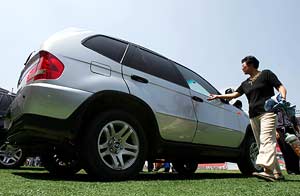
Found while catching up with my overload of simultaneously delivered Economist issues, a story entitled "Counterfeit cars in China", and subtitled "The sincerest form of flattery".
Of course, there have historically been regular instances of copyright, trade secret, and patent law violations in China. (Google search links, returning 1.3M, 287K, and 981K document hits, respectively). An argument can be made that such infringement is how third-world and emerging economies grow to become full players in the global market. That argument would ring true, however offensive the concept that "all you need to do to grow is to steal and learn".
COPYING in China goes far beyond fake DVDs, watches and handbags. “We can copy everything except your mother,” goes a saying in Shanghai. Soy sauce with fizzy water passed off as Pepsi, fake Cisco network routers (known as “Chisco's”) and mobile phones that look like the latest offerings from Nokia can all be easily found. So, too, can fake blood plasma.
Aside from the blood plasma (which I don't understand how one might fake), the rest of it is all old news. Counterfeiters of high-value manufactured goods should be restrained by to the barriers to entry, including "huge capital investment".
Of all the products to copy, however, a car is surely the most complicated. Cars consist of around 6,000 precisely manufactured components made from a range of different materials. For a car to be cheap, reliable and long-lasting, says conventional industry economics, these parts need to be put together in factories with huge volumes, lots of expensive machinery and many well-trained engineers.
Turns out that in China's case, that's not as true as might be hoped:
So it came as a surprise when counterfeit cars started to appear in China eight years ago. Early VW look-alikes were soon followed by the infamous Chery QQ. It appeared six months ahead of the car it copied, the Chevy Spark, because a Chinese firm somehow got hold of the blueprints.
All quite troubling, and it goes beyond the Chevy/Chery, affecting many other established manufacturers.
Yes, it's part of emerging economies' growth path, and yes, once they get to the point where they're creating more intellectual property than they're stealing, balance will be restored in many areas, including balance of trade, manufacturing costs, and living standards. But that doesn't happen overnight, and at some level, the imbalance causes pain in the trading system, yielding such things as (in the US) calls for trade protectionism.
Aside, however, from any arguments about whether, when, and how balance will be restored, it seems reasonable to expect some honor among thieves, no? Honor of the sort I'm considering would be that, if you're going to steal, at least don't lie about it, and if you're going to lie about it, at least put in the effort to make the lie plausible, if not believable.
What's triggered this mild outburst of mine on the subject? This:
Shuanghuan Automobile got into trouble for copying Audi's famous four-ring logo a few years ago. It then copied the design of Honda's CR-V, called it the SR-V and appears to have won the subsequent legal tussle. Last month the firm won an export licence, and it plans to start shipping another model, the CEO (pictured)—a sport-utility vehicle with a striking resemblance to the BMW X5—to Romania and Italy.
Copying DaimlerChrysler's small two-seater Smart car seems to have become especially popular. In January Shuanghuan launched an electric version, called the Dushi Mini. It followed in the tracks of Shandong Huoyun Electromobile, a firm that makes golf buggies, which launched its own version last year and announced plans to sell the car in Europe for less than half the price of the original.
After Daimler threatened to sue, the car was temporarily withdrawn. A spokesman for the Chinese firm said he had been surprised by the way his car resembled the original, explaining that the company had simply copied a toy car.
A toy car? Excuse me? Who's their spokesman, I wonder? Tommy Flanagan? Baghdad Bob?
Growing up to achieve a seat at the adult table in international trade would seem to preclude such blatant disingenuity. In the circumstances, the spokesman could have been expected to be at least a little sheepish after such an utterance.
(also posted at issuesblog.com)
on
| § 2
And some should be allowed to stand unchallenged.
Apropos this earlier item, I'd caution the participants to not be like this woman:
Woman registers a .47 on breath testerThu Apr 19, 1:41 PM ET (AP)
REDMOND, Wash. - A woman arrested following two car crashes last week registered a .47 blood-alcohol content on a breath test — nearly six times the legal intoxication threshold and possibly a state record.
Deana F. Jarrett, 54, was taken to Evergreen Hospital as a precaution following her arrest April 11, the Washington State Patrol said Wednesday. No one was injured in the accidents.
Jarrett blew the .47 on a portable breath tester after she collided with two other vehicles in quick succession, the patrol said. A check of all 356,000 breath tests administered since 1998 in Washington turned up only 35 above .40 — and none of those was higher than .45.
The legal intoxication threshold in Washington is .08.
Jarrett did not appear to have a listed phone number, and it was not clear if she had obtained a lawyer.
(excerpted in its short entirety, to avoid the corrosive effects of future link-rot)
It rather reminds me of a colleague from years ago, who once proudly held the "women's record" for blood alcohol level in Whitehall, OH, at .20%. I remember having read somewhere that .30% was lethal, but I'm not going to go and Google it, since, per the above, it must not be true.
on
| § 4
Chapter 11 proceedings seem to focus the corporate mind. Not always on anything that matters to business, however. Witness, below, excerpted from an email message I got from Delta Airlines today:
In a partnership with The Conservation Fund, we are the first U.S. airline to implement a voluntary carbon offset program — and we'd love to have you "onboard."
It's simple. Beginning
June 1, 2007 , you will be able to add a small donation to fund the planting of trees in sustainable managed forests around the globe when you book your ticket at delta.com. These trees will help off-set carbon emissions by absorbing carbon dioxide from the atmosphere and converting it to oxygen as part of their natural processes.We'll disburse 100 percent of your donation to "The Conservation Fund program" to plant trees and to support the organization's education and outreach efforts. Additionally, we'll make a donation to The Conservation Fund for every customer flying on a Delta mainline jet worldwide on Earth Day (April 22).
It's just part of our Force for Global Good initiative that strives to benefit the world we fly everyday. So go ahead and take a flight, and join us in uniting our customers and employees in support of environmental stewardship.
Note: this, from the company with the well-meaning customer service people who called to reschedule a flight I've got on tap for next week because their operations staff had changed things, leaving me a massive 7 minute connection time in Atlanta. Whoops. But at least they called.
Anyhow, a couple things occur to me right off the bat.
If they'd paid as much attention to their stockholders as they pretend to pay to the environment, their (former) stockholders wouldn't need to be such heavy users of Preparation H. Sure, the stock's at $0.16/share as I write this, but it's likely overvalued. Bankruptcy has a way of doing that.
Secondly, as I read that kind offer of theirs to join the "Force for Global Good", it sure looks like they're trying hard to do it with my money, and that it's not really them (other than on Earth Day™!) that will be doing the giving. If they want to give their own corporate money to a fool's boondoggle like carbon offsets, I'm fine with that. I'm not one of their stockholders, and am, in fact, a relatively steady customer of theirs. They've already proven, over the years, a callous disregard for the interests of their owners, and those owners are probably beyond surprise at this point. The customers, like me, being a bit more flexible in our ability to avoid having donations milched on our behalf, will see this as the useless public relations gum flapping that it is.
[wik] What good is corporate gum flapping without a press release?
on
| § 0
Found in Friday's WSJ (4/13, subscription req'd):
The WSJ has a regular section of the paper dedicated to houses I wouldn't want, in places I wouldn't live, at prices I can't afford. They're always adjacent to full page advertisements from Coldwell Banker or some other house-hawker, so perhaps there's an editorial synergy at work.
The story right before the one about Snoop Dogg's home, for instance, detailed a $125 million listing for a 45,000 sq. ft. estate called "Fleur de Lys", being sold by a 46 year old divorcee you've never heard of, formerly married to a man you've never heard of, who started and sold a company you've never heard of. The last line of that listing editorial masterpiece was this:
Joyce Rey, head of Coldwell Banker's Previews division, and Robert Kass of Windermere Real Estate have the listing.
So I'm going out on a limb here, and assuming that each of the stories had its editorial birth in a call directly from a listing agent to Ben Casselman at the WSJ, or someone else who works in the pretend-editorial department for the "Weekend Journal" section.
With that lead-in, I'd like to highlight a portion of the otherwise garden variety article Mr. Casselman produced. It seems that Calvin Broadus, a/k/a Snoop Dogg (or would that more properly be "Snoop Dogg, a/k/a Calvin Broadus"?) has put a house on the market. Blah, blah, blah - sounds like a nice enough place, at something like a normal price for Southern California real estate these days.
As before, I presume the story came from the listing agent, though s/he was not named in the article. Here's the description they included in the article for Broadus, the seller:
The rapper, 35, has sold nearly 19 million albums in the U.S., according to Nielsen SoundScan, and has appeared in several films. (He's also known for popularizing the suffix "izzle.")
That, plus he was sentenced earlier this on weapon and drug charges for some earlier, and unimportant to this story, infraction.
Am I the only one who thinks it odd that (if as presumed) the listing agent who provided the story thought it was important to the story to enlighten us all that he is known for the suffix "izzle"? More important than the drug and weapons charges?
Yeah, I'm probably the only one.
[wik] I can just picture, 30 years from now, Calvin Broadus, talking to some kid somewhere, and saying "'izzle? Yeah, that was mine."
[alsø wik] I can picture some kid, 30 years from now, hearing something like that and laughing his ass off.
on
| § 0
I'm sure that the rest of the Ministers got theirs, but I must have missed the memo on the start of the Canadian seal-clubbing season. Dang.
Via an article in the April 4 2007 Economist (subscription required) entitled "On thin ice", I've learned that global warming has impacted Southern Canada's ability to provide fodder for the particpants in its seal-clubbing industry. Clearly, the government needs to do something to avoid disenfranchisement of the affected group.
THE activists have armed themselves with helicopters, video cameras and outrage. The hunters have their sharp hooks and blunt clubs, often combined into a single sinister-looking instrument of Norwegian design known as a hakapik. Canada's seal-hunting season officially began on April 2nd along with the usual row between those who denounce it as senseless cruelty and those who defend it as a traditional and necessary part of local livelihoods. Thanks to global warming, however, the argument might soon become redundant.
So it seems that the protesters are impaired in their ability to effectively protest. Global warming - Is there anything it can't do? Admittedly, not everyone can muster much sympathy for the perpetually outraged pretend-protectors of the cute little seals.
The problem?
This year there has been less of the usual footage of burly men bashing small furry skulls and of blood smeared across the ice floes. That is not because the hunters have become less aggressive, but because suitable seals have become scarcer. Thanks to an unusually warm winter, the ice is melting early in the southern Gulf of Saint Lawrence, where hunting began this week. The seal pups on which the hunt preys are reared on the ice until they are old enough to swim. So the premature thaw has drowned them—before the hunters had the chance to kill many.
Less seal-cranium-crushing= less for PETA, or whomever, to kvetch about. In a nod to realities of the matter, the Canadian government points out that seal hunting "brings income to struggling fishing communities", which I'd guess is a good thing.
Not surprisingly, the protesters don't care, and want to protest, regardless of any benefits to the communities in which the hunting occurs. However...
... campaigners against seal hunting are not wholly beyond reproach either. Few bother to make it clear that the killing of the youngest pups with fluffy white pelts has been banned for 20 years. They also make it sound as if the seals are endangered. In fact, the seal population has tripled since the 1970s.
In another bow to reality, and due to warm conditions in the South, the government has reduced the quota for seal hunters from 335,000 to only 270,000. The practical effect is to have shifted seal-hunting to the colder northern climes.
The sealers in those areas tend to hunt with rifles, and so do not provide such good fodder for media campaigns.
You'd think, reading it, that both the hunters and the complainers are equally wrong-footed by the weather, but that's not the case - the hunters can always head north. There's not enough outrage available up there for the complainers, however, and therefore I stand by my assertion that they're the ones most unfairly affected.
Oh, and yes, the new word learned is hakapik. Help me out here - the name of that tool isn't onomatopoeic, since it surely doesn't make a sound like its name. What's the description of a word which (in its English incarnation, at least) has a name that sounds as though it's describing what you can do with it?
[wik] Technically, if the protesters actually cared about the seals, wouldn't they try to save them from drowning, as well as from the evil hunters?
on
| § 0
Ouch. Johno gets Mitt. Buckethead gets Joe. I get Hillary. One of these choices is not like the other two.
Why? Well, Mitt's a serious guy with a serious reputation among a fairly small subset of serious people who don't otherwise know too much about him, as Johno's undressing of him might indicate. He's not widely or well known, but Mitt has a vocal support group, and will do fine until the heat reaches room temperature in a national campaign. At that point, he's toast. Which is hard to do at room temperature, and don't ask me how long it took me to find that out.
Joe? He's famous for the same things that make him infamous, as Buckethead's clearheaded yet evenhanded rant exposes. There's a chance that he's a decent guy, underneath his hugely irkssome and noticeable but ultimately unimportant flaws. The fact that he can't seem to keep anyone's words from coming out of his cakehole, let alone his own, seems even more damning than the fact that he also has a history of not caring whose words he's using.
Easy targets, the both of them.

Not so, Hillary Clinton. Ms. Clinton is far more broadly known than either of the other two, and is still the frontrunner by a wide margin in the Democratic Party field. (See Mar 29 2007 Fox News/Opinion Dynamics poll). In that poll, Mitt Romney is tied for fourth place (at 6%) in the Republican ranks. He's tied with a guy who's not even sure he's running (Gingrich), a guy who, if he runs, would be a very interesting candidate and among the most (simultaneously) intelligent and arrogant candidates we've had to choose from in recent memory. Perhaps worse, Mitt's also trailing a guy in third place who wasn't even included in the poll until the March 29th issue, a man who has only recently entered the collective imagination for the presidency - Fred Thompson, at 9%. Fred's a guy who may still not run due to lack of energy, desire, or freedom from "indolent lymphoma". Worse yet for Fred's supporters, he's a guy who may even be too late to successfully run. And yet Mitt's still sniffing his exhaust. Like I said, easy pickings, both Mitt & Joe.
Hillary, on the other hand, at 36%, finds favor with more Democratic voters than those for Barack Obama and Al Gore combined. She may be one of the most polarizing figures in national politics since, well, since George W. Bush, but she's not someone who can be trivialized or taken lightly. And yet, that's my task here. Since this is stream of consciousness composition, I may find I've started and ended the trivialization with the picture above, one of many such candid photos that, if you pick the right frame from your choices, can make anyone look like they've got a ferret up their skirt. Pant-suit. Whatever.
Ms. Clinton is the other half of the most politically adept, yet managerially sloppy and morally "flexible", presidencies in my lifetime. I've often wondered whether she is, in raw intelligence, the smarter of the two, and a case can be made that perhaps she is. In the alternative, she's surely not far behind Mr. Clinton in intelligence. In political finesse, he has her beat by a country mile, but she'd surely have access to his gifts in that area during a national campaign. He owes her that, at a minimum, just for the dry-cleaning bills paid.
The political tactics that the Clintons, then and now, have been able to muster are brazen beyond belief. That's politics, however, and tells me more about what they're able to do to get her elected (anything required) than it does about their character (sketchy as all hell, just like all other politicians from either party). As a for instance, this, from HRC's Wikipedia page (provenance unknown, as always):
Former Bill Clinton fundraiser and ally David Geffen spoke out against Hillary Clinton in an interview with Maureen Dowd, stating that Clinton had no trouble lying and was overproduced and overscripted.[20] In response, the Clinton campaign attacked Geffen and the candidate that he is supporting for President, Barack Obama, charging that Geffen's comments reflected on Obama negatively and that Obama should return Geffen's money.
That's so Machiavellian that not only wouldn't I have reacted the way the Clintons did, I am incapable of having even considered it. If Barack Obama did anything other than laugh so hard he coughed up his lunch, I'd be hugely disappointed. But the story had the desired effect - deflection of tarnish on Bill Clinton's, and by extension, Hillary Clinton's, control of his network of allies.
Not that this is meant to be a post about him, but everything about Bill Clinton, the good and the bad, can be see as indicative of how Hillary will act as she moves her campaign forward. Sometimes the comparisons are parallels, but far more often, you'll find that they're opposites. When Bill Clinton was getting the snot kicked out of him by a rabid subset of the American body politic, it wasn't he who invented the term "Vast Right Wing Conspiracy" - it was Hillary. This, of course, was after he'd be catting about with the porcine intern, a fact about which Hillary couldn't plausibly have been ignorant. That sort of "Hey! Look over there!" defense isn't taught in grad school, as far as I know - it comes from a deep seated willingness to do whatever it takes to take and hold power. Bill was such a bad-ass smooth talker that he really didn't need to care about things like his reputation. If Joe Klein's faux-novelization of the 1992 presidential campaign, Primary Colors, is any indication, Hillary wasn't willing to rely on people forming their own impressions, unguided, of the Clintons, and had the same focus on the result, damn the impediments, even back then.
Her stewardship of the attempt at nationalized health care, in 1993, points to another polar opposite tendency between she and her husband. He was a consummate politician - a smooth talking pragmatist who, love him or hate him, had the gift of making many people listen to, if not agree with him. Hillary? Not so much. When the firestorm started after her foray into health care policy, Professor Martha Derthick (quoted in a 2006 George Will WaPo op-ed) wrote:
In many years of studying American social policy, I have never read an official document that seemed so suffused with coercion and political naiveté . . . with its drastic prescriptions for controlling the conduct of state governments, employers, drug manufacturers, doctors, hospitals and you and me.
Polar opposite of Bill? Yeah. Shrill? Pretty much.
Are her actions from the 1990s useful for predicting her likely trajectory in the 2008 Presidential campaign? Not completely. Some of the political wisdom of her husband has clearly sunk in since her initial campaign for her NY Senate seat. She's matured politically, and can, at times, seem positively statesmanlike. The risk remains, however, that she'll let out the shrildabeest. Two issues seem ripe for such a result.
First, she's called "off limits" any discussion of her relationship with Bill. I'm instinctively sympathetic to that request, not least because I'm no fan of reality TV, as I don't like to see people humiliated purely for entertainment purposes. According to James "The Lizard" Carville, in a December 2006 WaPo piece:
Despite all that, the subject of the marriage is too hot to handle. "It's uranium-242," said longtime Clinton adviser and friend James Carville, earlier this year. "You pick that stuff up and it'll blow up in your face . . . I'll talk about anything. But I ain't gettin' near anybody's marriage, especially the Clintons.' "
He's right. But the media and her opponents aren't likely so soft-hearted to leave this issue alone, and a real test of her ability to play on the big stage will be the manner in which she enforces her self-declared ban on this topic.
Another touchy spot is evident in the details of an LA Times article from Feb 18, 2007, entitled "GOP activists circling Clinton's campaign". In it, the actors discuss the tactics required to avoid a fate similar to that of John Kerry in the 2004 campaign:
Clinton has been publicly bracing for "Republican machine" attacks from the moment she launched her exploratory committee last month. Whether she can strike back quickly may prove crucial to winning over Democratic primary voters looking for assurance that she can survive a bruising general election and Swift-boat-style attacks.
"For Democrats, there's a strong sense this time around that they can't allow those same tactics to define Democratic candidates," said Democratic media consultant Jim Margolis.
If Ms. Clinton responds to "swift-boat style attacks" in the same was as Kerry did, she's toast. Swiftboating, you see, isn't slander or libel, as the LA Times and others who use the epithet would have you believe. As it applied in Kerry's case, assertions of fact were made by people close to him during his days in Vietnam, and he had a chance to respond. He largely failed to do so, and instead chose to whine about how unfair it all was. Swiftboating, then, is better defined as being put in a position where it's easier to whine than it is to rebut, respond, or explain the inconvenient facts because they're not rebuttable.
Partly because her opponents in this regard, such as StopHerNow, seem so unhinged, I don't think Ms. Clinton will be subject to the sort of factual expose and undressing Kerry begged for by his murky claims to heroism, and as a result, her best bet will be to respond only enough to such attacks that she can be seen to be responding, but not fully engaging, as it's beneath her. Claims that she's a rabid left-winger don't ring true. So what if, as StopHerNow says, she's left of her husband? He was really quite a centrist, believe it or not, and one could be to his left without being too awfully offensive. But as an apparent control freak, Hillary may not be able to stay above the fray, and that seems a risk she needs to mitigate.
One last slug in this already-overlong post, and perhaps the elephant in the room for Hillary, from that same December 2006 WaPo article entitled "The President in the Room", and an item that cements this as not just a Hillary campaign, but a Hillary and Bill campaign:
Yes, Bill can deliver political superstardom. He's a razor-sharp political strategist. He knows the institution of the presidency. His fundraising chops are unrivaled. All that is well and good -- perhaps too good, according to a September CNN poll, which showed his favorable rating higher than hers, 60 percent to 50 percent.
[wik] Other possible negatives? One word: "cankles" Two words: "pants suits"
on
| § 2
Old news, by now, but dredged back to my frontal lobe after having heard ESPN's Dan Patrick and Sports Illustrated's Rick Reilly talking on ESPN Radio today on the way back from lunch, and Reilly having said something to the effect that in five years, the winner of the 2007 Masters tournament, Zach Johnson, would be waiting tables at Olive Garden.
Apparently, Reilly has a habit of recycling his jokes:
(regarding Brett Wetterich, a rookie in last year's Ryder Cup matches) Rick Reilly, the celebrated American columnist, was more brutal. "You look at him and think, was he my waiter at Olive Garden last night? If he wasn't, he will be soon."
AUGUSTA, GA—World No. 1-ranked golfer Tiger Woods, after appearing to struggle through the weekend—playing with uncharacteristic inconsistency, bogeying twice in the final rounds, and breaking clubs—shocked the crowd at Augusta...
on
| § 0
At least so far, it's contained a few important items, many more less important items, a tiny bit of spam, and this kick in the teeth:
Florida President unsure of what to do with Ohio State
By VERN JACKSON
Gainesville Sun Staff Writer
April 4, 2007
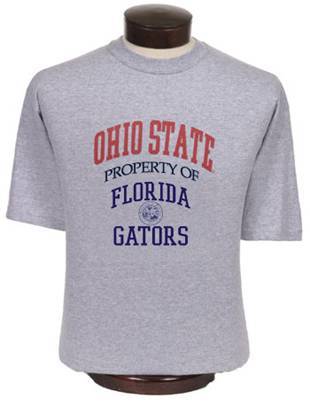
GAINESVILLE – In the wake of Florida’s unprecedented dual championship victories over Ohio State, the University finds itself with a unique and somewhat perplexing problem.
What to do with Ohio State now that Florida owns it.
According to little known and never before used “Clause 121” of the NCAA charter, when a University defeats another member University for two consecutive national championship games by “convincing margins,” the defeated University becomes the sole property of the victor.
University of Florida President J. Bernard “Bernie” Machen readily admits that he was unaware of “Clause 121”, and is unsure of what to do with Ohio State. “They have, what is it, over 54,000 students? Plus, it’s in Columbus, Ohio. It is very inconvenient.”
The University of Florida Board of Trustees is holding an emergency meeting this Friday to deal with the unprecedented situation. According to sources on the Board, initial ideas include –
Sell It – The easiest move the Board might make is simply to sell Ohio State. However, due to the University’s size, and its location in the relatively depressed real estate market of central Ohio, it may be difficult to find a willing buyer. “We are looking into this option,” Machen says. “We have contacted the Solid Waste Authority of Central Ohio to see if they need more land.”
Keep It – This option has several difficulties, but may be the only one if Florida is unable to get a buyer for fair market value. Primary among the difficulties is the large student body population of Ohio State. However, sources on the Board did say since OSU’s student population is near Florida’s 50,000, there may be a situation where Ohio State students could be lent to Florida students on a semester by semester basis as personal valets.
Florida junior Kevin Young thinks the valet idea is just swell. “Everyone should have their own pet Buckeye,” said Young. “It would be like having your own personal fraternity pledge. I think the idea rocks!”
Were Florida to keep Ohio State, issues of whether to allow OSU to keep their current team name and mascot, as well as whether to allow them to continue to play in the Big Ten, would have to be resolved. Says Machen, “I think we could reach some sort agreement that would allow them to keep Brutus Buckeye and play in the Big 10. After all, what would we do – move them to the SEC? They would only get hurt. Since they are our wards now, we could never allow that.”
The prospect also exists that Florida would have dissolve Ohio State athletics. In that case, the issue of what to do with the student athletes is uncertain. Florida football coach Urban Meyer, when approached with the prospect of having to absorb Ohio State’s football team, paused for a moment and said, “I suppose they could be a scout team for our scout team. They really aren’t fast enough for anything else.”
Finally, there is one other idea University officials have floated, and that is simply to donate Ohio State to charity. “As I understand it, thousands of Hurricane Katrina refuges are still displaced. We could give OSU to the Katrina Relief Fund, and allow people to relocate there,” Machen said. “That could be the win-win situation everyone is looking for.”
As Kenny, my Melbourne-FL-based-Ohio-State-fan correspondent said at the end of the forwarded screed:
The Buckeye basketball team should have a good chance of making it back to the big dance next year...I saw they signed some good talent for 2008.. but what are the chances they'd get a re-match with Florida?? Not likely.....at this point I'd settle for a Buckeye Championship in Women's field hockey.
Such are the fruits (for the Buckeyes) of losing the big game, twice, I guess.
[wik] Also found, at the same site as was the t-shirt picture above, this snippet:
"I saw a sign at the game, OHIO STATE -- The New GEORGIA"
on
| § 0
However well intended, however laboriously justified, if you look closely enough, you'll often find that the results of grand government plans don't always match the rhetoric. Or worse, that the rhetoric was, well, bullshit.
Take, for instance, the recent goofy shift in the timing for switching back to Daylight Saving Time. From Brad Feld's blog, "Feld Thoughts", have a look at his initial take on the DST firedrill just recently encountered, if not endured, by Americans. Mr. Feld said:
I wrote a post on March 12th titled Daylight Savings Time is Stupid. A bunch of people agreed with me, but some didn’t, suggesting that (a) I was missing the point and it was more fun to have light at night than in the morning or (b) the “authorities” insisted that we’d get GDP gains, (c) there would be big energy savings helping save the world, and (d) restaurants and stores would make more money due to sunny night shopping. Oh – and I also learned DST = daylight saving time, not “savings.”
After the event, about which a manageable but still non-trivial amount of media ink was spilt warning us of the second coming of Y2K (and ignoring completely, or being so misinformed as not to have known, what a complete non-event that was in the real world), Mr. Feld checked in with one of his colleagues, "Ross the IT guy", for a real-life opinion on the matter.
A minute spent viewing "Comments on Daylight Saving Time from an IT Guy" provides clear, if not definitive, proof that it was all a waste of time. An excerpt highlighting variance between dreams and reality:
DST change (Daylight Savings Time) has made no difference in national energy consumption and probably cost us more than it saved in lost productivity.
Big shock, that. No net effect, based on several sources with which Ross, the IT guy, checked.
Since we are all home the same amount of time we're all pretty much using the same amount of energy.
It seems so obvious in retrospect that you'd think it would have been just as obvious in prospect.
There is, I should note, a dissenting comment on Feld's blog. It's backed by nothing, of course, and refers to "volumes of research on this area, it's not just politicians spouting off", but I remain unconvinced this was anything but a complete waste of time. The cost to update all the systems required to put the change into effect was a one-time cost, and won't be repeated through all future cycles from standard to daylight saving time. But the benefits, unlike the costs, seem ephemeral at best, and non-existent at worst, and I'll continue to believe that until it's credibly reported to be otherwise. I haven't seen any stories claiming savings, and have seen several, in addition to Mr Feld's, claiming the opposite.
It reminds me of another current hot-button issue, about which many folks clamor for immediate action without having scientifically, accurately, or definitively assessed the cost of inaction, or the benefits of action. Or, failing that as an impossibility, admitting that those same costs and benefits are about as quantifiable as the number of angels that can dance on the head of a pin.
But I'll spare you any further flogging of that particular horse, since I expect Minister Buckethead will soon be doing that job better than I can. Stay tuned.
on
| § 0
Found on Digg Spy, as the most intelligent comment on a story entitled "Tom Hanks signs on to Angels & Demons for Record Payout?".
Now, mind you, it came after a bunch of comments about how Angels & Demons was far superior to the Da Vinci Code. Which is absurd, as it's like comparing runny shit to smelly shit. Who knows which was actually worse? Who cares? They both (the books, not the types of shit) served a purpose, namely to be throw-away airport reading purchases, which is precisely how I came to read them both.
Anyway, the comment linked above, from Dumbledorito, reads, in its entirety:
A&D has a plot so linear you could put your eye out with it. Plus, it has an antimatter bomb (WTF?) and will probably piss off even more Catholics. The ending was more improbable than the Pope having been a former ping-pong champion, and lastly, if you're going to make a movie about the Illuminati, it should be based on the works of Robert Anton Wilson.Sorry to rant. I just didn't care for it. It was also another "scholar wet dream" film as the bookish nerd-professor gets the hot chick thanks to his esoteric knowledge of an obscure subject.
Yeah, like s/he said.
on
| § 4
If you happened to pick up a copy of today's issue of USA Today, you could find a story entitled "Katrina claims stagger corps". You could find the same thing if, as happened to me, you saw it on a newswire, and thus didn't have to trouble yourself with purchasing the paper, with its sometimes-difficult-to-stomach format and voice. (n.b. - not it's opinion voice, but the clipped, short attention span voice they seem to choose for their stories, often resulting in news that, while it's neither more nor less accurate than anywhere else, didn't get the name "McNews" for nothing)
The story's key points are a bit breathtaking - New Orleans is seeking $77 billion in restitution and Louisiana's attorney general wants $200 billion.
New Orleans and Louisiana, swamped when the city's storm protections failed during Hurricane Katrina, demand the federal government pay a damage bill that is more than double the entire cost of the massive Gulf Coast rebuilding effort.So many claims have been filed against the U.S. Army Corps of Engineers that the agency needs at least another month even to tally the floor-to-ceiling stacks, spokesman Vic Harris says.
{...}
Those two alone are more than double the $110 billion Congress approved for Florida and the Gulf Coast after Katrina and two other hurricanes struck in 2005.
(ellipsis mine) Ouch.
The story, having specifically listed the amounts above sought by New Orleans and the state itself, goes on to elaborate:
New Orleans and Louisiana seek broad requests for costs after Katrina but don't list specific damages.
The great thing about suing for damages, from a defendant's point of view, is that the damages do have to be enumerated. In addition, any mitigation already provided will have to be taken into account, and surely the federal government's $110 billion so far approved must have contained some funds which have been applied against such damages.
There's also the sticky matter of shared responsibility. Particularly in the case of New Orleans, the actions taken and omitted by Mayor Nagin and his government in the aftermath of the hurricane would imply competence at some small fraction of anything the Corps might have exhibited. In any event, it's going to be a royal mess to sort out.
Luckily, there's an attorney involved, so don't you worry; this should all end up right as rain:
Homeowners could seek damages of an additional $200 billion or more, says Jerrold Parker, a lawyer whose firm is trying to organize a class-action suit against the corps."Just looking at the place, it's clear that there's tremendous damage," he says. "The fact is, everyone knew the protections were inadequate."
{...}
The corps must either pay or reject each of the claims. Those whose claims are rejected can take the agency to court. Parker says his firm represents more than 3,000 people who want to sue.
(ellipsis, again, mine) For the record, “Just looking at the place, it’s clear that there’s tremendous damage” doesn't count as "enumeration of damages". He also presumes, of course, that his 3,000 clients' claims and the contingent fees he hopes to glom from them are all in addition to the generous amounts sought by the various government agencies. This doesn't even pass the "red face test", let alone the "giggle test".
Left undiscussed in the story is the rationale by which the government and its agencies are liable for failing to provide absolute and flawless protection for flooding in, say, New Orleans.
A city that lies "5-10 feet below sea level". On the same page linked just left, you will see that...
The Army Corps of Engineers verifies that the New Orleans area has 325 miles of Congressionally authorized hurricane protection including: Westbank (66 miles); New Orleans to Venice, La. (87 miles); LaRose, La to Golden Meadow, La. (40 miles); Grande Isle, La. (7 miles); Lake Pontchartrain and vicinity (125 miles).
...but Mother Nature doesn't pay much attention to the Army Corps, let alone (just like the rest of us) to Congress.
Bad things happen to good cities. They also happen to New Orleans, which is not now, nor has it been in the past, a "good city". It's a truly unique city, and a very interesting one, but neither of those connotes goodness. While less, or at least differently, so than in the past, due to the effects of the hurricane, it's still a bit of a cesspool.
It's cops are notoriously and blatantly corrupt. They've had more than their fair share of murderers wearing the uniform, too. And, aside from the murder, that's just the cops - the elected politicians are no better. William Jefferson, he of the refrigerated cash, is a stellar example of this breed, but hardly the only one.
But it doesn't stop there. From the Autumn, 2005 issue of the City Journal:
The second job is less obvious. New Orleans’s immutable civic shame, before and after Katrina, is not racism, poverty, or inequality, but murder—a culture of murder so vicious and so pervasive that it terrorizes and numbs the whole city.In 2003, New Orleans’s murder rate was nearly eight times the national average—and since then, murder has increased. In 2002 and 2003, New Orleans had the highest per capita city homicide rate in the United States, with 59 people killed per year per 100,000 citizens—compared to New York City’s seven. New Orleans is a New York with nearly 5,000 murders a year—an unlivable place. The city’s economy has sputtered over the past generation partly because local and state officials have failed to do the most elementary job of government: to secure the personal safety of citizens.
And then there's the race card, described in the same article:
In the aftermath of the storm, hand-wringers wondered why they hadn’t noticed before that so many American blacks live in Third World conditions—supposedly only because they’re black. CNN’s Wolf Blitzer voiced white America’s knee-jerk best: “You simply get chills every time you see these poor individuals. . . . So many of these people, almost all of them that we see, are so poor, and they are so black,” he mused on the air.But Americans didn’t notice this before because it’s not true. Despite the president’s rhetoric, and despite those indelible images from the Superdome and the Convention Center, New Orleans is just as much a black success story as a black failure story.
Yes, New Orleans has a 28 percent poverty rate, and yes, New Orleans is 67 percent black. But nearly two-thirds of New Orleans’s blacks aren’t poor.
Yes, it’s true that nearly 25 percent of New Orleans’s families live on less than $15,000 a year, according to the 2000 Census. But 19 percent of New York’s families live on less than $15,000—and it’s much more expensive for poor people to live in New York, making them poorer.
New Orleans itself, its attorneys, and their clients, even more so than the state of Louisiana, appear to be trying to make their myriad problems those of all their fellow U.S. citizens. Simultaneously claiming poverty and race-based neglect from the federal government along with dismay at how wretched the city is now, ignoring that it's pretty much always been wretched, they're going for the gusto.
Or trying to.
It seems unlikely that, once the mess of layered claims, some bogus, some inflated, and some already addressed by insurance or other government single- double- or triple-handouts, is parsed, the extent of damage related to the breach of the levee system might be anywhere near crystal clear.
Add to that the absurdity of expecting guarantees from anyone, government or not, of protection against the weather, it becomes easier to hazard a guess as to what the outcome of this might be. I expect that the Army Corps, and by extension, all U.S. taxpayers, will be absolved of the imaginary financial responsibility that the plaintiffs in these cases are trying to foist off onto us.
(also posted at issuesblog.com)
on
| § 0
WASHINGTON, DC—"The question facing us today is simple: Do you like us? If not, why?" asked House Speaker Nancy Pelosi, seeking approval from the American people.
on
| § 0
Not for the first time, the technology world has a do-or-die patent judgment hanging over its head - "Judge grants partial stay in Vonage patent case"
The last such major drama was a bit more than a year ago, in the case of NTP v. Research in Motion (RIM), related to the Blackberry remote messaging service and its infringement of patents held by a patent licensing firm. In that instance, much of RIM's effort before ultimately reaching settlement was dedicated to contesting the patents. During late 2005 and early 2006, there were many stories of successful challenges to NTPs patents, as reported here, here, and here, as well as myriad other places.
In that last linked story, one of the two primary crutches on which the losers of patent infringement cases regularly lean was described like so:
More bad news for we-don't-actually-make-anything NTP in their long legal dispute with RIM — the US patent office just made a "first office action" rejecting the validity of the last of eight NTP patents they were reviewing, five of which were at the heart of the RIM patent infringement suit.
Another of the crutches is the all-too-common complaint that the Department of Commerce’s United States Patent and Trademark Office (USPTO) provides patents far too willingly, either for inventions that are obvious or trivial and thus not patentable or already widely known in the public domain prior to the patent filing. Disclosure of presumptively patentable inventions prior to first filing with the USPTO makes them ineligible for protection, in many cases, and certainly, disclosure by someone other than the patent applicant is strong indication that the invention fails the to surmount the hurdles regarding triviality and uniqueness.
Notwithstanding successful defense of patents widely considered invalid, like Amazon's patent for "one-click" technology in internet commerce, dissenters regularly continue the argument, both generally (as with DNA patents in the comment linked to the ledt) and related to specific patents like Amazon's.
In the case of NTP v. RIM, RIM had hoped to obtain reversals on all NTP-owned patents it had been judged guilty of violating. RIM ran out of time, and had to pay the piper, even though every single patent at the heart of the case had, by crunch time, been provisionally revoked. This was clearly an unfortunate, and arguably an unfair, result for RIM stockholders.
In the current case, Vonage was granted the temporary right to continue using the patents at issue, but not to use them in providing services to new customers. Vonage, predictably, was disappointed by this:
Roger Warin, a lawyer for Vonage, said the partial stay amounted to "cutting off oxygen and a bullet to the head" of the company.
And, given stronger finances, it seems possible that Vonage, like RIM before it, might attempt a blocking or delaying tactic while attempting to have the patents overturned.
But Vonage (they of the "shaky finances", both before and after their IPO) isn't RIM (they who, even if they perhaps shouldn't have needed to pay NTP, weren't mortally damaged by the battle). And Verizon isn't NTP. It's bigger, of course, but the technology underlying the patents at issue wasn't purchased, to my knowledge, but was instead actually invented by Verizon. Even under the arguably silly (silly because patents, like other property, can be bought and sold) stance that NTP didn't really deserve the patent protection it used to win the case, Verizon is a whole different breed of cat, possessor of many patents, quite familiar with the process of acquiring and protecting them, and to which such an argument doesn't apply. Any attempts to invalidate its patents seem likely to be a hard battle, with at best an uncertain outcome for the challenger.
While "a bullet to the head" and "cutting off oxygen" seems less likely to guarantee instant death than a bullet to the lungs and cutting off its head would be, Vonage, as Mr. Warin said, is in deep trouble as a result of the only-partial stay of the patent infringement judgment. Inability to acquire new customers will be their death knell, given a business model that's predicated, still, on market share growth instead of financial results.
Breathy claims, made during the initial trial, that they had alternative technology that could be used instead ring hollow for me, and were interesting for public- and customer-relations, but are not operative in a real world where new customers must coexist with old, and where implementing any sort of new technology, especially for a customer base far larger than the company's service quality seems to merit, would be like performing open heart surgery in the bed of a pickup truck going 90 mph on a rough road.
Good riddance to a company that's often treated its customers rather cavalierly? Perhaps not. But as a happy-to-be-ex-customer, I think it's more likely than not.
[wik] The more things change, the less they stay the same:
(5:47 PM ET Apr 6, 2007)
"Vonage receives stay, can continue signing up new customers".
SAN FRANCISCO (MarketWatch) -- Vonage Holdings Corp. said late Friday it has received a stay from a federal court in Washington, D.C., allowing it to continue to sign up new customers. Earlier Friday a judge the same court issued a ruling barring Vonage from signing up new customers, because Vonage in March had been found to infringe on patents owned by Verizon Communications Inc.
Apparently, Vonage used the "Oooooh! You're killin'me" defense. So I guess we'll just see.
on
| § 8
HEAVEN—Since His birthday last Dec. 25, the Lamb of God has committed Himself to a demanding regimen of exercise and prophecy-fulfillment in preparation for the Second Coming.
on
| § 0
"It", in this case, is the 2008 Presidential election pre-pandering season. How could I tell? Today's mail contained solicitations for donations from:
Pfft. Into the trash with the lot of them, after emitting a muttered "Holy shit!"
However, I was intrigued by several things about the mess of politically motivated mail feces pieces. First off, one of the items on that list is not like all the others. No, not the Mormon - the other odd item. Yeah, Richardson. I haven't a clue how his campaign is doing its targeting, but as much as I'm sure he's a stand-up guy and all, I don't know that I've ever taken any action which would have tagged me as anything other than, well, someone who would throw his mail into the garbage, unopened.
As for the rest, it's early days, and I guess there's a school of thought that the entirety of the Republican Party's mailing list (if not its "base", which excludes me) is ready for its quadrennial colorectal exam, to see if there are any changes in tendencies, proclivities, and candidate preferences. Oh, and IQ, too.
However, for anything other than a truly zero-cost mailing (which things don't exist), I'm amused that the GOP thinks the right marketing mode is "carpet bomb". At a minimum, given how early in the game it is, might it not make sense to attempt such mailings in waves, and adjusting the targets as responses from the gullible are tabulated?
I think it would, but they didn't ask me.
If they had, I'd have made the recommendation above, and I'd also have reminded them of John Wanamaker's famous saying:
"I know I waste half the money I spend on advertising," department store pioneer John Wanamaker said. "The problem is, I don't know which half."
I'd then point out that, according to Seth Godin, that's a myth:
Half my advertising works, I just don't know which half. Actually, it's closer to 1% of your advertising that works, at the most. Your billboard reaches 100,000 people and if you're lucky, it gets you a hundred customers...
Please ignore the casual numeric disdain of Mr. Godin - he's a marketer, not an arithmeticist. 100 people out of 100,000 is a lot closer to 1% than it is to 50%, but it's even more closer to 0% than it is to 1%.
And finally, I'd point them back to me, proof positive that the ratio that works is actually 0.00%
Note the two-decimal precision - that last bit is not only precise, it's accurate.
on
| § 7
Not that I want to bash on the same topic too hard, but subsequent analysis I've seen of the Oracle vs. SAP kerfuffle (below), brings into question my understanding of copyright law, and my analysis of the overall case. Such as this bit, from an article of 3/27/2007 by Michael Hickins, entitled "SAP Could be 'In a World of Trouble'":
Analysis: The lawsuit that Oracle filed against its rival in the enterprise software market last week is going to get even worse. When all is said and done, SAP's conduct, if proved true, could cost it hundreds of millions of dollars in penalties, untold points of market share and even, perhaps, jail time for some executives.In the complaint, Oracle said it plans to register thousands of new copyright claims for its software and then "amend its Complaint to add further copyright allegations and causes of action when the registrations for these copyrights" are granted by the United States Copyright Office.
I'm no lawyer, and I don't know who Michael Hickins is, but I'm guessing that either he's no lawyer either, or he's a lawyer similar in skills to the public defender assigned in the movie "My Cousin Vinnie".
Where do I start? Purple prose like "...hundreds of millions of dollars in penalties, untold points of market share and even, perhaps, jail time for some executives" is an easy first step.
Business judgment errors, if they were even errors at all, by a tiny subsidiary of SAP called TomorrowNow, seem unlikely to damage the corporate reputation of SAP to the tune of "untold points of market share", unless "untold" is a synonym for "zero".
In order for there to be hundreds of millions of dollars in penalties, it would seem required that Oracle present evidence of hundreds of millions of dollars in damages. This seems highly unlikely, and not just because this seems clearly less than some corporate spying skullduggery than SAP's division simply walking through unlocked doors at Oracle on behalf of Oracle's former support customers. I don't know what the controlling law is alleged to be, but treble damages, such as in the case of antitrust, don't seem applicable, and I have trouble conceiving that TomorrowNow, with several hundred employees engaged in servicing all its customers, not just those who've recently moved from Oracle, somehow mulcted hundreds of millions in business.
In earlier stories on the case, I'd not seen any reference to copyright violation as the core complaint. That connection is the basis that the author, via his source, "Eric Goldman, director of the High Tech Law Institute at the Santa Clara University School of Law", uses to arrive at the 9 digit number for penalties. The odd thing about this, aside from it being a new-ish underpinning for the complaint, is that in order to make its complaint even "complaintier", Oracle plans to "register thousands of new copyright claims for its software", and then amend its initial lawsuit.
Having authored copyrighted material, including software, I'm more than passingly familiar with the process, and it's got nothing to do with registering claims of copyright. All that's required is to clearly claim copyright in the document, and presto! you've got a copyrighted document. Registering such claims with the government extends the process, but doesn't increase the degree to which you possess copyright protection. So that part of the story raises flashing red flags to me regarding the credibility of Mr. Goldman, above, and by extension, of Mr. Hickins. If I'm right (and of course, there's a chance, however small, that I've misunderanalyzed this), Mr. Hickins is at worst guilty of producing an inflammatory article. Mr. Goldman, of course, should know better.
If the basis for the complaint is copyright infringement, then I wonder how it occurred. For instance, is the claim that SAP's division wasn't allowed to read the documents that were freely available on Oracle's system? I haven't seen (and don't expect to see) claims that TomorrowNow republished the documents under their own name, and fair use, last time I checked, included simply reading such copyrighted documents. If there's a clause in the Oracle support contract that prohibits disclosure of the contents of the Oracle documents, then the case might better be made against the customers who disclosed the documents, indirectly, simply by providing access to them via user ID and password.
I'm not the only one who's raised this question. From a story last week at InternetNews:
Scott Hervey, an attorney with Weintraub Genshlea Chediak, a Sacramento, Calif.-based law firm that specializes in trade secrets and trademark law, said it was too early to tell what this could end up costing SAP if all the charges are proven.He noted that Oracle based its complaint on unusual provisions, such as "trespass to chattel." He said the last time he saw that provision used in a lawsuit was in 2003, when Intel unsuccessfully sued a former employee for sending e-mail to current employees.
He added that it was also interesting to note the laws that Oracle was not invoking in its complaint. In particular, despite making claims that SAP stole and copied copyrighted information, Oracle isn't suing for copyright infringement. "I'm curious as to why there's no such claim," he told internetnews.com.
And while the complaint alleges that SAP used stolen passwords, Oracle chose not to sue under the anti-circumvention provisions of the Digital Millennium Copyright Act. "The anti-circumvention provision prevents circumvention of access controls--and that's what passwords are," he said. Oracle would not comment on why it made those choices at this time.
Funny - the reason I didn't recall this case being based on copyright violation is that, initially, it wasn't. Which makes it seem as though Oracle's lawyers are pulling the case together on the fly. Why might they do so?
Goldman, again:
And according to Goldman, the very language of the lawsuit reads as much as a marketing document as a legal one. "There is no doubt in my mind that the document is intended to be circulated to potential and current SAP customers," he said.Goldman pointed to several instances in the complaint, such as where Oracle refers to its "broader, deeper product line," showing that Oracle intends to use this case to seed doubt in the minds of SAP's current and potential customers.
Lawsuit as marketing ploy? Who would have thought it? Turns out that my opening line above needs amendment. Rather than "...brings into question my understanding of copyright law, and my analysis of the overall case", I should have said "brings into question my understanding of copyright law as a marketing cudgel". Yeah, that's more like it.
Finally, the mention of jail time for SAP executives seems silly, at this point in the case, because I'm unaware of any civil case that ends with jail time. Perhaps that's just me, and perhaps this could turn into a criminal case at some point. Though still no apologist for SAP, and still no lawyer, I think such an outcome seems highly unlikely.
(also posted at a issuesblog.com)
on
| § 0
I've had a devil of a time with delivery of the magazine (the Economist calls itself a "newspaper", whatever) recently, and within the past 4 days, I've received the last three weekly issues. So I'm a bit behind the times.
One of the must-reads, even when playing furious catch-up after having three weeks' reading dumped on me near-simultaneously, is a feature that's been in place for only about the past 5 or 10 years, a closing obituary. Another of the must-reads in each issue is the letters to the editor. In particular, as part of the standard configuration of the newspaper, the last letter in any given issue is normally the funniest.
Having, I hope, set the stage properly, I present you with this from the March 17, 2007 issue, the last of those letters:
Legacies
SIR – In response to the letters you received (March 3rd) criticizing your choice to run an obituary on Anna Nicole Smith, I would say that part of the joy of reading The Economist is to appreciate (for better or worse) how a waitress at Jim's Krispy Fried Chicken in a small Texan town can rise and fall and take a swathe of skilled, educated and talented people along with her. - Nick Jones, Atlanta
Somewhere, Greta Van Susteren must be sobbing deeply, wondering how her career ended floating in the sewers.
Oh, and in that same issue, in the US edition anyway, here was the cover illustration:

No, I have no idea what's up with that, either, though I guess it could be an indication that it's really cold in Europe.
on
| § 0


