

Actual Facts

While hummingbirds can't walk, they can break dance.
Posted by
Buckethead
 on
| § 3
on
| § 3
on
| § 3

While hummingbirds can't walk, they can break dance.
on
| § 3
I emailed this out to a few people, and was roundly ignored. Perhaps I shouldn't have sent it Friday afternoon at 5:00. In any event, I was thinking some more about this idea in my first eight hour meeting this morning:
Here's a alternate history teaser for you. I was reading a book by James Hogan called Kicking the Sacred Cow, a fascinating look at scientific theories not accepted by the mainstream, yet short (for various reasons) of full-on crackpotism. One of the things he discussed in his book was alternate theories of relativity. Without getting into too great detail, one aspect of this is that some physicists are coming to believe that Einstein's general relativity might have gone too far in trying to explain the speed of light and other conundrums. What they propose is that unlike in Einstein's theory, there is a peferred reference frame, and that that reference frame is determined by the ambient gravitational field. Further, once you accept this, you can derive many physical constants directly from Maxwell's electromagnetic equations that can only be assumed in General Relativity. Even further, it may be that gravity itself is a side effect of electromagnetism. (It may be that that peferred reference frame is in fact equivalent to the idea of the ether, and the reason why the Michaelson Morley experiment failed to detect it was the same for the same reason that it would be difficult to measure the air speed of an airplane from inside the cockpit.)
All very interesting, and worth a read. But what got me is the thought that if this is all true, powerful electromagnetic fields operated in the right way might have an effect on gravity. Which could be really cool for all of us if someone figures it out. And there's that Russian dude who claimed that he could do it himself. But what if someone like Michael Faraday - widely considered the most brilliant experimental scientist of his or any day, and inventor of the dynamo (on which all subsequent electrical technology is based) had a brainwave and built himself a giant electromagnet and figured out how to cancel out the effects of gravity back in 1825?
Suppose he spent the next ten years getting all the kinks worked out. And at the end of the day, he had a funky device that you could mount in a ship, and it would make that ship fly. By 1840 or so, people are building flying ships. Let's assume that ships can be made more or less arbitrarily heavy, thanks to the antigravity. Either another version of the device, or even something as prosaic as propellers, would push these literal airships through the atmosphere. Speeds would therefore be limited to something on the order of the steamships of the day - but they could go up thousands of feet in the air, and cruise for long distances. Essentially, the new aerial ships would have the same range, speed and carrying capacity as the wetter sort of steamships, but able to fly at altitudes of up to several thousand feet.
Further assume that the production of the device is difficult, but within the capabilities of any moderately industrialized nation of the time, limited perhaps by the need for some rare and expensive element. There might be some variation in the ability of different nations or companies or inventors to produce faster or bigger ships, but all will be more or less in the same ballpark, performance-wise.
What would be the effect of this technology on the wars and politics of the last half of the nineteenth century? These new airships would, unlike modern aircraft, have all the advantages of water-bound ships - range, cargo capacity, armaments and armor, etc., but able to travel at will over the whole globe.
Among the big shows scheduled for the 1860s include the American Civil War and the Austro-Prussian War. 1871 would see the Franco-Prussian War and German unification. The 1880s saw the great powers occupied in an undignified scramble for brown people's land. And all that would lead up to the really, really big show of WWI.
Some thoughts: the South would be unable to produce many of these ships, but it would certainly have some. Gen. Stonewall Jackson leading an airborne division? The German Reichsluftmarine wouldn't be as hemmed in by British control of the passages out of the North Sea. Tsarist Russia would no longer be hampered by lack of warm water ports. Switzerland would no longer be landlocked. Railroads would no longer be the only way to marshal troops quickly and transport them to the front. This last is important, given that the greatest effort and thought was put into plans for marshalling troops and equipment for transportation by rail. Much of the diplomatic screwups that led to the First World War were dictated by mobilization and rail schedules.
Air battleships would not be fragile structures of aluminum, easily blown to bits by AA guns. These battleships would in be in essence, real battleships like the HMS Dreadnaught or the USS Iowa given the ability to fly. Of course, in the time of the Civil War, it would be flying CSS Virginia and USS Monitor. But that's the nature of the beast. Naval air ships would carry the largest cannon available, and be capable of intense bombardment of targets on the ground. Cargo ships could hold hundreds of men and their equipment and travel hundreds or even thousands of miles at 20-30mph.
In short, the advantages of naval conflict - mobility, firepower and carrying capacity - would be carried over to land warfare, long limited by the speed of march and the carrying capacity of the individual infantryman.
What do you think might happen?
on
| § 2
As I was daydreaming during my second eight hour meeting this morning, it occurred to me that there is at least one other factor that would be significant in any breakup and possible assimilation of Canadian territory. I'm not sure of the specifics, but it is my understanding that Canada, while fully independent in terms of conducting its affairs both foriegn and domestic, it is still technically part of the British Empire. The Queen is still, after all, on the front of their monopoly money. I wonder what, if anything, Great Britain would have to say about the U.S. gobbling up several ex-Canadian provinces.
on
| § 0
My wife's band, Dead Men's Hollow, is going from success to success. Tomorrow, they are playing a free concert on the Millenium Stage at the prestigious Kennedy Center for the Performing Arts (right by the Watergate Hotel in our nation's capital.) And today, I learn that they have been nominated for no less than six Washington Area Music Awards from the Washington Area Music Association.
DMH is up for the following Wammies:
You can hear their music by following the link above and clicking on "Music." They've got some free downloads, just for you.
I can't say how proud I am. Despite many obstacles, and even harassment, they are moving up in the world at a steady and relentless pace. Their music gets better everyday, so listen now and you'll be able to say, "I knew them before they kicked the Dixie Chicks clear out of country music."
on
| § 4
I have been informed, by a reliable source, that it is Blackfive's birthday. I was informed by this reliable source early this morning, and I could have scooped the entire interweb on this important story had I not spent the first six hours of my work day in twenty hours of meetings. Nevertheless, go wish him a happy birthday in a way that means most to bloggers - visit his site, then (if you don't already have one) create a new blog and link him twenty or thirty times.
Then, link me twenty or thirty times for giving you the idea.
I recently had the pleasure of meeting Blackfive, and enjoying with him and two lovely ladies some excellent Malaysian food and about four hundred dollars worth of beer. Blackfive is a standup guy, and I am honored to have met him. So really, go over and say happy birthday.
on
| § 3
A fossil is an extinct animal. The older it is, the more extinct it is.
on
| § 0
The whole Canada thing has gotten me thinking. While support for independence in Quebec seems be holding steady, or even declining, the potential for a breakup of Canada is still real, if somewhat remote. But what would actually happen if Canada did break up?
The first puzzle is what the remainder of Canada would do in the event of a decisive vote for sovereignty in Quebec. There seems to have been some preparation for this eventuality, and I doubt many in British Canada would really object much to the idea of Quebec going its own way. The situation would be nothing like that of the southern states seceding in 1861 – there would certainly be no civil war to force Quebec to remain part of Canada. The likely result, at least in the near term, would be an amicable divorce, in its nature very like the split between the Czech Republic and Slovakia.
The Quebecois and the rest of the Canadians would divvy up the marital assets – military bases, government facilities, and the like. They would agree to things like free movement of citizens, trade reciprocity, and access to the St. Lawrence seaway for the western parts of Canada. The opinion of the United States would have to be considered – especially in regard to that last item, seeing as how such a large portion of US trade uses the St. Lawrence seaway as well – it is the only access to the sea for the entire US Great Lakes region, including Chicago, Detroit and Cleveland. But so long as this was guaranteed, I don't think the US would really twitch at the idea of the Quebeckers going their own way.
The repercussions of an independent Quebec might move well beyond their own independence. I can imagine that once the idea of Canada is broken, others who might not have considered secession might find it, well, thinkable. The obvious candidates in this case would be Alberta, Saskatchewan and British Columbia. We are told that Canadians in the west have long felt shafted by the elites in the east, whose policies have either taken, or threatened to take, the wealth of the west to be given to the economically disadvantaged in Quebec and the Maritimes, whose economies are not as vibrant, or as well blessed with natural resources.
Alberta, especially – the Texas of the north – might be the first to follow Quebec into secession. There have been movements for secession there in the past, though not particularly large or successful. Unlike Quebec, however, with Alberta and the plains provinces, the probability of one or more of these newly independent nations turning around and petitioning the US for statehood would be significant. And that would raise big questions in the US, which has not admitted a new state to the Union in almost a half century, and the only real parallels would be with Texas and California, more than a hundred and fifty years in the past. More on that in a minute.
Meanwhile, assume that the unraveling of Canada continues, and gathers momentum. Quebec started the ball rolling, and Alberta gives it a good kick soon after. In quick succession, Saskatchewan and British Columbia also declare independence. The Central government in Ottawa has lost its biggest problem, which is nice. But it has also lost two of its most prosperous provinces, which means that it will be far less able to make transfer payments to the economically stagnant Maritime Provinces. Further, it is now geographically separate from them, with Quebec awkwardly positioned betwixt the two parts of the rump Canada. What will the Maritimes think at this point? Continuing support from Ottawa might seem to be less and less assured. Perhaps they, too, would consider independence, followed by a petition for statehood.
The advantages for certain provinces in statehood are in some cases fairly clear. As Bob and Doug McKenzie put it in the Daily Hoser:
Top Ten Affects if Canada and the United States merged into one nation:
Beyond those benefits, the western provinces have, arguably, more in common with American citizens just across the border than they do with Canadians in Ontario. Likewise, the population of the Maritimes has a lot of affinity for New England. Being a part of America means getting all the benefits of being American. (And, of course, the downsides.) They would be able to participate directly in the formation of American policy with representatives in Washington. They would benefit from social programs that for all the whining, are not that different from those in pre-balkanized Canada – and that would be an important point for the Maritime Provinces.
In short – being part of Canada might seem a bad deal in the middle of a collapse, but going it entirely alone might seem a bit risky, hence the flip to America.
But how would the Americans react to all this?
If one Canadian province petitioned for statehood, the argument might be different than if many did. Just think about the various considerations and calculations that will be taking place in the minds of congressman, senators, state leaders and pundits:
Partisan types will be wondering how the citizens of a new state will vote. Most of the provinces under consideration would be, by American standards, very low in population. New Brunswick, Newfoundland and Labrador, and Prince Edward Island are all sub-South Dakota in size. PEI is tiny – actually only a fourth the population of our current least populous state, Wyoming. Nova Scotia is about a million people, which puts it in the range of a Rhode Island. Saskatchewan and Manitoba likewise. Alberta, at over three million, is equivalent to Connecticut. BC is the largest at over four million, equivalent to South Carolina. The smallest provinces would only have a single Congressman. Those with a million people would get two. Alberta would get as many as five, BC perhaps six. The overall effect would be small. But in the Senate, things would be different, as each of these new states would get the same two as everyone else.
And who would get those congressmen and senators, and who would benefit in the electoral college? The plains provinces are almost entirely conservative. Alberta is entirely conservative. It can be assumed that most of those votes would go to the Republicans. The Maritimes vote predominantly Liberal and NDP, and it can be assumed that most of those votes would go to the Democrats. That's three red states and four blue states – if each province comes in as its own state. British Columbia would be a battleground state. In the last election, it voted in 17 conservatives, and 19 from the libs and the NDP. But the peculiarities of the Canadian election system mean that as far as percentages go, it's not so close: 55% Libs and NDP, 37% Conservative.
If all the provinces came in, partisan bickering could probably be overcome since over the spread of all of these provinces; it's more or less a wash right-left wise. But if only Alberta, Saskatchewan and Manitoba wanted to join, the Democrats would howl at the near certain addition of six Republican senators. Small states (and their representatives) would likewise howl at the further dilution of their already small influence in the Senate.
The influence of these new states on Presidential elections would also be debated. Our electoral college gives a lot of influence to small states in the race for the Presidency. And if Prince Edward Island became a state, 137,000 people would wield three electoral votes, a 1:46,000 ratio compared to 1:616,000 ratio for Californians. Again, the relative balance of conservatives and liberals across all the provinces would likely reduce most complaints – something like the way free and slave states were admitted to the Union before the Civil War.
What other issues would there be? The advantages to the US of having access to Alberta's oil reserves would be clear, though environmentalists might oppose admission on those grounds. (Or support it, so they could influence it.) Expansion would likely be viewed as a good thing in principle by most Americans, especially as Canadians are for the most part very like us. Integration of ex-Canadian military forces into the American armed services would likely not be anywhere near as big a problem as it was for the Germans absorbing the East Germans. The cultural affinities of Canadians to America would likely lead to a smooth process overall. The great latitude the Constitution provides to the states in how they order their business would certainly help as well.
A little research on the web revealed the basic process of borg-like assimilation of new territories:
It doesn't matter if the territory was already US territory or an independent nation as was California and Texas. So long as the state government is republican in nature, the details don't seem to matter much.
If Quebec left and the rest of Canada decided that they could still be Canada without them, this would all be moot. I think the key would be Alberta. If even one more province decided to give the stinkfinger to Ottawa, it would start a domino effect leading to the United States absorbing most of Canada outside Ontario. The only province that seems to have a reasonable shot at making it on its own as an independent nation is British Columbia. The rest are too poor, or too landlocked to be completely viable states, hence the anschluss with the U.S.
[wik] Posts like this are what happens when I leave my book at the office before getting on the Metro for the ride home.
on
| § 5
There has never been a major world leader named "Floyd."
on
| § 3
I officially declare this Canada day on the Ministry. In the spirit of this official celebration of the lives, achievements and peculiarities of our neighbors to the north, herewith, some linkage:
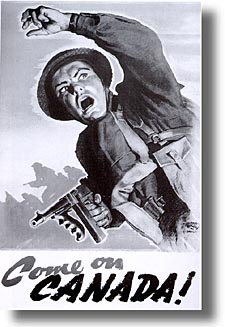
[wik] Our resident Canadian, Ross, is cordially invited to comment on the momentous events underway in his frozen homeland.
[alsø wik] Murdoc has a round-up of blog commentary, of which my favorites are Joe Katzman at WoC (no surprise) and this seemingly counterintuitive bit from Frank Warner that makes more sense if you think about it for a second. Murdoc also dared to use the "H" word.
[alsø alsø wik] I should also mention that the Austin Bay piece, well, I stole that from Blackfive.
[wi nøt trei a høliday in Sweden this yër?] Joe also links to this nifty graphic.
on
| § 3
Interesting commentary from the Christian Science Monitor about the "Triumph of the Redistributionist Left." While disheartening for me - especially considering that I will not get the nice Christmas presents from Social Security that the older generations will, all aside from philosophical considerations - the guy has a point:
It's about something much deeper; namely, that the era of big government is far from over. Trends are decidedly in favor of that quintessential leftist goal: massive redistribution of wealth.
Republicans' capture of both Congress and the White House was, understandably, a demoralizing blow to the left. But the latter can take solace that "Republican" is no longer synonymous with spending restraint, free markets, and other ideals of the political right.
While the left did not get its way on tax cuts, this may be only a temporary defeat: Freewheeling spending has made future tax cuts politically a lot harder.
During the first five years of President Bush's presidency, nondefense discretionary spending (i.e., spending decided on an annual basis) rose 27.9 percent, far more than the 1.9 percent growth during President Clinton's first five years...
Discretionary spending is dwarfed by mandatory spending - spending that cannot be changed without changing the laws. Shifting demographics combined with an inability to change those laws virtually ensures that, through programs such as Social Security and Medicare, America's workers will be forced to redistribute a larger and larger portion of their income to other Americans in the coming decades.
...Certain trends have been favoring the left for the past several decades. In the early 1960s, transfer payments (entitlements and welfare) constituted less than a third of the federal government's budget. Now they constitute almost 60 percent of the budget, or about $1.4 trillion per year. Measured according to this, the US government's main function now is redistribution: taking money from one segment of the population and giving it to another segment. In a few decades, transfer payments are expected to make up more than 75 percent of federal government spending.
That's not a pretty picture.
on
| § 4


