Let's party like it's 1789

Crazy maverick senator Zell Miller has said, with his face hanging out, that we should no longer directly elect our senators. The esteemed Georgia senator thinks that the founding Dads had it straight the first time, and that senators should be appointed by the legislatures of the several states.

Now, those of you who are devoted readers of this webthingy will know that I am all about originalism, the genius of the founding fathers and our comparative unwisdom, and in thinking that almost every political development since about 1800 was generally for the worse. However, I must beg to differ with Democrat in Name Only (DINO) Miller.

Because of the curse of gerrymandering, the vast majority of seats in the People's House, the House of Representatives, are elected by "safe" districts. There is, thanks to careful (not to say maniacal) line drawing, absolutely no chance that these seats will ever face a competive election, even when an incumbent steps down. The only interesting competition you'd see is in the primaries for the dominant party.

Contrariwise, the shark like operatives for both parties have not yet devised a method for gerrymandering whole states. Senate elections are (aside from Presidential elections) the only place where our votes can truly make any sort of difference in who represents us in Washington. Of course, this is completely at odds with the intent of the founders. They envisioned the Senate being the calm, wise, reserved debating soceity that would restrain the whims of the democratic mob in the House. Instead, we have the mob in the Senate, and party hacks from safe districts in the House.

Zell's proposal would remove the one democratic part of the Congress. And we can't really afford that. I would agree to his plan only if we passed an amendment that somehow removed the problem of gerrymandering. (I have no idea how you might accomplish that, but if you have ideas, please use the comments.)

[wik] Rich Lowry has more on this up at the National Review Online.

Posted by Buckethead Buckethead on   |   § 7

Hmmm...Steel or Fiberglass?

Haaretz and The Telegraph are discussing the lack of heavy armor in Iraq and connecting that lack to high casualties in April. That situation will only continue, because I just read in my newsletter that the 1st Cavalry Division, which is completing its deployment to Iraq and is for all intents and purposes an armored division, left most of its armor in Texas.

FORSCOM commander General Larry Ellis (under whom I served when he was Colonel Ellis, in his final weeks leading the 1st BDE, 3rd ID and who is a fucking super stud) points out that the improved humvees in service now are the best available solution to the situation. Until either more Strykers become available or an entirely new vehicle designed and fielded, this is it. A different option is to go back to the future: another Army officer says he has 700 old M113s that were prepositioned in Kuwait and have been gathering dust. Why not use them as battle taxis instead of soft humvees, he asks?

Problem is that humvees were never intended for frontline battlefield usage. They were designed to replace the venerable jeep as a mechanized mule, not to operate in the real fight. But in these counter-insurgency operations, where the bad guys are everywhere and nowhere, there are no rear areas where humvees can operate safely. The tactical question might be whether this or that upgraded humvee can do the job, but the larger question should be, what vehicle do we need that can act as ambulance, police cruiser, tactical command post, and general purpose people mover while providing enough occupant protection and vehicle survivability in an environment of 360 degree hostility? And while we're bullshitting, it needs to be light enough for easy air transport and cheap enough to buy a zillion of them. Have something on my desk for Monday.

I was a support guy and worked on commanders' staffs in two different Bde HHCs and one Bn HHC. I drove M577s, the command post carrier version of the original '113. You'll notice that you have to crouch in a '113. On '577s, you'll see how tall the vehicle is- the interior was tall enough to stand up in, and the walls had steel shelving crammed with radios, COMSEC gear, maps, batteries, personal weapons, sledgehammers, shovels, food, shit-tickets (aka victory paper aka toilet paper), comic books, porn, and everything else too heavy or...uh, sensitive... to carry around.

The M113 family is very noisy and very slow. Both the '113 and moreso the '577 (due to the generator and cradle next to the driver's hatch; clearly visible in the pic) severely restrict the driver's field of vision. Not only do the tracks damage roads, but roads also damage track! Wear and tear and continual use on hard surface can increase the likelihood of throwing the track, literally, where the whole damned thing pops right off the road wheels. I don't know how prevalent this problem is in Iraq, since there are numerous '113-family vehicles in the field already, but I'm not sure adding 700 more to the end of the supply chain would be a good thing. Furthermore, stock models are not armored beyond the steel they're made of. They'll stop small arms- probably- but I'm not optimistic about heavy crew-served machine guns (say 12.7 mm+) or RPGs. Even if the steel stops the heavy round or rocket, it would likely spall the interior. I understand that actual '113s, as opposed to '577s, have some sort of an anti-spall kit for interior surfaces and bolt-on armor kits for the hull, but I don't know how available that gear is. Even with after-market add-ons though, an RPG will still likely ruin your day; if an IED blows a drive sprocket, you're in deep doo-doo.

BUT- is all that better than tooling around downrange in the fiberglass and canvas convertible that is the humvee? Probably!

At least until we get some Halderman-ian armored infantry fielded.

Posted by GeekLethal GeekLethal on   |   § 3

Hamtramck-abad

Practitioners of the religion of peace have once again managed to piss off alot of people.

Last week the Hamtramck, MI City Council gave "initial approval" to allowing city mosques to broadcast calls to prayer over loudspeakers in a decision sure to piss off both infidels in general as well as muslims who might want to sleep in that day.

Not surprisingly, the council completely caved to muslim demands with a unanimous vote of support. Don't want to offend anyone, don't you know. Well, except for people who don't want to hear it, which is the rest of the city. Final approval was expected at last night's meeting.

Leaders of the city's muslims claimed that infringing on their right to make a goddamned racket through loudspeakers was actually infringing on their right to practice their religion, going on to claim that it was in their tradition to do so. I'm no more an expert on Islam than the next kaafir but as best I understand it, Islam did pretty well for itself through the 13 centuries that passed BEFORE electric amplification. And don't try and tell me that none of Hamtramck's umma has a damned watch to tell him when he's supposed to get down to some Mecca-facing.

We know though that the legal issues in question- noise ordinances, rights of religion- are only the mechanism muslim leaders are using to proselytise. Masud Khan, head of the Al-Islah Islamic Center, initiated this whole loudspeaker business. Pleased with the council vote, and after the requisite Allah-thanking, he added,

"Hamtramck is going to be a pioneer city for the whole United States."

Posted by GeekLethal GeekLethal on   |   § 9

Call it the "McClellan Doctrine"

Without presuming to make any assumptions or accusations about the courage of the Bulgarian people and their armed forces, the following quote, from an MSNBC article about the renewed fighting in Fallujah-- including artillery-- struck me funny.

Bulgarian President Georgi Parvanov demanded Tuesday that Bulgaria’s 450 troops be moved to safety away from the holy city of Kerbala after his convoy was fired on when he visited them Sunday.

Posted by Johno Johno on   |   § 4

Let's build some life!

This really long scientific article talks about some eggheads making DNA blocks or something, and then putting them together to create life. I was too lazy to read more than the first paragraph, (which I have excerpted below) but I am sure that this technology will in no way effect my day to day life, or the moral or technological underpinnings of it.

Evolution is a wellspring of creativity; 3.6 billion years of mutation and competition have endowed living things with an impressive range of useful skills. But there is still plenty of room for improvement. Certain microbes can digest the explosive and carcinogenic chemical TNT, for example--but wouldn't it be handy if they glowed as they did so, highlighting the location of buried land mines or contaminated soil? ...nature apparently has not deemed such a thing fit enough to survive in the wild.

Posted by Buckethead Buckethead on   |   § 0

Cold Fusion: not quite so lamebrained an idea

Technology Review is reporting that the Department of Energy has decided, on the basis of recent research, to look into cold fusion once more. Fifteen years after Pons and Fleischmann were greeted with awe and then ridicule, some are beginning to take it seriously again.

Read the article for the details, but the gist of it is this: some of the confusion over other experimenters not being able to reproduce the results lay in the concentration of heavy Hydrogen in the Palladium cells. If there are more Deuterium atoms than Palladium atoms, then you get extra heat. With lowered amounts, you get spotty to no results. Further, new experiments show that fusion byproducts (such as Helium-4) are appearing in amounts appropriate to the level of heat generated. No one really knows how all this is happening, but:

He [Peter Hagelstein, associate professor of electrical engineering and computer science at MIT, who chaired the tenth International Conference on Cold Fusion in Cambridge last August] suspects the difficulty lies with "a very powerful approximation" at the root of 70 years of nuclear physics—that all nuclear interactions occur between two particles in a vacuum. He thinks that assumption breaks down in cold fusion, where the interacting particles are tightly packed in a metal lattice. His idea is that the deuterium nuclei exchange vibrational energy, or "phonons," with the surrounding palladium atoms. That exchange could enhance nuclear interactions that would otherwise be vanishingly small, so that the reactions can occur at the rates implied by cold fusion experiments. Hagelstein's theory is still in development, but is reaching a point where he can start making testable predictions—a vital step toward making cold fusion a credible science. "In time, hopefully, we'll get more of the puzzle figured out," he says.

We see effects like this in chemistry - where the presence of one compound acts as a catalyst for the chemical reactions of two or more other compounds. Is it so unreasonable that there could be catalysts at the subatomic level as well? Who knows, we might get the fusion powered DeLorean after all...

Posted by Buckethead Buckethead on   |   § 0

Do Dead Androids Dream of Electric Banking?

Weird Franco-psycho writer Emmanuele Carrere has penned a biography on weird California-psycho writer Philip K. Dick, I Am Alive and You are Dead.

A recent Economist had a brief review of the book, which is not yet released. That review spent alot of its brief space describing Dick's drug use and abuse; presumably Carrere spends alot of time on that as well, as the "review" didn't offer much substantive critique of other content.

One fun fact the review mentioned was the love affair Hollywood has with Dick's work (an affair that will continue through the immediate future) has generated upwards of $700 million, yet not as much $$ flows back to the Dick estate as one might hope.

I'm not a big fan of biography, but I might have a peek at this one just for the union of weird spirits in Carrere and Dick.

Posted by GeekLethal GeekLethal on   |   § 11

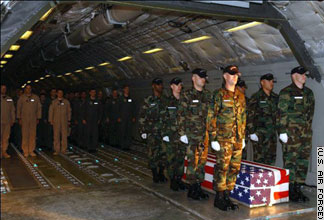
Why Hide The Fallen?

I was dismayed last week when a Defense Department contractor was fired for publishing pictures of coffins containing slain soldiers on their way home from Iraq. An undersecretary of Defense argued "we don't want the remains of our service members who have made the ultimate sacrifice to be the subject of any kind of attention that is unwarranted or undignified." While I can understand the DoD's will to secrecy and the policy it generated, it ultimately does very little good. Sometimes risking undignified treatment is the price of freedom.

In the current climate of half-truths and obscurity that President Bush and his advisors seem to prefer, even long-standing policies like this get caught up in the larger tide of similar gestures seemingly designed to deny the American people information that they might actually want to have. I'm not blaming Bush-- this isn't his policy-- but it just doesn't help him, either.

I am personally glad the photos were published. War is an abstraction to us, and images of the fallen make it decidedly less so. Like the images of September 11 (or March 11), and like the hideous photos brought home from prior wars (a Spanish partisan falling, his carbine flung away from his body, his head exploding, the screaming Vietnamese girl, burned by Napalm), they translate the current libervasion of Iraq into human terms far removed from the best-case calculus of the President's advisors or the redfaced screaming of the BusHitler crowd.

Wars look ever more like video games, and ever since WWII, the USA has been able to absorb the cost of committment without undue strain. This changes how we see things. During WWI, the USA itself felt the impact of the fighting abroad. Rationing, huge casualty lists, and the sinking of civilian ships brought the fact of war into everyone's consciousness. Ditto WWII, where the stakes for the USA were higher still. But now that war is less of an effort for the country, and conducted on a smaller scale far away (and for increasingly complicated reasons and goals), it becomes more of an abstraction. It's all well and good for me to sit here and play armchair pundit, commenting on that abstraction. But I can easily forget that the men and women in Iraq who joined the military are giving their lives in defense of liberty. I might not see the endgame, and I might not agree that Iraq was the very best place to fight. But neither of those considerations takes away from the gratitude I feel toward the people of the US military.

Images like were published in The Seattle Times (and everywhere else) overcome that abstraction in favor of fact. It is good to be reminded that the military treats its fallen with deep respect and overwhelming honor, and it does the right thing by the dead for the country to see and understand not only the sacrifice they have made, but the great dignity with which our country recognizes that fact. Hiding these images, making a policy of hiding these images, is the wrong thing to do. Whether you are for or against the war, these pictures do a great service.

Below the fold.

[wik] According to the Washington Post, the ban on images like these dates from the Clinton administration, but was specifically enforced at the start of the Iraq War. "In March, on the eve of the Iraq war, a directive arrived from the Pentagon at U.S. military bases. "There will be no arrival ceremonies for, or media coverage of, deceased military personnel returning to or departing from Ramstein [Germany] airbase or Dover [Del.] base, to include interim stops," the Defense Department said, referring to the major ports for the returning remains." (Dana Millbank, WaPo, 10/21/2003). Draw your own conclusions about the Bush Administration's committment to secrecy.

[alsø wik] Kathy Kinsley observes that the Pentagon may be revising the policy. KK has some thoughts.
image

image

The Memory Hole has hundreds more.

Posted by Johno Johno on   |   § 11