

 Ministry Archive: Buckethead
The MIT Student Newspaper has an interview with everyone's favorite music industry pimp, Jack Valenti. It seems that Jack is not too solid on the whole concept of "Fair use."
 on
| § 1
on
| § 1

Crazy maverick senator Zell Miller has said, with his face hanging out, that we should no longer directly elect our senators. The esteemed Georgia senator thinks that the founding Dads had it straight the first time, and that senators should be appointed by the legislatures of the several states.
Now, those of you who are devoted readers of this webthingy will know that I am all about originalism, the genius of the founding fathers and our comparative unwisdom, and in thinking that almost every political development since about 1800 was generally for the worse. However, I must beg to differ with Democrat in Name Only (DINO) Miller.
Because of the curse of gerrymandering, the vast majority of seats in the People's House, the House of Representatives, are elected by "safe" districts. There is, thanks to careful (not to say maniacal) line drawing, absolutely no chance that these seats will ever face a competive election, even when an incumbent steps down. The only interesting competition you'd see is in the primaries for the dominant party.
Contrariwise, the shark like operatives for both parties have not yet devised a method for gerrymandering whole states. Senate elections are (aside from Presidential elections) the only place where our votes can truly make any sort of difference in who represents us in Washington. Of course, this is completely at odds with the intent of the founders. They envisioned the Senate being the calm, wise, reserved debating soceity that would restrain the whims of the democratic mob in the House. Instead, we have the mob in the Senate, and party hacks from safe districts in the House.
Zell's proposal would remove the one democratic part of the Congress. And we can't really afford that. I would agree to his plan only if we passed an amendment that somehow removed the problem of gerrymandering. (I have no idea how you might accomplish that, but if you have ideas, please use the comments.)
[wik] Rich Lowry has more on this up at the National Review Online.
on
| § 7
This really long scientific article talks about some eggheads making DNA blocks or something, and then putting them together to create life. I was too lazy to read more than the first paragraph, (which I have excerpted below) but I am sure that this technology will in no way effect my day to day life, or the moral or technological underpinnings of it.
Evolution is a wellspring of creativity; 3.6 billion years of mutation and competition have endowed living things with an impressive range of useful skills. But there is still plenty of room for improvement. Certain microbes can digest the explosive and carcinogenic chemical TNT, for example--but wouldn't it be handy if they glowed as they did so, highlighting the location of buried land mines or contaminated soil? ...nature apparently has not deemed such a thing fit enough to survive in the wild.
on
| § 0
Technology Review is reporting that the Department of Energy has decided, on the basis of recent research, to look into cold fusion once more. Fifteen years after Pons and Fleischmann were greeted with awe and then ridicule, some are beginning to take it seriously again.
Read the article for the details, but the gist of it is this: some of the confusion over other experimenters not being able to reproduce the results lay in the concentration of heavy Hydrogen in the Palladium cells. If there are more Deuterium atoms than Palladium atoms, then you get extra heat. With lowered amounts, you get spotty to no results. Further, new experiments show that fusion byproducts (such as Helium-4) are appearing in amounts appropriate to the level of heat generated. No one really knows how all this is happening, but:
He [Peter Hagelstein, associate professor of electrical engineering and computer science at MIT, who chaired the tenth International Conference on Cold Fusion in Cambridge last August] suspects the difficulty lies with "a very powerful approximation" at the root of 70 years of nuclear physicsthat all nuclear interactions occur between two particles in a vacuum. He thinks that assumption breaks down in cold fusion, where the interacting particles are tightly packed in a metal lattice. His idea is that the deuterium nuclei exchange vibrational energy, or "phonons," with the surrounding palladium atoms. That exchange could enhance nuclear interactions that would otherwise be vanishingly small, so that the reactions can occur at the rates implied by cold fusion experiments. Hagelstein's theory is still in development, but is reaching a point where he can start making testable predictionsa vital step toward making cold fusion a credible science. "In time, hopefully, we'll get more of the puzzle figured out," he says.
We see effects like this in chemistry - where the presence of one compound acts as a catalyst for the chemical reactions of two or more other compounds. Is it so unreasonable that there could be catalysts at the subatomic level as well? Who knows, we might get the fusion powered DeLorean after all...
on
| § 0
People been Crapinon ya? Have Fucol to do because no one's Cummingtonite? Feel like saying Fucitol? Well this is what it looks like:

From the Ministry of Silly Molecules.
on
| § 0
This is entirely too cool.
on
| § 1
Krauthammer has a good one up in the Washington Post.
on
| § 4
Clifford May writes:
Bob Woodward's new book is less an expose than an inkblot test. It's remarkable how people can see the same words on the same pages - and come away with entirely different pictures.
...An example? For months, the president's critics have accused him of exaggerating or even distorting the CIA's intelligence on Iraq's weapons of mass destruction. Indeed, the charge has been made repeatedly that the president "misled" the public - even that he "lied" and "betrayed" America.
The big news in Woodward's book is that Bush was deeply skeptical about the CIA's conclusions regarding Iraqi WMD - even after he was presented with a "Top Secret" document starkly warning: "Baghdad has chemical and biological weapons."
What changed the president's mind? Woodward vividly describes a meeting in the Oval Office in which George Tenet, the director of central intelligence, responded to Bush's doubts by rising up from his seat and throwing his arms in the air. "It's a slam-dunk case!" he said.
Even that didn't quite persuade Bush. He pressed further, asking Tenet: "George, how confident are you?" At which point, the nation's top spy - a nonideological nonpartisan who held the same job in the Clinton administration - "threw his arms up again. 'Don't worry, it's a slam dunk!' he repeated."
Imagine if - instead of heeding this warning - Bush had ignored it, put on his sweat suit and gone for a jog around the White House. Imagine if a terrorist attack, utilizing WMD supplied by Saddam Hussein, had followed. Bush would have faced impeachment - and deservedly so.
But the president didn't do that. Instead - according to Woodward's reporting - he instructed his CIA chief to assemble the evidence on WMD, adding cautiously: "Make sure no one stretches to make our case."
That's a remarkable bit that I have not seen in the media. How very strange.
He ends with a good closer:
One last word: Those media moguls who have chosen to highlight only parts of Woodward's book they hope will damage Bush might want to recall the old joke about the man whose psychiatrist shows him a series of inkblots.
"Listen, Doc," he says, "I have serious problems to discuss with you. I have no time to look at a bunch of dirty pictures."
on
| § 0
Shane McGowen getting in a bar fight is perhaps predictable. But, he could find Jesus, and begin living a peaceful and contemplative life. Really. But for the ultimate in "Dog Bites Man" we have this Washington Post headline:
Beijing crushes a student group
Drudge's headlines, which are often better than the originals, caught the dog bites man flavor of the story even better:
China still ruthlessly cracking down on political dissent...
on
| § 0
CHEYENNE, WY - After attempting to contain a living-room blaze started by a cigarette, card-carrying Libertarian Trent Jacobs reluctantly called the Cheyenne Fire Department Monday. "Although the community would do better to rely on an efficient, free-market fire-fighting service, the fact is that expensive, unnecessary public fire departments do exist," Jacobs said. "Also, my house was burning down." Jacobs did not offer to pay firefighters for their service.
From our dear, beloved, Onion.
on
| § 0
The primary tactical function of a battleship is to engage and destroy the enemy naval forces, which obviously supports the naval mission of protecting friendly shipping and ensuring control over the space. The essence of space power will (like sea power) rest in the ability to dominate space. You do that by denying use of it to the enemy. And you do that by destroying his navy if it comes out of port. But how will this happen, and what will future battles look like?
A lot depends on the political nature of the war in which the battle takes place, and the geography of the solar system. (Interestingly, this will be constantly changing - as the planets, moons and asteroids orbit the sun, each at their own pace, the distances and relationships between them will change. There will not be, as on earth, constant or permanent sea-lanes, straights, or territorial waters. From month to month, minimum energy orbits between the planets will be in constantly different arrangements. It will become easier to get to one place, and harder to get to others. This will affect naval strategy.) Further, what will each power be trying to achieve or trying to protect? Is the goal invasion and conquest, or merely to frustrate the goals of the enemy?
The greatest naval battles involving battleships were Trafalgar and Jutland. In each case, the British were trying to frustrate the enemy. That is to say, the British had no desire to follow up a naval victory with large-scale invasion. However, the French in 1804 and the Germans in 1916 needed to defeat the British in order to achieve other desirable goals. All the British need to do is to defeat the enemy fleet, and everything else follows. Lets assume that the Europans, long the dominant power in the outer solar system, are content with their control over trade routes in the Jovian system, and between Jupiter and the outer planets. They are growing fat and rich on the trade that passes through their ports. However, the Titanians, upstarts and growing powers in the Saturnine system, are deeply unhappy that the arrogant Europans get all the money and all the glory. They want their own share of the trade with the populous inner system, and further want a piece of the growing pie that is comet harvesting in the Kuiper belt at the outer edge of the solar system. (Which the sneaky Europans are poaching on.)
The Titanians have built a respectable space navy, with a core of Orion drive battleships, and a larger number of smaller conventional nuclear thermal drive commerce raiding corvettes and frigates. As diplomacy falters, an unfortunate incident involving a Europan revenue cutter and a Titanian-flagged merchant solar sailship inbound to circum Mars provides the pretext for war. Europan merchant vessels are spread throughout the system, carrying almost a third of all shipping. Most of these are slow, automated solar sail freighters, but others span the spectrum of commercial ship design. The Titanian navy deploys many of its commerce raiders downsystem to strangle the Europan economy.
The Europan main battle fleet is not currently circum-Jove, as it recently moved forward to the Trojan belt to overawe the piratical kingdoms located amongst the asteroids clustered 60 degrees ahead of Jupiter in its orbit. What remains in Jupiter space is the smaller home fleet and a gaggle of small warships.
Due to the alignment of the planets (something that the Titanian high command was certainly paying attention to) there is a favorable transit from Saturn to Jupiter, as Jove is overtaking Saturn, being located in an inward and thus faster orbit. The Titanian fleet is in an excellent position to quickly drop down on Jupiter, while the Europan fleet is nearly a quarter of the way around the sun and ahead of both Jupiter and Saturn. It will be difficult for them to make it into battle in time.
The Europan home fleet can not refuse battle, because that would leave their moon open to attack. But though the quality of their crews is unparalleled, the Titanian fleet slightly outnumbers the Europans. Europan planners feel that it is a nearly even match. But tactical considerations favor the Titanians. As they will be decelerating into the Jupiter space, their heavy pusher plates will be facing toward the Europans. This provides maximum protection to the Titanian battleships, and allows uninterrupted X-ray laser fire as the battle is joined. Contrariwise, the Europans must perforce be accelerating towards the incoming fleet, and their pusher plates will generally be facing away. Smart maneuvering will mitigate this somewhat, but the front of the ship remains the front of the ship.
The Europan Navy dispatches its corvettes and cutters outsystem, using a gravity whip maneuver that will disguise their eventual position. They will coast up, powered down, and lie in wait for the enemy fleet. Hopefully, they will inflict significant damage as the Titanians pass - but losses will be high as the ships reveal their positions by opening fire. The Europans can be confident in the placement of these lurkers, because the location of the Titanian fleet is well known, and can only follow a narrow set of courses and still arrive at Jupiter.
The Titanian fleet powers on, occasionally launching a spread of sensor drones ahead in hopes of detecting enemy corvettes. These drones are soon overtaken by the fleet as it accelerates towards battle. The first combat occurs fifteen million miles out from Jupiter. The furthest of the screen of corvettes avoids detection until within a quarter million miles of the fleet - less than the distance from the Earth to the Moon. All of its X-ray laser missiles have been deployed, as have all of its sensors drones. The resulting sensor net gives the ship a much better picture than the fast moving Titanian battlefleet. All at once, the laser submunitions fire - each a small nuclear explosion pumping ten multi-gigawatt X-ray lasers. Sixty lasers hit twelve targets, a spread determined by the sophisticated targeting computers on board the ESNS Gomer Pyle (the Europans have an odd sense of humor) and the instincts of her veteran gunners. As much as possible, the gunners on the Pyle try to hit from the side, and avoid the thick refractory material of the pusher plate. In this, they succeed somewhat - the more alert among the Titanian targets detected the Pyle in time to turn tail toward the enemy. Nevertheless, the HRE Vindictiveness is completely disabled, and two others severely damaged. Light damage on the remaining ships is soon made good.
For its trouble, the Pyle is quickly destroyed in a hail of laser and particle beam fire. But the Europan command is pleased.
Over the next several hours, as the Titanian fleet slows as it backs into Jovian space, it endures several more attacks by lurking Europan cutters, corvettes and frigates. One more battleship is destroyed, but the Titanians are now alert and wary, and destroy thirty Europan warships with long range massed laser fire. Before the Europan home fleet can reach the Titanians, one more Titanian warship is hulled by a lucky long-range shot by a massdriver on the outer moon of Erinome. Now the home fleet has completed its swing around Jupiter, adding his gravity to their already impressive acceleration. The fleet is moving toward the enemy. But now, the admiral of the fleet faces the most crucial question in a space battle - what speed and course? His decision now will likely determine the course of the battle; because as good as his gunners and drone controllers are, if he does not put them in the right place, their skills will be useless. His options are limited. He must prevent the Titanians from bombarding Europa and her orbital factories, shipyards and habitats. If the Titanians maintain their present course, they will do just that. So he must either destroy or deflect them...
[wik] This battle relates to the discussion on space navy tactics discussed here, here, and here.
on
| § 37
Here are parts one and two. And here is a battle in space.
Strategery and Spaceship design
All of this brings us finally to considerations of strategy. What would these warships be used for? Warships are often thought of in terms of how they kill other warships. This is not completely unreasonable. However, in strategic terms, warships exist to exert control over the sea. Historically, this has taken two forms here on Earth: to either protect your own shipping (preserving your use of the seas) or denying the use of the seas for your enemy. More recently, sea power has been used to project military power inland. US carrier battle groups are able to inflict significant amounts of damage to inland targets, and are also able to provide cover for amphibious assaults. To achieve these missions, warships and navies must often defeat other navies, which is why we so often think solely of warships' abilities to kill other warships. But the underlying purposes of navies and warships will drive the development of ship design.
In a solar system that is inhabited by competing powers, these missions will have close analogs. Protect your own interplanetary shipping. Deny it to the enemy. Project military force onto enemy targets on planets, asteroids or moons. Provide cover for space-borne assault on enemy targets. Each of these missions will require different types of warships. We have discussed the different types of warships that could be built with the technology that we have now, or could reasonably develop in the near future. We have seen that they fall into two major categories. How will they be used?
The Orion drive will provide a (very expensive) platform for moving large amounts of men and materials quickly across interplanetary distances. Ships built around less effective drives will be cheaper but much less capable than the Orions. It seems unlikely that any private concern would, in the near future, have the resources or need to build Orion drive commercial ships. Most private, and non-military government transport will use rockets, ion drives or solar sails. Sails will be especially favored by private concerns because of the cheapness of operation - absolutely no fuel costs. Faster transportation for VIPs or urgent cargos will be provided by souped up, stripped down nuclear thermal rocket powered craft.
If a power wishes to impede the shipping of a rival, non-Orion warships will be the most cost-effective commerce raiders. These ships would operate like earthly submarines, and it would be well within their power to effectively attack enemy shipping, or engage in anti-"submarine" warfare. Reconnaissance, intelligence gathering, lurking, stealthily inserting commandos - these are other missions that they might conduct. They could even serve as a sort of destroyer screen for a force of more capable ships. As escorts for friendly shipping, they would be useful in warding off the predations of enemy commerce raiders. But these light warships would be less well suited to the other missions that a space navy would be called upon to fight.
[wik] Side note: in talking about the relative usefulness of Orions and other warships, I am imagining a time when the solar system is somewhat well settled, and rival powers have emerged, and space warfare has had time to evolve. Initially, combat between the smaller classes of warships would be the leading edge - until the first Orion warship is built. I think that the first Orion would be like the British Dreadnought, taking naval warfare to an entirely different level, and possible igniting an arms race. The first interplanetary warships will be commercial or government ships originally designed for other purposes and retrofitted with weaponry. Indeed, ships like that will still be part of navies for a long time after the first purpose-built warships are laid down. But eventually, someone will become sufficiently frustrated with the limitations of conventional ships, and build that first Orion.
Battleship or Carrier?
Since we've been so free with analogies to naval warfare, let's throw out a few more. If the smaller class of warships, using conventional drives, are to be likened to submarines, what is the proper analogy for the Orion drive warships? The obvious choices are Aircraft Carriers and Battleships. Which one it ends up being depends a lot on weapons technology.
On earth, the battleship was surpassed by the carrier because of the advantages of aircraft. The best carrier without its dive-bombers, fighters, and torpedo planes would be a sitting duck for even an awkward, adolescent battleship. Why did aircraft have such advantages? Speed and range. Battleships were not only the largest of warships, they were the fastest and longest ranging. Aircraft trumped that by being able to fly above the water at speeds ten times or more faster than the fastest ship, and then drop bombs on the battleship with impunity from thousands of feet up.
Can we imagine an analogous vehicle in space? We have already seen that an Orion powered ship will be faster and have longer range than any smaller ship. While an Orion-powered ship could indeed carry fighter-equivalent spacecraft, dispersing your firepower into a bevy of smaller and slower ships does not seem to be as great an advantage as it was for wet navies. The same logic that drove the development of ever larger, ever more heavily armed battleships seems to apply to spaceships as well.
However, another consideration might yet result in Orion carriers rather than Orion battleships. The development of autonomous reconnaissance and (very soon) combat drones is well under way. There is no reason to believe that these developments will not be carried into space - in fact, all of our robotic space probes could be considered non-combat autonomous drones. The advantages of a non-crewed warship would be many - greater tolerance for acceleration, no need to waste mass on life support and a vulnerable but clever meatsack, and less concern if the drone is lost as opposed to a piloted warship. I don't think that the big warships will ever be unmanned, as the limitations placed on communications by the speed of light will require that humans be present at the battlefield. But that does not mean that drones will not be present on the battlefield. As I mentioned earlier, the line between weapon, sensor, and drone will grow vague. Each ship will be attended by a network of drones, feeding sensor data back to the mother ship; and if opportunity presents - deploying itself as a weapon. A big part of battle management will be the handling of these networks of drones. (I think that will be true here on earth in a very short time as well.) But these drones - be they weapons platforms akin to fighters, sensor drones, or x-ray lasers, will not make the Orion warship into a carrier. The primary focus will I think remain on the primary weaponry of the warship; if only because the autonomous drones of various types could never keep up with the mother ship. It does not pay to deploy millions of dollars of equipment that could be rapidly left behind by a fast moving battle, and play absolutely no part in the battle itself.
So the Orions will be battleships, queens of space. The generous payloads of Orions will likely see them armed with powerful generators, lasers and masers, particle beam weapons, railguns and metalstorm cannon. Bundles of lasing rods like those used in the standoff X-ray lasers could be dropped overboard with propulsion nukes, literally gaining more bang for the buck. The powerful weaponry of an Orion battleship, powered by an onboard fission reactor, would likely outrange as well as outpower any smaller ship. (Just like with traditional battelships, which could shoot farther than any other.) Armor will be possible, making the battleship resistant to many of the weapons capable of being carried by smaller warships, and even to those mounted on orbital bases. (An Orion battleship is in effect a mobile base - considering its size.) Crew complement for an Orion Battleship might number in the hundreds - mostly for damage control, but also to manage all the weapons, sensors, drones and communications that would be required by such a vessel. Next bit will cover what might happen in an actual space battle.
[alsø wik] Side note: The only reasonable variant on the basic battleship that seems likely is an assault version. It would perform the traditional naval missions of projection of force and covering assaults. This vessel would be used to rapidly transport space marines and the means to get them into whatever they're attacking - winged landing craft, zero-gravity assault boats, or whatever is required. This type of ship would also favor the types of weapons that could be used to bombard planetary surfaces. In time, as space navies build more Orions, variations in size and relative power might eventually be grouped into traditional categories such as frigates, cruisers and battleships. Or we might come up with altogether new names.
[alsø alsø wik] I think that in the long run, the traditions of the Navy will be more suited to space warfare than those of the Air Force. But since the Air Force is closer to space - they will likely get there first. And we'll have generals in command of our space fleets. And that would suck.
on
| § 11
Part one can be found here, and here is part three. Here can be found a battle in space.
Gravity Gauge
When we think about battles in space, it is useful to draw some parallels to earthly naval warfare. Just as there is a distinction between blue water and brown water navies, there will be a similar divide between warships designed to fight within the gravity well of a planet, and those intended to fight in the depths of interplanetary space. Warships designed to operate in close proximity to bases, and to deal with the rigors of maneuver in a steep gravity well will be very different from those required to make long journeys in flat space between the planets. We can think of the former as river gunboats, the latter as battleships.
Gunboats operating in orbital space around, say, Earth will have powerful, high thrust engines and limited facilities for life support. They will be based in orbital forts, or perhaps launched atop disposable launch vehicles like the Gemini or Apollo rockets of the sixties. The life of the crews of these warships will be more like that of an Air Force fighter pilot than that of a submariner - which I think will be the closest analog for long duration deep space warships.
Gunboats, operating in the constrained space around a planet, will engage at shorter distances than their deep space cousins. In most respects, their armament and sensors will be very like that of a modern jet fighter. In fact, they will probably look something like a modern fighter - as being able to enter the atmosphere (at least the upper reaches of it) will be a very useful thing. Aero-braking, skip-jumping along the top of the atmosphere, and similar tactics will all save fuel while increasing the range and maneuverability of the ship. And being able to land on Earth will be a happy alternative to dying in space in the event of damage to the ship.
Looking beyond the descendants of a marriage between the space shuttle and an F-15, other types of orbital gunboat can be imagined. Light sail ships, boosted by ground or space based lasers might also be developed. Heavier warships, analogous to coast guard cutters might linger in orbit for weeks at a time, before returning to base. If scramjets are ever perfected, then warships operating at the interface between space and the atmosphere might become common. All of these types would have some capacity to attack targets on the ground, and in fact some might be designed around that mission. Erwin Sanger, an Austrian designer in the forties, imagined a rocket-powered bomber that would skip along the top of the atmosphere.
In combat within the gravity well of a large planet, altitude will be the most important tactical consideration. Like the wind gauge for sail-powered warships, gravity gauge will be the dominant factor. Having the advantage of position will be crucial, in that a position higher up the gravity well translates to more options for maneuver. Also, shooting up the gravity well is inherently harder than shooting down. The first pilots of these warships will have to learn the somewhat paradoxical logic of orbital mechanics - slowing down speeds you up, and vice versa. For pilots used to the straightforward maneuvers within an atmosphere will have to adapt quickly.
Deep Space Design Tradeoffs
Deep space will offer vastly different challenges to warship designers. All of the propulsion systems that might be available in the near future have serious limitations. Two tradeoffs will determine the design of all warships. The first is mass/acceleration; the second is power/stealth. I noted in the first part the tradeoffs required by stealth. Most of the tradeoffs for mass and acceleration will push ship design in the same direction.
The major propulsion systems that could be constructed with current or very near future technology are chemical rockets, nuclear fission rockets, nuclear pulse drives, ion drives and solar sails. The first three are high thrust, short duration drives; while the last two are low thrust, long duration. With the exception of nuclear pulse, which I will discuss separately, all of these systems impose the same limitation on warship design: every ounce of mass will reduce the total acceleration the warship is capable of. Space types refer to this as delta-v, or change in velocity. It is a measure of the total change in velocity (speed plus direction) that the ship is capable of with a given drive and fuel supply. It doesn't matter whether your ship accelerates really fast and then coasts, or if it makes a long slow burn, since delta-v measures the total change. This makes it a useful comparison between ships even of vastly different design.
(While solar sails will have effectively infinite delta-v, because they use the solar wind for propulsion, solar sails will not be well suited for combat since the sails are so visible and so fragile. Warships will be confined to the other drives.)
Ship designers will always be striving to make the ship lighter. This will allow engines of a given capacity to achieve a higher delta-v. However, there are things that a warship must have in order to be effective. Weapons, armor, sensors and stealthing; crew, and food, water and life support for voyages lasting months or more; a storm cellar to protect the crew from solar flares; fuel or reaction mass; these are all things you will need to bring along. Rockets and ion drives are low energy, and this balance will place a premium on low mass weapons, small crews (and thus lessened life support requirements) and little or no armor.
Weapons that require vast power plants will be right out. (Both for mass and heat/stealth loss reasons.) Weapons that are themselves heavy will be right out. Missiles will not be very useful in long-range engagements, due to the fact that a rocket capable of propelling a warhead to a target tens of thousands of miles away in time to affect a battle will be almost as large as a small space ship. This would seem to put a premium on beam weapons. However, as we discussed in the previous part, and as Clueless mentioned, power plants capable of powering lasers, masers, and particle beam weapons will be heavy and produce lots of heat.
So, it may very well be that early spaceships will be armed with rapid-fire cannon and machine-guns. With some effort, a high velocity, rapid-fire cannon could be developed for use in spaceships. Rate of fire would be important, as I discussed in the first part. The more rounds put in the general vicinity of the target will increase the chance of a hit. One of the most promising technologies is the Metalstorm system invented by the Australian O'Dwyer. This system stacks bullets in the barrel, and fires them electronically. By bundling several barrels together, it can achieve rates of fire approaching millions of rounds per minute. Gunners on warships would fire hundreds of rounds at a time, laying patterns that would (hopefully) intersect the course of the target. Variations might include sub-munitions, target seeking or sensor rounds, and explosive rounds. After firing all its rounds, individual Metalstorm units could be discarded, increasing available delta-v. Rapid-fire, self contained, requiring effectively no external power, and disposable after use - Metalstorm cannon seem an ideal fit for spaceships.
As technology advances, smaller and more efficient power plants will allow warships to move toward beam weapons that will be more accurate than the cannon described above. Unless radically better drives are developed, missiles will remain the weapons of orbital gunboats, and not deep space navies. The mass penalty for missiles with adequate range will simply be too great. Warships of these types will be armed with cannon; and, if they can be developed, standoff x-ray lasers.
Deep space warships built around rockets or ion drives will tend toward small. Small is better for mass and stealth both. In all likelihood, they will be narrow, to provide a smaller radar and IR signature for enemies to detect. (That is, as long as the ship is pointing in the right direction.) They will be covered with stealth materials, and the rear of the ship will have complicated and fragile fractal heat radiators as well as the drive exhaust. Weapons will be concealed beneath the stealth covering. Life for the crew will be hard, living in cramped spaces for months at a time. I imagine it will be rather like a submarine.
Orion Drive The exception to much of the mass considerations discussed above is the nuclear pulse, or Orion drive. This concept involves building a very large ship with a heavy base plate attached to the back of the ship by some very serious shock absorbers. Then, you light off a small nuke behind the ship. Repeat as necessary. This is an over-the-top propulsion scheme. With this, you could accelerate very large masses very quickly. Ships using an Orion drive would simply have to be big just to make the acceleration survivable. Since you need a big ship; adding armor, huge power plants, or anything else you want is not such a big deal. An Orion powered warship would be a huge hulking brute. It would not be subtle, and stealth would be a lost cause.
No other type of spaceship (based on current technology) could match the Orion for speed and payload. It will be in a class by itself until and unless someone invents fusion or antimatter drives. Meanwhile, the inherent limitations of the other propulsion types will limit the kinds of warships that can be built around them. (As will the existence of Orion powered warships.) And given the requirement for (large numbers of) nuclear devices for propulsion in an Orion, and the stupendous expense of putting that much mass in orbit will probably mean that only governments will ever have them.
Life for a crewman on an Orion warship will be easy, by comparison. The generous payloads of an Orion will make for more comfortable quarters, and better life support. Large amounts of armor will likely contribute to the peace of mind of the crew as well. Rotating crew quarters providing artificial gravity might even be possible. The speed of Orion will also mean shorter journeys - weeks instead of months between planets.
In the next part, we'll look at strategic considerations, and how these ships might be employed.
on
| § 17
Steven den Beste has written a two part (so far) article on the possible outlines of combat in space. As is typical for the master of the USS Clueless, it is long and examines the topic in a thorough and logical manner. However, I find that his thinking diverges significantly from my own thoughts on the matter.
The first essay is a compressed history of naval combat here on Earth. The second part begins the discussion of what might happen in space. Clueless makes two central assumptions: 1) Stealth will be difficult if not impossible to achieve; and 2) that nuclear weapons will not be used. I'll talk about the second one first.
[wik] Here are parts two and three, and here is a description of a possible battle in space.
Fire Control Solution Most of the interaction between technology and tactics centers on what might be termed a fire control solution. Another way to look at it is this: You want to kill one guy on a hill, in plain sight, three miles away. Shooting at him with a rifle will only bring him down by chance - rifles are not accurate at those ranges. You have three choices.
How does this apply to space warfare? In space, there is no cover to hide behind and no foxholes to dig. If you are in plain sight (more on that later) you can, theoretically, be hit. However, space is very, very big. How do you hit and disable or destroy an enemy who is a quarter million miles away, and moving an order of magnitude faster than a bullet? You will have to use one of the methods outlined above, and that will shape battle tactics more than any other factor, save one: stealth.
Nuclear Weapons in Space To go back to our earlier discussion of the death of the man on the hilltop, one way to ensure his demise was to use a bullet that rendered accuracy less important. What weapon that we now possess is better at this than a nuke? In the end, I don't think nuclear weapons will be avoided in space warfare - there utility will be too tempting to military planners. Considering the general hugeness of space, and the possibility that combat will take place over light seconds of distance, targeting becomes a real problem. When you look at the sun (well, glance. Didn't your mother tell you not to stare at the sun?) you are seeing where it was over eight minutes ago. When you look at the moon, you are seeing where it was, one and a half seconds ago. The moon is a big target, and not moving very fast in relation to the earth. But a small spaceship, actively trying to jink and maneuver to avoid your righteous anger, is going to be a tough shot when even information conveyed at the speed of light is seconds out of date.
Nukes will surmount this problem to a large extent, by the stupendous explosions they create. It reduces the targeting problem by increasing the size of the kill zone. In the end, and because of the lack of bunnies and whales in space, nukes will definitely be used. (Use near the atmosphere of Earth might still be avoided, though.)
Stand-Off Weapons A further use of nukes is in disposable X-Ray lasers. Imagine a small nuke. Put a cylinder of carefully designed rods around the nuke. Light off the nuke. What happens - hopefully - is that the nuclear explosion bombards the rods with highly energetic gamma rays. In the instant before being destroyed by the explosion, the gamma rays cause the spontaneous emission of X-ray photons in the lasing rods, creating several X-ray laser beams. Instead of an expanding sphere of radioactive death, you get a several lances of highly-focused X-ray death. Initial research for these weapons was done back in the eighties for SDI. While those tests were inconclusive, something like this should be possible. A weapon of this nature would be rather amazingly powerful, and could be fired without giving away the precise location of the launching warship. (And, of course, it would function as a sensor drone until detonated.) Even if the X-ray lasers turn out to be impossible - stand-off weapons will likely form a large part of space tactics. There will be a spectrum of autonomous weapon systems, starting with pure missiles, shading into sensor drone/missiles, and into autonomous weapons platforms analogous to the X-45 we described here. The boundaries between the different types will be vague, and many types will be developed. But I don't think that any crewed warship in a deep space battle will be without robotic surrogates. (Actually, I don't think it will be long before that is true here on Earth.)
Other Weapons Clueless' other comments on possible space weapons are well founded and sensible. I especially liked his thoughts on the use of cannon in space, especially in light of the need to avoid heat - no large power plant would be necessary to fire a cannon. These are the weapons, along with nukes, that we will use to beat on each other as we take our squabbles into space.
Utility of Stealth Technology Reconsidered Steven dismisses stealth technology, and invokes the Second Law of Thermodynamics to defend his assumption. However, there are several factors that I think he is missing. First, all space ships will need to radiate heat, making it possible for enemy sensors to detect them. However, the Second Law does not require my spaceship to radiate heat toward the enemy. If I am not mistaken, it should be possible to direct the radiation of heat toward a sector of the sky not infested by enemy sensors, thus reducing your IR signature. Also, much ingenuity could be invested in coatings, surfaces, insulators, heat exchangers and the like to pull heat from the surface of the ship, and place it elsewhere, out of the direct view of the enemy. And again, space is very, very big. To detect a ship that is trying to be cool, from tens, hundreds of thousands, or even millions of miles away, would require very sensitive IR gear indeed. I imagine that in some respects, fleet movements will be like modern submarine deployments, with heat replacing sound as the deadly giveaway. Non-essential power systems will be turned off until needed. And ships will be cold. They will coast like derelicts until battle is met.
Likewise, active sensor systems like radar will be used only sparingly. Lighting up a radar system powerful enough to detect stealthed objects at thousands of mile distances (remember the inverse-square law) will be like lighting up an enormous "shoot me" beacon. Conventional stealth technology does not render the airplanes invisible to radar. In effect, it makes them smaller - and thus harder to detect. The same technologies (and their descendants) will still be used to render ships harder to detect.
Despite the troubling limitations of active sensors, there is hope. One possible work-around is the use of sensor drones. These would be deployed well in advance of battle, to allow maximum drift from the mother ship. The take from a sensor drone would be piped to the warship by tight beam laser communications to minimize the chance of detection. These could use active sensors without endangering a crewed warship. Also, data from passive sensors on a number of drones could be combined with that of the mother ship to form a much more powerful virtual sensor. Interferometry has been used for decades here on earth by astronomers, and there is no reason to suppose it won't be used in space combat. (I would imagine that each sensor drone will also be a missile. There is no reason not to combine them. Not all missile/drones will have the complete sensor suite, but if you're going to be talking to your missiles to guide them to target, you might as well benefit, intelligence-wise, while it's still around.)
All ships will have their passive sensors working nonstop, trying to detect a warm blob, or a whisper of radio, or the occultation of a star. A warship's powerful radar systems will only be engaged rarely, and only after the commander is certain that his location is already known. It is always possible to achieve strategic surprise - even when the enemy knows where you are. Tactical surprise requires more, or at least different, levels of cunning. With almost dormant, heavily stealthed ships, you could get fairly close to the enemy without detection. Of course, fairly close in space combat will likely end up being the distance from the earth to the moon.
In a little bit, I'll continue with some thoughts on how the stuff I just talked about relates to space strategery and tactics.
on
| § 40
Despite my well-known propensity to comment on rap lyrics, this story is not about a robot learning to rhyme. Rather, it is the next stage in the eventual enslavement of mankind.
Those treacherous quislings at the Boeing Corporation have designed a flying robot capable of dropping GPS-guided bombs.
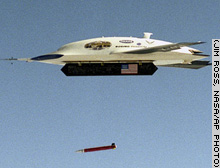
The first bomb was a non-explosive test munition, but it landed inches from its target, demonstrating the lethal capacity of this new robot. Displaying a frightening lack of regard for the future of a free humanity, Boeing Chief Operator Rob Horton said, "It's absolutely a huge step forward for us. It shows the capability of an unmanned airplane to carry weapons."
The test mission was conducted under human supervision, but the robot handled all the details. The X-45 is almost completely autonomous, flying and attacking without need for human control. A person is still in the command and control loop - the robot must receive authorization before delivering its munitions. Of course, it is only a simple step to remove that person.
Horton, who was sitting 80 miles from the target, authorized the drone to drop the bomb, which was released from 35,000 feet as the plane flew at 442 mph.
The military sees such aircraft taking part in its most dangerous missions, such as bombing enemy radar and surface-to-air missile batteries, in order to clear the path for human pilots.
The Y-shaped, tailless plane has a 34-foot wingspan and weighs 8,000 pounds empty. It is the first drone designed specifically to carry weapons into combat.
Other robotic planes, including the Predator spy drone currently being used in Afghanistan, have been modified to carry weapons. Boeing hopes to build hundreds of the X-45 planes, which would cost $10 million to $15 million each.
Of course they would.
on
| § 2
You can go here for the full details. The only winner that I read (saw) was the winner for best screenplay - which went to the Lord of the Rings: The Two Towers. As further evidence of how completely out of touch I am, I barely recognized any of the nominees or winners. I need to stop reading antedeluvian sf like Norstrilia, and read some new stuff.
Coraline, the winner for best novella, is the only Gaiman book I haven't read. I suppose that will be next on my list.
on
| § 0
The Buckethead clan is heading west, to attend a wedding. So, no more muddleheaded and aimless bloviating 'til Monday. You'll have to limp along with the pithy and wise commentary of my comrades. Wait, that was suppossed to be the other way around...
on
| § 0
Only ten, you say? Chris Edwards has a list of ten problems he sees with our current tax system. Most of this is fairly obvious, but it is rather disturbing to see it all at once.
I'd add to his list the problem of tax withholding. This is the big con, that allows the government to get away with confiscatory taxation. If you had to pay, as I have, all your taxes at once - you'd never think of it the same way again. When the IRS takes a little bit each paycheck, money that you never see, it's relatively painless. Like the frog/boiling water concept. You think, "wow! I'm getting money back!" if you have a refund. Of course, you're not. But if hundreds of millions of people had to write a check equal to a third to a half of their yearly income on this day, you'd have a tax revolt immediately after.
on
| § 3
What if you could decide how your tax dollars could be allocated? How would you divy up the government's share of your income? More money for butter, or guns? Food stamps for whales, or send the Marines to Mars? James at Outside the Beltway links to an article by Charles Murray posing that very question.
I've thought about this before, and even posted this on the subject, though I'm too lazy to find the link. I think that a system like this would be hideously complex to implement. It would wreak havoc on the smooth functioning of the government, since budgets could be subject to wild swings tax dollars follow the fickle whims of the taxpayers. It might even be unconstitutional, since the Legislature is given the power to disburse funds from the treasury.
However, it would also be really cool. It would be a stupendous demonstration of faith in the common people. Lobbying would take on whole new forms, and arguable far less corrupt ones. Special interest groups would actually have to convince real, individual people that their particular hobby horses are the ones that deserve money. Groups of citizens could organize to direct funding to favored projects. Public involvement in politics would (alright, might) soar as people follow the projects they sent their money to. Think of the pride you would feel when you see a mars probe that you funded lands and starts poking the Martians in the belly. Or when a bomb that you funded blows up an enemy compound. And so on.
You'd have to allow some flexibility though - something on the order of a discretionary fund that would allow the government to maintain funding of secret projects, and of projects that got zeroed out by the populace but are deemed important enough to be maintained. Citizens could also be given the option of putting their money in this fund, or assigning one of several default distributions.
But I think that Charles and James are right that a large percentage of the funds would be pointed in the direction of tangible government services. And I really can't think of a downside to that.
on
| § 0
Lileks speculates on why we won't be seeing a 9/11 movie:
And thats the problem. I wonder whether Hollywood execs shy from a 9/11 movie because they think it might send the wrong message.
It would anger people anew, and were supposed to be past that. It would remind us what was done to us instead of rubbing out noses in what we do to others I mean, unless you have a character in the second tower watching the plane approaching and saying My God, this is payback for supporting Israel! its going to come across as simplistic nonsense that denies the reality in the West Bank, okay? It would have to tread lightly when it came to the President, because even though we all knew that he wet his pants and ran to hide, wed have to pretend and do scenes in Air Force One where hes taking charge instead of crying help mommy to Dick Cheney, right? I mean the idiots in flyover people believe that stuff, and youd have to give it to them or they write letters with envelopes that have these little pre-printed return address stickers with flags up in the corner. Seriously. Little flag stickers. Anyway, we would have to show Arab males as the bad guys, and thats not worth the grief; you want to answer the phone when CAIR sees the dailies of the guys slitting the stewardess throats? And heres the big one: if we make a patriotic movie during Bushs term, well, it doesnt help the cause, you know. People liked Bush after 9/11. Why remind them of that? Plus, you can just kiss off the European markets, period.
Richard Clarkes book is available? Heres a blank check. Option that sucker.
Its like it's 1943, and Hollywood turns down a Pearl Harbor movie in favor of the gripping account of a Washington bureaucrat who warned FDR that the oil embargo would needlessly anger Japan. The attack on Hawaii would take up five minutes and even then it would be a shot of the hero listening to the radio with an expression of stoic anguish. If only they'd listened.
on
| § 3


