

 Ministry Archive: Buckethead
While reading the news about the recent Mars landers, I ran across this false color map of the Martian surface:
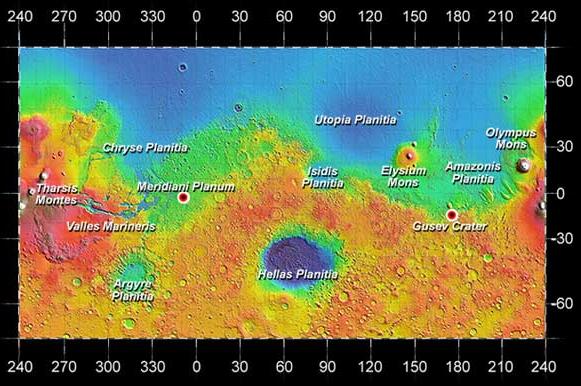
The colors are keyed to altitude, with blue representing the lowest parts of the Martian surface. This is a serendipitous choice, because we can get an idea what Mars might look like should we ever decide to terraform Mars. If we managed that incredible feat, the blue areas on the map above would roughly correspond to seas on a living Mars.
Terraforming is a rather bold concept - some argue that we couldn't begin to create a new ecosystem on Mars when we don't understand the one we have right here. Others argue that it would be wrong on general principles meddle with the environment as it exists now on Mars. Others, more pragmatically, argue that it's just too hard or it will cost too much, or any of the standard objections to doing anything new. I disagree with all of those objections.
The evidence is increasingly strong that there is water ice on Mars, most likely in great quantity - both in the polar ice caps and frozen in the soil. There is also frozen carbon dioxide in the polar caps, which is a useful source of materials we'd need in a terraforming program. Most of what we would need is already present on the Martian surface, but locked away where it does nothing to support conditions suitable for life. Scientists believe that liquid water once existed on Mars, and that the atmosphere was once far thicker. If we can alter the balance on Mars, we can (hopefully) tip it toward a warmer and wetter environment.
Currently, Mars temperatures are within shouting distance of conditions on Earth - just colder. But the atmosphere is very thin, and composed primarily of carbon dioxide; and the planet is very, very dry. We can engineer changes, but the most effective means will be those that start a virtuous circle of changes, and leverage natural processes on Mars to change the climate towards something that we could live in. So, we need to make it warmer, and wetter, and increase the thickness of the atmosphere. How do we go about it? There have been many proposals, and here are some:
If a terraforming project ever does start, it would likely use a combination of some or even all of these methods. The key, at the start is to induce warming. Once we warm Mars, and starting with the polar ice caps, we can begin to get Mars working for us. As the polar ice caps melt, CO2 will sublime directly into the atmosphere, increasing the density. Denser air retains heat better, which will increase the effects of whatever means we are using to melt the caps. Water vapor released into the atmosphere will further push this cycle.
As mean temperatures rise, and pressure increases, we should begin to see the effects of warming all around Mars. Subsurface ice deposits and permafrost (if they exist, but it seems likely) near the equator will begin melting, adding to the effects started at the poles. Here, larger iceteroids might be used to hit concentrations of subsurface ice, and the impact will release water vapor into the air quicker than otherwise would be possible.
At the bottom of the Valles Marinaris, the immense canyon as wide as the continental United States, air pressure will rise fastest. Here we can begin to introduce the first of the microbes that will begin to change the thickening atmosphere from largely CO2 to one more closely resembling Earth's. By introducing bacteria similar to those that once lived on Earth a billion years ago, we can get oxygen into the air. These organisms excrete oxygen as a waste product. As oxygen levels rise, these bacteria will die - because too much oxygen is poisonous to them. They will then form the food for the next wave of colonists. Algae, nitrogen fixing bacteria, lichens, whatever will survive in the thin but increasingly homelike Martian atmosphere.
While the first organisms are being introduced and tested, more mechanical processes will continue. When the Martian air is thick enough and warm enough, and saturated with sufficient oxygen, we can begin introducing life that evolved for conditions at high altitudes, extreme cold and dryness. They will push the ecology further. As the basins fill with water, creating the first seas and oceans, we can stock them with life as well. The seas of Mars will quickly become the primary driving force for thickening the atmosphere, and conditions there suitable for earthly life sooner than the cold desert of the dry land.
One thing that is most promising about the introduction of life to Mars is that beyond a certain point, we don't need to be overly concerned about what we introduce. If we get an atmosphere even a quarter as thick as Earth's, with half the oxygen, we can start introducing Earthly life. Whatever thrives will thrive, and the ecosystem will begin to develop a rude equilibrium. As the air thickens, we introduce a wide variety of other species, and again let nature take its course. The only thing we need to be careful about is making sure we don't introduce mosquitos, horseflies or ticks.
The life that survives will contribute to the process. And the lessons we learn will guide us in the later stages of terraforming. It will be an immense laboratory for the environmental sciences, and those lessons could easily be applied here on earth. Eventually, there will come a day when conditions reach "shirt sleeve" levels - when the air is thick enough and warm enough that men can walk on the surface with nothing more than winter clothing and an oxygen mask. Later, we would reach a point where the air is equivalent to high altitude areas on Earth.
Then, we can build ski resorts with hot tub equipped condos on the slopes of Olympus Mons, the highest mountain in the Solar System.
Smarter people than I have looked at the ideas behind terraforming and believe it could work. Given the resources and the will, it could be done, especially as conditions on Mars are already so close to Earth's. Terraforming say, Venus, would be much more difficult. Thinking about moving comets and building hundreds of mile wide mirrors seems incredibly hard and at the very least hideously expensive. They would be, now. But if we move into space, we will develop the skills to do these things - we'll have to. If we construct solar sailing ships, we'll learn to create large lightweight mirrors. The Martian terraforming mirrors will just be larger versions. If we go to the asteroid belt, we will learn about moving rocks in space. Moving something in space is easier than moving something on Earth, because there is no gravity, no friction to slow it down. Even the largest rocks can be moved by a constant application of even a small amount of thrust. The more we live in space, the more we will learn to do things on a huge scale. Space is big - if Europeans think Americans are bad for thinking big, they will hate our descendants who live and work in space.
Soon enough, we will have the skills do do it. And the cost may not be all that much to a civilization that lives on the scale of a solar system. The biggest objection that the project will have will come from the environmentalists, who will insist that Mars be left as it is. If life is discovered on Mars, terraforming would certainly kill it. That would be a reason not to proceed. But if Mars is a dead planet, I see no reason why we shouldn't expand not just human life, but all earthly life to another home. For insurance against accidents like the dinosaur killer if for no other reason.
Instead of a dead, dry and cold world, we could have another Earth. Beautiful as Earth is, but different, with new wonders for us to experience. Dolphins and whales could swim in Martian seas; and who knows, perhaps we can make good on the Jurassic Park idea and bring back the dinosaurs, and give them a new home on Mars. Along with Mammoths, Mastodons and sabertooth tigers.
And hey, if that ends up looking a little like Edgar Rice Burrough's Barsoom, so much the better.
 on
| § 3
on
| § 3

The Mars Rover Opportunity made a perfect landing Saturday night, and is already sending back pictures:
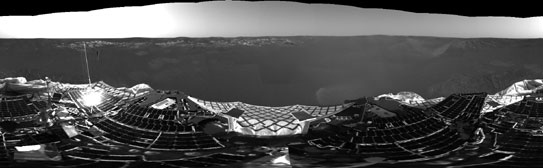

That makes five operational probes circum Mars - two American landers, two American Orbiters, and the European Orbiter. As a bonus, the European Orbiter has found some direct evidence of water on Mars. Now all we have to do is go there in person and set up ski resorts with hot tub equipped condos. Just think of the fun you could have skying in one third gravity!
[wik] It seems that Spirit has been upgraded from 'Critical' to 'Serious but Stable' condition. Good news there. Link via On the Third Hand.
on
| § 4
The Heritage Foundation recently released a study on Poverty in America. This study provides some welcome perspective on the issue of poverty. The study contains some interesting statistics and what not, and is well worth reading.
The underlying issue is the confusion between absolute poverty and relative poverty. Absolute poverty is what most of us think of when the word poverty is mentioned. People going hungry because they don't have enough money for food. Homelessness, evictions, ramshackle housing, or overcrowded tenements. The sort of thing that involves real suffering. Relative poverty is making less than other people, but nevertheless having sufficient money for housing, utilities, food, and other needs.
The government defines poverty in relative terms - most of the bottom quintile of income is by definition poor. But as the Heritage study indicates, most of these people are not poor in the traditional sense of the word. They have homes, cars, air conditioning, plenty of food and health care. They have tvs, vcrs, cable and other luxuries. The average poor person in America lives better than the average citizen almost anywhere else in the world. We need, really, to distinguish between the two.
Jesus said the poor we shall always have with us - and as long as we define "poor" as the bottom fifth of incomes, we always will.
Some people will always make less than others. Where we need to make the effort to ameliorate poverty is with the less than one third (possibly much less) of the government defined poor who actually suffer from a significant amount of absolute poverty.
I saw this report on the news Saturday evening, and was struck by the comments of the man (I didn't catch his name or what group he was with) who was interviewed to counterpoint the Heritage position. He expressed considerable disdain for the authors of the study, and suggested that they should walk the streets of the poor parts of our cities and see whether or not real poverty existed in this country. (Obviously, if they did so, they would see the light and immediately endorse any number of Democratic entitlement programs.) But that was not the conclusion of the study - not that there are no poor people in this country, but that the numbers are far smaller than some would claim if we are careful and honest in our definition of the word "poor."
A good while back, my compatriot Ross posed the question of why do we become conservative or liberal? Every now and again, I pull that question out of its cage and smack it around a bit. That study makes sense to me. Based on my own experience and on my expectations of both how the world works and how I think it should work. I was poor twice in my life. Once because I was the child of a single mother when I was young, and again in my twenties because I was young, unskilled, and far more interested in beer than regular, gainful employment.
We are a rich soceity; we can and should help the poor. But should I have been helped on either of the two occasions when I was poor? No, because I don't think we deserved the help. My mother and I made it, though things were often tight. She worked two jobs, and sometimes we rolled pennies at the end of the month. But Mom managed to save enough to buy a house by the time I was eight - five years after my parents separated. (Dad helped with the child support, too.)
What about the second time? Hell no. Once I laid off the intoxicants and the gave up my aversion to work, things swiftly turned around. My parents actually delayed this by helping me far too often out of corners I painted myself into.
With sound personal fiscal policy and a realistic appraisal of how much standard of living you can afford almost anyone with any income at all can meet all basic requirements for life, and live comfortably if not exactly in the catbird seat. Barring major upheavals, this can be maintained indefinitely. Those people do not need the government's assistance. They should fend for themselves because that is what freedom and personal responsibility call for.
I think people have a responsibility to look after themselves. Freedom also means the freedom to screw up your life, make poor life choices, and have a low income. The relative poor get my sympathy, but not my endorsement for dipping into the public purse. The absolute poor are a different story. If things have really gone balls up, charity demands that we help. If that charity is through the government, so be it. It is misguided to attempt to help those who no one in the history of the planet up until the last half century would have called anything but rich. A waste of money and effort that could be used to help the actual poor, or accomplish other worthy goals.
on
| § 6
By way of Atlantic Blog, we hear that Jeff Jacoby of the Boston Globe has five questions for the candidates. Of the still live candidates, only Kerry did not respond.
Here are the questions:
I think the Atlantic Blogger got it right in one with his summary:
Lieberman comes across (I think tolerably accurately) as thoughtful, the only candidate not to answer the religion question by sounding as if he is picking bits from the How to Talk to the Different Constituency Groups book, and the only candidate with any sort of clue about the dangers of terrorism. Wesley Clark manages to convey, quite accurately, just how much of a windbag he is. Sharpton manages to do a decent job of hiding from the ignorant the simple fact that he is the most thoroughly evil man in American politics, including Ted Kennedy. But my favorite part is reading the ramblings of Kucinich. It must be pure agony for the satirists to read this stuff, trying to figure out how to satirize the guy.
on
| § 6
My lovely wife, while preparing for our looming superbowl party in her monomaniacal yet adorable way, found this strange phenomenon:
The particular post linked above is all about using superbowl parties to hook people into shave their heads and wear the Dean saffron robes. Personally, I'm not a huge sports fan but if I went to watch the big game and was confronted with this, I'd be peeved. Belinda pointed out that the M.O. behind this concept is similar to that used by fundamentalists to witness to normal people. First you lure them in, then... bam! Hit 'em with God's truth.
on
| § 0
The National Taxpayer's Union has released a study of the the Democratic candidates' fiscal policy statements which reveals that all of the candidates would significantly increase deficits, even counting the offset produced by repealing President Bush's tax cuts.
The NTUF study systematically examined the fiscal policy implications of the eight contenders' agendas, using campaign and third-party sources (like the Congressional Budget Office) to assign a cost to each budget proposal offered by the candidates. For actual legislation that the candidates have endorsed, the study also relies on NTUF's BillTally project, a computerized accounting system that has, since 1991, tabulated the cost or savings of every piece of legislation introduced in Congress with a net annual impact of $1 million or more. Highlights of the study include:
- If the policy agenda of any one of the eight candidates were enacted in full, annual federal spending would rise by at least $169.6 billion (Lieberman) and as much as $1.33 trillion (Sharpton). This would translate to a yearly budget hike of between 7.6% and 59.5%.
- All candidates offer platforms that call for more spending than would be offset by repealing the Bush tax cuts (using even generous estimates of the tax cuts' impact).
- The eight candidates have proposed over 200 ideas to increase federal spending, and only two that would cut federal spending. Those two proposals have been offered by Dennis Kucinich (thus, the seven other candidates haven't made a single proposal to cut any spending).
...George W. Bush, who campaigned as a fiscal conservative in 2000, has presided over a jump in federal spending of 23.7% since taking office. Yet, Johnson still found that even the most parsimonious of the Democrat Presidential candidates would have outpaced the spending run-up under Bush by 15%.
I've always found it amusing when Democrats criticize Bush for spending profligacy - not because they're wrong, but because of the deep pot-kettle-blackism of the exercize.
on
| § 2
Michelle of A Small Victory came up with this nifty guide to the Democratic candidates:
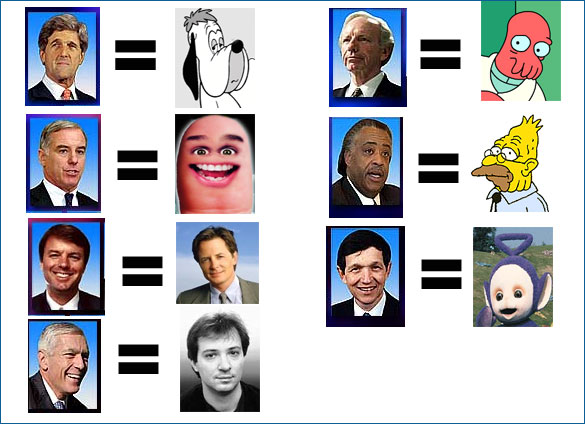
I don't know that I agree with all her choices - I would have hooked Clark to Niedermeyer and Sharpton to, oh, I don't know, maybe David Duke. Kucinich is spot on though.
on
| § 4
According to the World Tribune US intelligence estimates that over 70% of Al Qaida has been neutralized.
"The Al Qaida of the 9/11 period is under catastrophic stress," State Department counter-terrorism coordinator Cofer Black said. "They are being hunted down, their days are numbered."
Black's assertion, made in an interview with the London-based British Broadcasting Corp. on Thursday, is based on U.S. intelligence community estimates that about 70 percent of Al Qaida has been neutralized, officials said.
Saudi officials agreed with the U.S. assessment and said the kingdom has made significant gains against Al Qaida, Middle East Newsline reported. They said Al Qaida leaders have been arrested and training camps have been discovered.
U.S. officials said Al Qaida has been rapidly losing its attack capabilities and was relying increasingly on smaller Islamic groups based in Southeast Asia and North Africa. The officials said thousands of Al Qaida operatives have been captured, killed or neutralized, with cells eliminated even in such strongholds as Kuwait and Yemen.
With the capture of Saddam, many resources have eben transferred back to the hunt for Osama bin Laden. Rumors of his capture were floating around yesterday, including over at the Northeast Intelligence Network. As the situation in Iraq settles down somewhat over the coming months, more resources will be shifted to the hunt for Al Qaida, and I think that we'll see more victories on that front.
Officials said Al Qaida would continue as a much weaker organization and would focus largely on Saudi Arabia, the Horn of Africa while seeking to consolidate under the protection of Iran. They envision attacks being financed rather than carried out by Bin Laden.
The loss of veteran insurgency operatives has reduced the lethality of operations, officials said. Another factor has been the lack of success by Al Qaida to establish and sustain cells in many Western countries.
"The next group of concern would be a generation younger," Black said. "They're influenced by what they see on TV; they are influenced by misrepresentation of the facts. They seem to be long on radicalism and comparatively short on training."
This is substantial progress, but we need to focus on other terrorist groups, and find more ways to put pressure on state sponsors of terror. My earlier post on hezbollah speaks to both of these concerns.
on
| § 0
Reuters is reporting that a recent Reuters/MSNBC/Zogby poll shows that Kerry has a nine point lead over Dean, but that the race is narrowing.
Kerry led Dean 31 percent to 22 percent in the latest three-day tracking poll, but the last day of polling showed Kerry with a much smaller margin over Dean while John Edwards and Joseph Lieberman both gained ground on the leaders.
"Kerry's lead is now nine points over three days, however he led only by 26 percent-22 percent over Dean in Friday polling alone, while Edwards and Lieberman each hit 10 percent," pollster John Zogby said.
"Dean's showing on Friday may suggest that he has bottomed out and may in fact be starting to increase," Zogby said. "Another day like this and Dean may be in striking distance again."
Retired Gen. Wesley Clark, in third place, held steady at 14 percent.
It looks like the damage from the "I have a scream" speech was serious indeed, but hasn't effected Dean's hard core supporters. If Lieberman and Edwards continue to make inroads into Kerry's numbers it could be a wide open five-way race with Kerry only first among equals. It will be very interesting to see how the polls play out in the days leading up to the election.
I find it heartening that the Democratic party seems to be rejecting the dark side and giving more support to the moderates. A real presidential race will benefit the conservatives by forcing the Republicans into an open debate on the issues, and to clarify their positions in opposition to those of a strong Democratic candidate. Fighting against Dean would ahve allowed the GOP to pursue the middle much easier.
on
| § 4

Maybe I like him after all.
From Bike Crazy via my personal deity, Allahpundit.
[wik] I shouldn't kick him when he's down; but if you're not gonna kick a man when he's down, you shouldn't kick him at all.
[alsø wik] I found, over at Mother, May I sleep With Treacher?, another good Dean parody mp3. This one is Deliverencesque.
on
| § 3
James over at Outside the Beltway (which name doesn't exactly narrow his location down much, does it?) links to a report from UPI and Janes that the United States is seriously considering striking Hezbollah bases in southern Lebanon. Jane's Intelligence Digest released a report saying the administration is considering strikes in Lebanon's Bekaa Valley, where the bulk of Syria's forces are deployed, as way to pressure Damascus.
"Our sources are pretty damn good," Standish [editor of Jane's Intelligence Digest] told United Press International. "We've never had a libel action since we were founded in 1938. ... If you look at the track record of people who have given us this sort of information ... these are tried and tested sources that we have confidence in."
Standish dismissed the possibility that the information could have been planted by an American who wanted to derail any such attack.
"I think this is a U.S. administration that does what it says it will do," said Standish, stressing that this is a plan under consideration, not a decided course of action. "Clearly, this is about ratcheting up the pressure on Damascus. ... I think this is also part of the wider Realpolitik, which is to start the process of isolating Hezbollah much further. ...
"What we're looking at in this context are air strikes and the use of special forces snatch squads -- that kind of activity. We're not talking about a peacekeeping deployment or an invasion of southern Lebanon."
Standish said if this were another administration, there would be more room for skepticism. But the Bush administration is willing to go in a new direction after Sept. 11, 2001.
The prospect of an attack in Lebanon is not so crazy when you consider the incursions that US forces have made across the Syrian border in the past several months. The motivation behind any potential attacks, suggests Standish, is this:
"I think one can understand the reasons why people in Washington would like to apply this kind of pressure, because if Syria can be forced to cease backing Hezbollah -- which obviously has its own connections with Hamas and Islamic Jihad -- this is an issue. If you can cut the funding off for international militant organizations, that's a pretty big first step in reducing the effectiveness that they have in terms of the trouble they can cause."How would air raids and special forces operations cut the funding?
"The funding comes from Damascus and Tehran. If the administration shows that it actually has the will to strike directly at Hezbollah targets, it sends a very powerful message: 'Look what we've done with your proxies. The next step along the line will be you.'
Standish was asked why U.S. air strikes would have a different effect than Israeli air strikes.
The psychology would be different, he replied.
"Hezbollah expects to be hit from time to time by Israel. ... But if the U.S. itself chooses to engage, I think that is an enormous step forward because it's a difference fundamentally between Israel saying that it's acting in self-defense or in a measured response to a particular incident and the U.S. saying, as a matter of policy, that just as it made war against al-Qaida and closed its bases and denied it the freedom to operate in Afghanistan," it is taking the same steps against Hezbollah. ... "A key issue is to deny the enemy the ability to train, to maintain bases, and of course ultimately -- on the political level -- to attract funding from Tehran and Syria."
The United States, as the last superpower, can send such a message, Standish said.
"Already I think it's having an effect in the Iranian situation," he added, "if you look at the concessions in real terms that have been made on the nuclear front and the willingness to conduct covert diplomacy. It's been a pretty open secret that there have been middle-ranking talks (between the United States and Iran) over the last few years in Switzerland and other European locations. So I don't think we should be surprised if Tehran decides that to continue to put funding into Hezbollah is counterproductive for its own safety."
"I think this sends a message, and I think the message is uncompromising: 'There is still time for diplomatic maneuver, but patience may be limited.' "
I would not be opposed to these sorts of actions. The more direct pressure we can put on terrorist groups, and psychological pressure on their state sponsors, the better.
on
| § 0
Via The Spoons Experience, we learn that a high school in Omaha has punished several students for making an unofficial nomination for the school's annual "Distinguished African American Student Award." According to the Omaha World Herald;
The students' actions on Martin Luther King Jr. Day upset several students and have led administrators to discipline four students.
The posters, placed on about 150 doors and lockers, included a picture of the junior student smiling and giving a thumbs up. The posters encouraged votes for him.
The posters were removed by administrators because they were "inappropriate and insensitive," Westside spokeswoman Peggy Rupprecht said Tuesday.
The student in question was a white South African whose family had moved to the states six years ago. Trevor Richards, the student who was featured on the posters, was suspended for hanging them along with two others. The fourth student was punished for circulating a petition in support of the first three.
Volokh has weighed in on the first amendment aspects of the case, and I would never presume to tread on his feet on legal matters. What amazes me is that some high school kids could come up with such a brilliant, nuanced and effing hilarious strike against the blinkered, arbitrary and offensive hyphenated-American worldview that contaminates our schools and society.
When I was a kid in high school, back before walkmans, cell phones, computers with hard drives and - frankly - anything cool at all; we had a situation that was structurally similar to this one. The art department sponsored a contest open to the entire student body to design a new piece of artwork for the grassy area outside the senior commons. Submissions were to be small models, and the winning entry would be created in full by the hardworking craftsman of the shop classes.
The winning entry was submitted by a girl named Erin, and it was as banal an example of derivative modern art as you'd ever run across. It was a spiky metal thingy, vaguely star-shaped but decidedly lopsided and ugly. The shop classes dutifully made the final version out of scrap steel, and the custodial staff installed it on a concrete pedestal so that everyone could admire it on their way to lunch. This piece of faux art elicited a fair amount of criticism, both for its complete lack of aesthetic value and also because of the general regard the student body had for its creator. (Erin was given a brand new Porsche for her sixteenth birthday. Persistent rumor insists that she demanded daddy give her a new one with an automatic transmission because she couldn't be bothered to learn to drive stick. Whether this story is true or not is irrelevant, as it does accurately reflect her character.)
One dark and moonless night, a group of students stealthily crept up to the monstrosity, and bolted a toilet bowl to it. They also used locktight on the bolts. The poor, benighted custodian spent most of the next morning attempting to remove the toilet. The school administrators were furious at this lese majeste, and bent every effort to determining the identity of the renegades.
The next night, either the same group or possibly a different crew altogether attached a second toilet bowl and managed to move the sculpture to the roof of the high school. The administration redoubled its efforts to find the miscreants, but with no success.
But the funny thing is that the principle didn't really lose it until copies of an unsigned manuscript managed to be inserted into the newest edition of the school paper. This essay defended the actions of the vandals as a valid form of art criticism. I wish I still had a copy of the little manifesto, as it was rather well written. The principle was reduced to threats dire punishment and offered rewards to anyone who would narc on the guilty students. But, no one was ever caught or punished for the incidents, and eventually the artwork found repose in an unmarked grave somewhere on the north side of town. The whole episode was marked by a higher than average comic sensibility - for high school students. Instead of crude graffiti, outright destruction or other stereotypical high school hijinks - they actually made a comment on the hated artwork. A rude one, but clever.
But no one in my high school, ever thought about larger issues as these kids in Omaha did. Or pierced them so ably. My hat's off to them.
on
| § 2
Not to tread on the toes of our eminent musicologist Johno, but I think in his recent opus on the enduring value of the remix, he failed to note a significant argument for his position:
Lileks' YAAAAAARRRRHHHH!!! Remix
I bust a nut listening to this. If I needed proof beyond the fact that we blatantly ripped off the name of our blog from a bleat column that the man is a genius, this would be it. Heh. This also reinforces Johno's position on the imminent demise of the Dean insurgency. Indeed.
Many thanks to Greg over at BTD for bringing this to my attention. And shame on NPR for not giving the cite.
[wik] Here are some Chewbacca roars so you can compare and contrast.
[alsø wik] I especially like the harmonica bit.
[alsø alsø wik] I am especially glad that our very own Johno came up with this "wik" thingy, because I would have been too mortified to steal it from another blog.
[wi nøt trei a høliday in Sweden this yër?] Apparently, Former Senator Alan Simpson said of Dean, "He looked like a prairie dog on speed."
[see the løveli lakes...] And people were worried about McCain being unhinged...
on
| § 2
Sometime ago, my comrade in arms bought a tshirt for my son John Christian. Now, at long last, you can see the boy and his shirt in all their glory.

Note the gangsta style hand positions, and the look of glee as he prepares for battle. And only eight and a half months old - just think what he'll be like when he's two.
Little John will have much to thank Uncle Minister Johno for by the time he grows up. These pictures probably won't be any of them. More great pictures below the fold, including one that I will be sure to show to his every future girlfriend.
Sir John the-I'm-to-drunk-to-realize-what-I've-got-myself-into:

I've got a cunning plan. A plan so cunning, you could brush your teeth with it:

on
| § 1
Dick Morris has a typically interesting take on the Iowa Caucus.
Buckethead says check it out. I actually met Dick Morris, and he's a smart guy.
on
| § 0
The first four parts of this series are here, here and here and here.
In the first post, I discussed how we could quickly and relatively cheaply develop the means to launch people and large cargos into orbit. That is the necessary precursor to any significant endeavor in space. While the methods I outlined would reduce costs to orbit, they would not make them exactly cheap. But they would give us a ladder while others could work on building an escalator. The second post discusses, in broad outline, one idea for developing the life support technology that the Mars mission would require. The third post talks about propulsion options and precursor missions to Near Earth Asteroids. The fourth part discusses how to reach the moon, and what to do once we get there.
What Does it All Mean?
What I have proposed over the last four posts is a comprehensive outline for the beginnings of a human exploration of space. If we choose to go to Mars, we need to be certain that in the process we create the means to repeat the feat at any time we choose. That was the great mistake of the Apollo program we achieved our goal, but to do it again would require another great expenditure of treasure and effort. The four programs I outlined would prepare us not only for a mission to the Red Planet, but for a hundred other missions that we can imagine easily; and many more that we cannot now envision. Once we are in space, new doors will open, and we will perceive opportunities that are hidden from our planet bound eyes.
The four programs are interlocking, and each will develop important capabilities that will be essential for a Mars mission. One of the greatest advantages of a scheme such as the one I have outlined is that setbacks in one area (save the first) will not hinder the progress in the others. The end result will be that lessons learned in all of these can be incorporated into the final Mars mission design, and that mission will be more robust, and safer, than anything we could plan or execute from the ground.
We can leverage our existing launch technology to get more people and material into space far cheaper than we can now. The designs that I propose are not complicated, and there is little reason that they could not be brought into being within the next couple years. Any aerospace company could design the OSP, so long as NASA stayed out of the development process. We should create a not overly detailed specification crew capacity, safety margins, and rockets it must be capable of being launched on. Then, several companies will submit bids and prototypes. Then, we select one. The military has always been able to get this kind of thing done in several years, and once upon a time, NASA did it in months. Given a high enough priority, we could have these things flying by the end of 2005. The Shuttle-C is even easier, given that nearly every single bit of design work has already been done. We could have a heavy lift launch vehicle by the end of this year if we really wanted to.
Once we have these two vehicles in place, then the ball starts rolling. We develop our life systems technology in earth orbit while sending the first pieces of the lunar outpost to the moon. Astronauts begin exploring the moon and developing the skills we will use on Mars while prototype nuclear rockets are tested in space. Later, an NEA mission spacecraft is assembled at the ISS, possibly fueled with lunar ice, and incorporating life support systems developed in the orbital laboratory. While that mission is underway Mars rovers and landers and all the equipment the explorers will use is undergoing brutal testing on the airless moon; and new experiments in propulsion, life systems and all other useful things are underway. When the NEA mission returns, we gather all that knowledge together, and plan the Mars mission.
What form will the Mars mission take? I dont know. But there are several things we can predict. If for more than a decade we have been expanding our ability to live and work in space; we will be able to build a bigger spacecraft than most have imagined to this point. An experienced crew at the ISS will enable us to assemble in orbit a more capable spaceship than could be launched in one piece from the ground. This allows us to make the ship safer, through redundant systems; and the mission more fruitful, because we can take more equipment to Mars with us. Whether we use a variation of Zubrins Mars direct plan, or opt for a nuclear rocket, doesnt really matter. Either way, we can take advantage of direct experience in exploring space both on the NEA mission and on the moon.
So what's the timeline? I would suggest the following:
A key component to keeping this schedule without breaking the Treasury would be lowering the per pound cost to orbit. But I think, truly, that we can invent the vehicles that will do that. If we can invent a spaceship that costs no more than twice what a Boeing 747 costs, and that costs little more to operate and turn around between flights, sending a pound to orbit will cost perhaps three times what it costs to air-freight that pound to Australia. On that cost level, we can move into space in a big way.
Well so what?
This plan assumes that the government would be the prime motivating force behind the Mars mission and all the precursor programs I have outlined. This is merely one sensible way we could go about it at least in terms of getting to Mars. Getting to Mars is an inspirational idea, and we would learn and see incredible things if we did it. Enough to justify the expense? Perhaps. However, this plan has many advantages in relation to the civilian space industry.
In the 1830s, it would have made little sense to build an intercontinental railroad in the United States. There was no need, because the United States itself did not span the continent, and there was little worth going to on the left coast at that time. Decades later, of course, there was gold, and growing settlements, and a hundred other reasons that people wanted to go to California. The Federal government for its own reasons assisted private industry in creating the means for people to travel west to California, but in the process created the means to travel to everywhere in between for their own reason.
In the early part of the twentieth century, the federal government assisted the nascent aviation industry. First, by offering contracts for air mail delivery which helped early airlines and airplane manufacturers both. Second, by conducting basic research into aerodynamics which was shared with the aviation industry. This allowed aviation companies to convince financiers to invest in their projects with some confidence, because government scientists said it was possible.
These two models should guide us in our thinking about how to approach space development in the 21st century. NASAs adversarial stance toward private space industry needs to end now. If anyone doubts this remember the fuss that NASA raised over the flight into orbit of Dennis Tito. Tito was rich, to be sure, but used to work for NASA and was not exactly the least qualified space tourist you could have found. Government can have a role but it should be to assist private industry rather than hinder it. Like the railroads, the government can sponsor the creation of the means for anyone to get into space. Offering contracts for vehicles and services, we will unleash the creativity of the marketplace to produce solutions. And the government funding will get the nascent space industry over the hump to the point where they are as viable in the marketplace as Lockheed or Boeing.
I proposed the two vehicles from the first post simply because they would be the easiest and quickest way to get us into space. But frankly, they are stopgaps. They would get men and material into space until private industry can supply us with a more cost effective alternative. The companies competing for the X-Prize may even without government help soon provide us with a better way to orbit. But there is little doubt that if the government offered a guaranteed contract for purchase to the first space capable, fully reusable vehicle, this would happen a lot sooner.
In a future where the government pursues deep space exploration but leaves the grunt work of travel to orbit to private industry, there are many possiblilities. We could see the production of true aerospace planes that can take off and land from airports and deliver small cargoes to orbit or to destinations on earth. Cone shaped SSTOs like the Delta Clipper might take off regularly from spaceports on the Florida coast, and gigantic cargo lifters might launch from floating platforms in the Gulf of Mexico. If the government defines only the goal, any number of technologies might be produced to meet it. Specialization will increase efficiency as well.
And once these thousand flowers have bloomed, there is no reason that they cannot be used for purposes other than government funded deep space exploration. If access to space becomes if not cheap, at least affordable then people will find ways to use it. Hotels in space, research labs sponsored by universities and corporations, and privately owned shipyards for Mars missions all become possible. And we should not forget that throughout the history of the space age, most commercial space activity has focused on Earth. Communications satellites, GPS, weather satellites, and the like all serve the needs of people on Earth. What other services could be provided if we could lift bigger and more capable satellites into orbit? And any vehicle that can reach orbit can just as easily reach the other side of the Earth in 45 minutes. I am confident that FedEx or United Airlines could think of ways to profitably use that capability. Space technology is not confined to utility only in space everything that we develop will allow us to do things here on Earth as well.
And once we begin to move into space, there are other possibilities as well. Instead of chemical or nuclear rockets, entrepreneurs could explore the use of solar sails and ion drives. These do not have the brute power of the rockets we know, but accelerate continuously and slowly. Over time, they can exceed the greatest speeds possible by conventional rockets. And solar sails have the added and great advantage of requiring no fuel whatsoever just the skill to spin an aluminized Mylar film a couple square kilometers in area.
And when we think of space habitats, we think of aluminum canisters hauled to orbit at great expense. But there is no gravity in space, and no need for immensely strong structures. Some clever fellow could invent an inflatable habitat, taking next to no space in a launch vehicle, but expanding to tens of yards in diameter. Modern materials like Kevlar would provide protection from micro-meteors even better than aluminum does. String several of these together, and you have an instant space habitat; instant real estate in fact that could be rented or sold for profit. If we make it possible to get there, people will create places to go and reasons to stay that is in our nature. In time, people will travel to the moon, the asteroids, and Mars on commercial spaceliners, and build lives there. Travel in space, in zero gravity is much easier than getting into orbit. In terms of energy expended, once youre in orbit, youre halfway to anywhere in the solar system. Once we build a road over that barrier, ordinary people (like me!) could travel into space, and pursue whatever dreams they have.
If we build the transcontinental railroad, all the things that come after it will happen naturally, and in ways we could never plan in advance. All the connecting spur lines, whistle-stop towns, mining communities, industry and agriculture, settlement and so on will develop on their own. People will become rich and poor, but the world will be a more interesting place. (Hopefully, we wont run into hostile Indians, though.)
on
| § 5
The first three parts of this series are here, here and here.
In the first post, I discussed how we could quickly and relatively cheaply develop the means to launch people and large cargos into orbit. That is the necessary precursor to any significant endeavor in space. While the methods I outlined would reduce costs to orbit, they would not make them exactly cheap. But they would give us a ladder while others could work on building an escalator. The second post discusses, in broad outline, one idea for developing the life support technology that the Mars mission would require. The third post talks about propulsion options and precursor missions to Near Earth Asteroids.
Getting to the Moon
President Bush mentioned a return to the moon as a primary goal. This is one of the few things he got right. A permanent presence on the moon will allow us to conduct research and development that will directly aid a future Mars expedition. The utility of a lunar research outpost falls into two general categories:
Before we discuss how a lunar base will be useful to us, lets discuss how we might get there. In the first post, I mentioned the development of a variant of the Orbital Space Plane that could be used as an Earth/Moon shuttle. Unlike a standard OSP, this model would be wingless saving mass by eliminating wings that will never be needed. It will be a small pressurized cabin, with life support for several crew for perhaps a week. By adding a service module along the lines of that used by the old Apollo capsules, we can extend the life support duration by a couple weeks, and also add a rocket motor that will give our shuttle the ability to leave Earth orbit and travel to Lunar orbit.
Back with Apollo, we had to launch everything needed for the mission all in go. Since there is no need for the massive thrust necessary to leave the earths surface, a much smaller rocket will allow us to move crew and cargo back and forth between Earth and Lunar orbit. Since we now have an orbiting space station, we no longer have to worry about getting everything we need into orbit all at once. Empty Shuttle-C fuel tanks can be used as refueling depots to top off the tanks of the inter-orbit shuttles. Cargo and crew will reach orbit on OSPs and conventional disposable rockets. All of these will be assembled together at the ISS, and depart for Lunar orbit.
Once we reach Lunar orbit, we have the problem of getting to the surface. To establish a Lunar base we need to get habitat modules, crew and supplies down to the moon. In keeping with the idea that specialized vehicles are better than general purpose ones (as long as you have the lift capacity that frees you from the necessity of doing everything in one launch) we can develop one or two more vehicles. But to save on design effort, we should make them modular, so that we can get the most use out of our design dollar. Weve already adapted the OSP for a crew and small cargo shuttle. The immense cargo payload of the Shuttle-C will allow us to lift something bigger into orbit something more on the lines of a truck rather than a taxi. This vehicle would have a rocket and fuel tanks at the back, an open framework for cargo in the middle, and a crew module at the front. The rocket would be powerful enough to land the vehicle on the lunar surface, and be equipped with landing gear and a crane.
The cargo shuttle could carry a standardized habitat module and land it wherever we intend on setting up a base. Once on the moon, the crane would lower the hab to the ground where it could be linked to other modules, forming a small outpost. Once free of the habitat module, the now empty shuttle would begin service as a shuttle between the lunar surface and lunar orbit. Subsequent moon bound cargos could even be automated launched from Earth on a Shuttle-C, and boosted toward the moon by a smaller rocket. Once in Lunar orbit, the cargo shuttle could dock, load up the cargo and return to the lunar base. Crew transfers would also be done in lunar orbit. (In time, it might be worth the expense to deploy a small lunar orbiting space station something much smaller than the ISS basically a habitat module, a docking port and a solar array. This would simplify the process of cargo and crew transshipment, and give a refuge for emergencies in Lunar Orbit.)
For the first few years, there might be only one or two cargo shuttles, both likely in use on and around the moon. (The cargo shuttles would also be the best means for long range transportation on the moon.) Three or four of the OSP-derived interorbit crew shuttles would meet the needs of transporting crew between different locations in Earth orbit; and to lunar orbit. But as time goes by, we could slowly add more of each of these vehicles, steadily increasing our space transportation infrastructure as our presence in space expands. At no point is there a need for large, single expenditures. There is no reason why a simple OSP either the space variant or the regular earth landing style should cost more than a single jet fighter; and the cargo shuttle should not be that much more.
As we build this infrastructure, we can create a lunar base and keep it staffed and supplied. The lunar base at the start would be one or two habitat modules approximately the size and shape of the ones making up the ISS, and similar in construction. Once on the moon, a lunar bulldozer would cover them with soil to protect the inhabitants from solar radiation. As needs require, more habitat modules can be launched and integrated into the base. From this small but safe outpost, the astronauts could begin the research that will allow us to successfully explore Mars.
What to do on the Moon
What research will they be doing? As I mentioned above, there are two main avenues: exploration technology and skills, and materials and fuel. First, exploration. Research has already been started on the construction of Mars rovers and prototype vehicles will be tested in desolate areas like Canada, the Antarctic and Detroit. But there can be no better place to test than the moon, which has the dual advantages of being in some respects a harsher environment than Mars and yet is close enough to allow for the rescue of our astronauts in case of accident. As we develop rovers, models for Mars habitats, new space suits, Mars rated exploration gear and so on, we will ship them to the moon. There, astronauts will use these vehicles to explore the vicinity of the lunar base and gain practical skills in exploring a hostile environment. These skills will be necessary when we get to Mars.
As far as materials go, many have proposed that we could mine for minerals on the moon, and use those materials in the construction of our Mars bound spaceship. The advantage of using lunar materials for deep space activities is that they only have to be launched out of a gravity well one-sixth as deep as Earths, with the cost in fuel proportionally lower. Aluminum, silicon and oxygen are the major components of the lunar regolith, or soil. Using relatively simple techniques, the loose soil of the moon could be baked to remove the oxygen, and smelted for aluminum and other elements. It is conceivable that lunar aluminum could be used for structural components for a Mars mission, but on the whole I think this is unlikely in the timeframe were talking about here - though in future decades, there is little doubt that lunar building materials will play an important role in our expansion through the solar system.
The first usable export from the moon will likely be oxygen, and it is possible that some lunar oxygen might find its way into a Mars mission. The major problem is that even with the smaller gravity well, the transportation infrastructure would not be up to bulk shipment of oxygen for use as fuel or for life support. The small number of landers will be used to deliver crew and materials to the lunar surface, and deadheading the landers back to orbit will save precious fuel. If lunar oxygen was being produced, the quantities in the early stages would be small. These would be small prototype facilities, designed to learn how to best use the moons resources, and not geared toward mass production.
There is one exception to this general forecast if large quantities of ice were discovered at the lunar poles, hidden from the sun at the bottoms of craters that have not seen daylight in billions of years. This would present a wonderful opportunity. With a small amount of electricity easily available on the moon for two weeks at a time water ice could be directly converted into rocket fuel. (Of course, the water can also be used for life support but in much smaller quantities.) Lunar landers could refuel at the moon, saving the cost of shipping fuel from Earth, and load their cargo bays with fuel for use elsewhere. One of the worst logistical bottlenecks in space development is getting sufficient supplies of fuel into orbit, because for every pound of fuel you end up with in orbit, you have to burn ten times as much to get it into orbit. Then, to get a store of fuel to the moon, you have to burn more fuel to leave earth orbit, and more again to get down to the lunar surface. Finding a convenient source of fuel on the moon would greatly ameliorate that bottleneck, and reduce the cost of any endeavor we undertake in Earth orbit or beyond.
There are of course other reasons to go to the moon. If we established a presence on Mars, we could use that foothold to pursue several scientific endeavors. Selenology, or lunar geology would keep many planetologists busy, and teach us much about the origins of the solar system. The lunar farside would be an ideal place to look into the heavens. A farside observatory would be shielded from Earth by the entire bulk of the moon, have no interference from atmosphere, have a low gravity to make large mirrors easier to construct and install, a stable base free of the problems of orientation that had to be solved on Hubble, and (given a regular human presence) easier to keep in good working order. Space several of these around the edge of the farside, and you could use interferometry to get resolution far in excess of anything weve done so far. These scientific projects and others would be made possible by a human presence on the moon.
on
| § 0
Drudge is excerpting an article from the redoubtable Mort Kondracke, editor of the hill rag Roll Call. Since I don't want to spend $199 for a subscription to that wonderful publication, you will have to be satisfied with this:
"Here's a harrowing pair of facts for Democrats: In 60 years, no Democrat has ever won the presidency without carrying the youth vote. And right now President Bush's approval rating among 18- to 29-year-olds is 62 percent, higher than his nationwide rating. Top Republican strategists admit that the youth vote is fluid, but right now the trends are all in their direction, which they hope is a harbinger not only for 2004, but also a possible longer-term party realignment."
A Bush campaign official said, "It's called the theory of political socialization. Who are the most Democratic people in America? It's the over-65 age group. Why? Because the two presidents they knew best were Franklin Roosevelt and Herbert Hoover. And who are the most Republican? People in their 40s, who came of age in the last two years of Jimmy Carter and the first two years of Ronald Reagan. If your politics were being formed during the last two years of Bill Clinton and the first two years of George Bush, there's a fairly good chance that we'll have your support."
Kondracke writes, "It seems impossible that a generation reared on free-love television and rap music, a generation far more tolerant of ethnic diversity and homosexuality than its elders, could support the GOP, whose base in anchored in the religious right. In fact, Democratic theorists such as Ruy Teixeira, John Judis and Stan Greenberg look upon the expanded role of minorities, cosmopolitan regions and diversity-minded young people to produce an 'emerging Democratic majority' through the force of demography.
"But, at the moment, the numbers support the view of GOP leaders that young people are trending Republican because they like Bush."
We've talked about this here before, and I think that 'ol Mort is missing an important factor - most of these kids' parents were 60's or 70s style liberals, and there is nothing more aggravating to a hippy than to have your son join the Young Republicans. Also, I think a lot of this hinges around reaction to the war on terror, as the 9/11 attacks are the event for people this age, and the Republicans are seen as the ones doing something about it.
on
| § 2
By way of Kathy K over at On the Third Hand, we have this rather surprising
article from Ralph Peters in the Post. Peters is not known for his loving feelings about Clinton, or his administration. But read the article... it's interesting, and has some important things to say about relations between the middle east and the U.S.
On another note, we have this from the Middle East Quarterly: an analysis of the failure of the Oslo accords, and what lessons can be drawn from it.
Staying with the Israeli theme, we come to this thought provoking gem from Tech Central Station, one of the most awkwardly named good websites around. The demographic trends mentioned in that article are one of the biggest problems facing the state of Israel right now - and for a long time to come.
on
| § 0
The results from the Iowa Caucus were surprising to me. Not that Dean faded, because for several days his strength has been flagging. What surprised me was the sudden Edwards surge - to second place, no less. I am sure Johno will agree with me that Kerry's win is not exactly a good thing, but then I don't think any of them winning is a good thing.
Speaking of good things, it looks like Gephardt will, unlike Quixote, stop tilting at windmills and withdraw from the race. Three down, seven to go.
Over at Common Sense and Wonder, Max reports that the has been a realignment in the election markets.
Last week I mentioned that I was tempted to short the Dean-NH Contract at Tradesports.com. At the time it was pricing in a 85% chance of a Dean NH victory. And since I could see that Dean would probably lose Iowa, I figured the price of that contract would plummet. Now the Dean contract is only trading at 40. Oh well.
FYI, here are the latest from the political markets:
Iowa Electronic Market probabilities for candidates to win the Democratic nomination:
Kerry - 34.5%
Dean - 24%
Clark - 17%
Hillary - 2%
Lieberman - 1%
Gephardt - 0%
Field (Edwards and the rest) - 22%
(There's a lot of other good stuff there, check it out.)
With Gephardt knocked out, even with his strong labor support, I agree with Max that it looks like Kerry v. Dean for the big nomination. However, Edwards is showing strong and he can't be ruled out. For one thing, even though his positions are almost identical to Kerry's, it's a major plus for him that he isn't Kerry. It will be interesting to see when the Rev. Al either leaves the race, or makes whatever move he had in mind when he got in, because he surely didn't think he was going to win. I predict that Dean, Kerry, and Edwards will be in until the convention, at least nominally. I further predict that the other candidates will leave in this order: Lieberman, Clark, Kucinich, Sharpton.
Lieberman, despite his appeal to the middle, can't crack 5%, and will realize this soon enough. Unless Clark does a lot better in New Hampshire than most people think, he will drop, because I don't think he's getting the funding he needs to persevere. Kucinich is just too crazy to quit early. Sharpton might stay until the convention, just to try to pull some kind of kingmaker move with his support in the black population. Who knows.
[wik] James at Outside the Beltway has a good roundup of the the Caucuses.
[alsø wik] Greg over at Begging to Differ has an interesting thought about the Edwards rise and Dean fall:
Edwards seems to be positioning himself as the Pollyanna of the campaign, someone capable of giving voters positive messages they can feel good about. In Iowa, it seems to have paid off, big time. For Edwards to pull in over thirty percent of the vote is remarkable. It also makes one wonder if Dean's appeal doesn't translate into votes. (Possibly, Democrats feel the same way about Dean that many conservatives feel about Rush Limbaugh or Bill O'Reilly: they get a cathartic buzz from listening to their schtick, but they'd never choose either to be their leader.)
This seems to me to be a good take. The calm, cornfed midwesterners of Iowa are not as likely to respond to the Dean anger as some flinty New Englanders or flame hungry internet supporters. I have a hard time believing that Edwards is anything more than a set of carefully crafted policy points with no soul, but hey! I could be wrong.
on
| § 2


