Music Wonkery

Where we think deep, musical thoughts.

The Man They Call Possum

There's more than one song in the world that can make me tear up like my favorite dog done died. It's in my bones. I was brought up on country music, and as a descendent of Welsh-Irish-German-English-French farmers-miners-clergy-unlettered rabble, I am very much genetically disposed to break into maudlin song at the drop of a hat given the opportunity and a surprisingly small quantity of strong drink.

Nobody in the world does a good weeper better than the estimable George Jones, possessor of the greatest voice in the history of country music, and arguably deserving of a mention as one of the best interpreters of song - period - in the entire twentieth century. You take Edith Piaf, Billie Holiday, Louie Armstrong, Aretha Franklin, all your operatic divas and even Ol' Blue Eyes too. Me, I'll take the mysterious man with the close-set eyes from the hardscrabble pine barrens of East Texas.

There's a good reason why. Some of my earliest childhood memories are of George Jones crooning his towering hits "A Good Year For The Roses" and "He Stopped Loving Her Today" over the staticky radio my father kept on the workbench in the garage right above the ratchet set. The first of these two was probably one of the first songs I ever heard in my life, and the second was, when I was six, one my very first favorite songs not produced by Disney. (Just to prove that I had unimpeachably excellent taste in music even at that tender age (oh, yeah), two other favorite songs from my kindergarten years were "Cloudy and Cool" by Chet Atkins and "There Ain't No Good Chain Gang" by Johnny Cash and Merle Haggard) The keening string sections and Jones' over-the-top vocals made a big impression on my young mind and had two long-term effects. Aside from leaving me with an unfortunate and abiding affection for the schlockier output of 70's-era Nashville, those garage days also made me a George Jones fan for life.

Since that time, I have gone through phase after phase, getting way into Pink Floyd, hair metal, Wax Trax industrial, punk, 'grunge', Neil Young, Zappa, Elvis, Tom Waits, Charles Mingus, and so on and so on world without end amen. And yet, time after time I return to the music of my early childhood: I always return to rockabilly, honky-tonk, and especially the music of Johnny Cash and George Jones.

What is it about George Jones that's so alluring? Honestly, seen from a distance he's almost comical. If any fan of his ever wants an unpleasant shock, I recommend playing one of Jones' more purple performance (say, "The Grand Tour" or "He Stopped Loving Her Today") back to back with one of Jim Nabors' bigger slices of schmaltz, such as "The Impossible Dream" or "You'll Never Walk Alone." Although the two men approach a song differently, there are similarities: each is gifted with an absurdly resonant voice that they use to maximum effect, and they share a knack for working the hell out of a song. But most importantly, the two have done their very best work when trying their damndest to get into self-parody's pants.

In a deeply perceptive essay collected in his book Grown Up All Wrong, the venerable Robert Christgau (longtime music critic for New York's Village Voice) captures what, aside from his voice, makes George Jones so compelling. Although his technical prowess and the unique timbre of his voice (seeming to emanate not from the head or chest, but from a constant sorrow choking his throat into a sob) would be enough, that's not all there is. It's the strange feeling that there's something off about the incredibly harrowing performances he turns out at the drop of a hat.

Christgau notes, as many have noted before, that Jones is a famously shallow character. Those close-set eyes don't seem to hide stunning depths of emotion that he can call on to fuel his histrionic ballads; instead, Jones' most intense performances always seem to be just that, astounding performances, feats of technique and talent that can be turned on and off like a spigot. Put a song in front of him, and no matter whether it's a goofy jingle or a musical setting of a Donald Hall poem, he'll turn out a performance that sounds like it comes straight from the heart.

In short, the man seems to lack introspection. While it's tempting to hunt in his famously dissipated biography (for example, his tumultuous marriage to Tammy Wynette, or the time he was kidnapped by some business associates and put in a room with a pile of cocaine until he was high enough to agree to their wishes) for clues to the wrenching pain he can communicate in song, those clues seem to be false leads. Instead, we just need to take George Jones at face value: if the song makes you sad, why bother asking whether that comes from the singer or from you?

What the appeal of George Jones all comes down to, at the end of the day, is those immodestly emotive performances delivered in that voice, that astonishing voice, deep and full and rich and sounding as though every syllable is wrenched from the throat of a man caught between desperate prayers and miserable sorrow.

George Jones started his singing career in the saloons and honky tonks of East Texas as a teenager, and after a stint in the Marines (partly to escape the aftermath of his first doomed marriage), he signed with the local Beaumont, Texas label Starday.

At first, there was little hint of the full depth of Jones' talent. His first few recorded sides were masterful impressions of other singers - Lefty Frizzell, Hank Williams, and Roy Acuff among them - but nothing that sounded like George Jones. Still, between 1954 and 1960, Jones started to build a pretty good career as a hardcore honky-tonker, turning out worthy slices of rockabilly that contained few hints of the full measure of his talent.

But around 1961, Jones turned a corner. Under the guidance of producer "Pappy" Daily (also his former label head and producer at Starday), Jones released three crucial singles - "The Window Up Above," "Tender Years," and "She Thinks I Still Care." In them, he made two great breakthroughs. The first was musical. By slowing the music down from a gallop, and making some more pop-oriented choices in the instrumentation, Daily gave Jones' voice more room to play with the melody. The results were his first fully realized vocal performances, and although his voice hadn't yet deepened into what it would become, there were finally glimmers of his fabled tone.

The second innovation was the material. Jones has always thrived on love songs, especially the hard parts of live, but these songs were more plaintive and descriptive than some of his other singles had been. "The Window Up Above" was about a man watching his woman cut his heart out with another man, "Tender Years" was a noble if surely vain pledge to wait for a woman who was still sowing her oats, and "She Thinks I Still Care" was a masterful song full of (naturally) empty denials that he still carried a torch for the woman who'd left him.

It's at the end of "She Thinks I Still Care" that the first big moment happens, at least to my ears. After a string of protestations, "just because I asked a friend about her," "just because I saw her out somewhere," Jones delivers the last line of the song like he had never sung anything previously: "just because I saw her and went to pieces, she thinks I still care." On the word "pieces," his voice breaks, falls down an arpeggio, and melts into nothing, all without sounding forced, silly, or out of place. Like the sun breaking through the clouds, it's the first time we really hear Jones learning what he does best.

After this point, Jones began a two-decade run of wild success, racking up dozens of top-ten hits, touring widely, and continuing to refine his style. He released some very successful duets with Melba Montgomery (including the rough but ready "We Must Have Been Out Of Our Minds"), and cut album after album after album for Musicor Records. The Musicor years saw a number of hits, including "A Good Year For The Roses" and "Walk Through This World With Me," two of his very best ballads, and a boatload of the novelty songs that have been Jones' stock in trade. The best of these, like "The Race Is On" and the fantastic moonshinin' song "White Lightning," rank among his best stuff; the others tend to be completely forgettable.

But at the same time, Jones was beginning a long, slow death-spiral into drink and drugs that soon began to overtake his career. Many of the albums he cut in this period were second-rate affairs, compiled from sessions tossed of with whatever material was at hand when he sobered up enough to realize he was low on money or when his management decided to flood the market further.

By the late 1960s, this had taken its toll. Jones had earned a reputation for missing live dates (and the nickname "No-Show Jones") and decided to make a change of venue by moving to Nashville. There he formed two of the most important relationships he'd ever make: he met his third wife, country singer Tammy Wynette, and his long-time producer, amanuensis, and creative better half, Billy Sherrill.

With Wynette, Jones began to record a number of very successful duets that also seemed to parallel the arc of their relationship, such as "Take Me" and "The Ceremony." Unfortunately, after a few years of whiskey, cocaine, and hijinks with handguns and car wrecks, Jones and Wynette were singing "We Loved It Away," and Wynette was writing for George a solo hit called "These Days I Barely Get By." As the drugs took deeper hold of him, Jones entered a two-decade career twilight, punctuated by moments of genius and moments of utter ruin.

The greatest of the strokes of genius was 1980's LP, I Am What I Am. Billy Sherrill was an in-demand Nashville producer, key inventor of the "countrypolitan" sound and devotee of Phil Spector's Wall of Sound. Consequently, he sought to stuff every crevice of every track he produced with a panoply of strings, steel guitars, keyboards, choirs, and drums saturated with acres of reverb and echo. Although had Jones initially balked at Sherrill's sound and his autocratic way of running sessions, by 1980 their working relationship had become deep and strong.

It was Jones' trust of Sherrill that led him to cut for I Am What I Am a song he wasn't too sure about, an absurdly maudlin, mawkish, pathetic, bathetic, over-the-top ballad called "He Stopped Loving Her Today." It was the story of a man who pledged eternal love to a woman who refused to love him back, until he finally died of his broken heart. On paper, it seemed to be much the same as dozens of other songs Jones had cut over the last quarter-century, only twice as sentimental. And yet somehow, over months of drunken missed takes and coked-out false starts, "He Stopped Loving Her Today" emerged as the probably the greatest performance of Jones' career, and one of the finest vocal performances ever committed to tape.

(An aside. What is it about geniuses with drug problems? The mental image of George Jones peeling himself off a sticky studio couch with a crushing hangover and stepping up to the microphone to unfurl a searing and perfect vocal take reminds me of the legendary session that bassist James Jamerson played for Marvin Gaye's What's Goin' On. Jamerson reputedly came up with the perfect and eternal bass line of the title song in one heroic take from the floor of the studio, lying flat on his back because he was too high to get up. What is it about geniuses with drug problems?)

Since the high water mark of his "He Stopped Loving Her Today," his last #1 single, Jones has aged into a gray eminence of country music, releasing decent-to-good albums that sell okay and are mostly totally ignored by the country establishment. His voice has somehow only deepened and become richer with age, even as Jones gets well into his seventies. He has also become one of the great touchstones of country music, a wellspring from which scores of younger musicians have drawn inspiration. And yet, Nashville treats him like a leper. In one telling incident from 1999, the Country Music Association refused to let Jones sing all the verses of his latest hit, the CMA-nominated "Choices," at the Country Music Awards, citing time constraints. Jones chose to boycott the show instead, and in a surprise move, singer Alan Jackson sang a verse or two of "Choices" at the end of his own CMA performance, in a show of solidarity with one of his idols.

In the same year, No-Show Jones almost lived up to the promise of his other nickname, The Possum. Newly sober yet somehow hammered on vodka, Jones wrapped his car around a Tennessee underpass and very nearly died. Although he had been through countless close shaves and near-death experiences in his career, this one seemed to bring it home to him that it was finally time to straighten up and fly right. With each passing year, it seems more and more likely that The Possum will die peacefully in his sleep rather than as a pink smear decorating a quarter mile of lonesome highway.

Any serious fan of American music really needs to have some George Jones in his collection. But knowing just what to buy can be rough. Jones has recorded dozens of LPs in his half-century career, and the majority are wildly uneven affairs that aren't really for novices. On the other hand, the greatest hits collections also tend to have drawbacks: they are poorly selected and cheaply licensed, confined to one era or one label's output, or too broad and expensive for beginners.

The new Epic/Sony Legacy collection The Essential George Jones nearly overcomes all these pitfalls. Like the rest of Sony's Essentials series (chronicling artists like Johnny Cash, Michael Jackson, Herbie Hancock, and Dolly Parton), it does a pretty good job of introducing novices to the high points of Jones' career. But at the same time, there are some glaring omissions that keep it from being the one-stop bargain it wants to be.

For this to be the perfect Jones best-of, there are some requirements that must be met. One of them is fidelity. The people who put together The Essential George Jones had the good sense and grace to kick things off with early songs that weren't big hits, like the non-charting half-berserk rockabilly of "No Money In This Deal," and the Hank Williams clone, "Why Baby Why." Although these songs didn't get a lot of national play, they are crucial to a fair treatment of Jones' career.

But if you've only got two discs to work with, a fair view of Jones career means a nearly unbroken string of slow weepers and mid-tempo duets about love gone bad, going bad, or doomed to go bad someday soon. And indeed, of Essential's forty tracks, about thirty are of this ilk, and it's worth it. On slow songs, Jones' rich tone and unique way of pronouncing lyrics so that the vowels come out rounded and full are presented to their best advantage, and even though the entire second disc is twenty slow ballads right in a row, Jones' superhuman talents make sure that every song stands on its own as a fully realized little story.

However, there are a couple areas where Essential falls down. Most importantly, it appears that the compilers weren't able to secure the rights to any of Jones' sides recorded for the Musicor label. Although that era of his career, covering about 1965-1971, was one of his most uneven, it's also an era that contains several stone classics. Any truly essential collection absolutely must include "A Good Year For The Roses" and "Walk Through This World With Me," to name my two favorites But since these songs aren't here - and believe me, I'm not just picking nits - this collection isn't the only George Jones you'll ever need.

The collection also includes only three songs from the nearly twenty albums Jones has recorded since 1986. In fairness, I understand the need to bias a collection of this kind toward the hits (and indeed, the collection is thick with number-one hits), but in my opinion three songs over twenty years is hardly a fair representation of Jones' often respectable output in that time.

The Essential George Jones is pretty good, and almost even good enough. But since it skips right over his Musicor years (not to mention most of the last twenty years), it falls a little short in being the only Possum you'll ever need.

Posted by Johno Johno on   |   § 5

Why Motorhead Rocks Your Hole, Reason #82

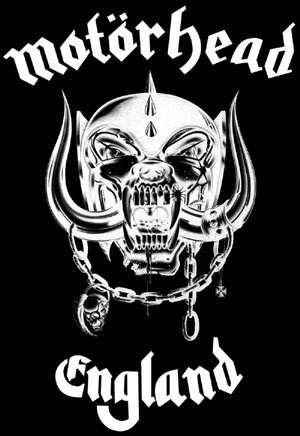
Because of this totally badass logo:

image

I don't know what it is, but it's totally sick. It's like a malevolent boar or something. Plus it has "England", which kicks ass. You know it rocks your hole.

Posted by GeekLethal GeekLethal on   |   § 5

Phil gets hickory smoked

Ministry Crony Phil has got himself a new band. It seems the old band succumbed to a population exposion. So the new band isn't power pop with wicked female vocals. Instead, Phil has maneuvered his way into a folky-rocky type band with wicked female vocals. Which means that Phil is now halfway to being assimilated by the DC bluegrass borg collective that ate my wife.

The Fragments are no more, long live The Hickories. It seems that Phil can't lose for winning. One band stuffed full of talented musicians sucks the gas pipe and decides to pay attention to real life, so he instantly finds another band stuffed full of talented musicians. For old time's sake, give a listen to a Fragments tune, then go listen to two of the new bits, over here. I'm sure Phil will let me know when they're playing out, because I asked him to. And then I will let you know, and if you're near the nation's capitol, you can go see them in person, like me.

[wik] Looking at the new band's website, I see that they link to Amy, who is one of the singers in my wife's band, Dead Men's Hollow. It's a small fricken world, I tell ya.

Posted by Buckethead Buckethead on   |   § 3

Thank You For Sending Me Talking Heads

Talking Heads started out as a group of art-school students fronted by an emotionally distant caffeine junkie and playing skeletal, angular songs topped with disjointed lyrical extursions. But they ended up the 1980s as critically-acclaimed, stadium-filling stars playing a heady stew of Caribbean, African, funk, pop, and postpunk. All along, frontman David Byrne sang lyrics in a high, thin warble that for all their elliptical imagery, seemed to always hunger for human connection. Detachment and confusion were common themes; many of their best known songs, from "Once In A Lifetime" to "Heaven" and "Life During Wartime" were about detachment, wonder, the stultifying effect of happiness, and the bracing emotional wallop of misery.

Rhino Records (who else?) are in the process of reissuing all eight of the band's studio albums in a two-sided DualDisc format. One side is a regular CD containing a remastered version of the original album plus the inevitable bonus tracks, and the other side is a DVD containing a 5.1 Surround Sound mix of the album plus some bonus features like lyrics, photos, and videos. I have to admit that I'm not always thrilled when labels do this - I still have CD players that choke on any disc that doesn't conform to Blue Book standards, and my new copy of More Songs About Buildings And Food won't play on one of my computers. I'm also resolutely old school; DVD content doesn't typically thrill me when appended to an album (more on this later). I'm getting over myself, though... if more bands do what Green Day did with their excellent Bullet In A Bible and release video and audio versions of the same concert in one package, I'll be a happy man. But for now I need to simply recognize that most people younger than even my tender years are perfectly OK with this outlandish new thing they call tech-mology, and just let it rest.

But I'm here to talk about More Songs About Buildings And Food, Talking Heads' second album, originally released in 1978. The name of the album is a bit of joke on the dreaded "sophomore slump," but it's not an advertisement of the contents. Well, "The Big Country" actually is a song about buildings and food, but only obliquely, so I will pretend it doesn't count. Instead, Talking Heads' second album sees them moving away from the very stark and spiky arrangements they used on their debut, and starting to incorporate some of the soul and overtly funky gestures that would underpin their later, more experimental work. Although all the songs on Buildings and Food were written by David Byrne, producer Brian Eno (in his first of many collaborations with the group) moved Chris Franz' drums and Tina Weymouth's bass to the front of the mix. As later proven on their own work as the Tom Tom Club, Franz and Weymouth had a greater sense of fun and of uncerebral playfulness than Byrne. These tendencies were already on display, and their earnestness helps offest the nerdy coolness of David Byrne's persona.

One thing that sets More Songs About Buildings And Food apart from the Talking Heads albums that came after is that it almost sounds unfinished. That's not to say the songs are half-baked (they aren't) or the production job has glaring holes in it (it doesn't), but rather that you can hear the band, especially Byrne, reaching for something new all the time. The band's best album, for my money, is the double live The Name Of This Band Is Talking Heads, which includes live performances of some of the material from Buildings and Food. Before I gave the latter album a very close listen, I thought that all of David Byrne's little experiments on the live record - stretching out or smothering his vowels, spastically repeating phrases or chop|ping them in|to harsh syl|la|bles - were a function of his being on stage and looking for a way to do something new with a lyric he's sung a thousand times before. But this is not so - the same kinds of bizarre little tics festoon the original album versions, and the music that underlies them sounds just as spontaneous as it does on stage.

Although Eno had begun to deepen the band's sound with sneaky production tricks, Buildings And Food still sounds like it was recorded live in the studio. This is very different from his later contributions to the band's sound, which would result in complex audio collages that sounded frankly (and gloriously) studio-generated, and that the band would have to work hard to approximate on stage. But for the time being, Eno decorated songs like "Stay Hungry," "I'm Not In Love" and "The Girls Want To Be With The Girls" with judicious and subtle intrusions that don't obscure the band's odd hybrid of postpunk and rigid funk. In fact, Eno's contributions are so subtle as to be practically stealthy, only revealing their complexity under close scrutiny.

Just listen to "Found A Job," for example. Although it sounds at first blush like a simple scritchy and nervous four-piece arrangement with a very dry (echoless) sound, the choruses are loaded with panned guitars and background keyboard flourishes, and David Byrne's vocals suddenly sound like they're coming from a much bigger room. While perhaps not as thrilling as the adventures of later albums, the excellent songwriting and production on Buildings and Food rewards repeated (even... obsessive...) listening, with headphones.

What really elevate Buildings And Food above merely being a step forward from their debut (titled '77) are the last two songs, the famous cover of Al Green's "Take Me To The River" and the airy narrative song "The Big Country". The former was the first time on album that Talking Heads really relaxed into the deep grooves that Franz, Weymouth, and keyboardist/guitarist Jerry Harrison were capable of creating. The bubbling bass line and open textures seemed especially novel after nine straight songs full of twitchy energy, and were a harbinger of the band's explorations in the years to come. On the other hand, "The Big Country" featured possibly David Byrne's most lucid and straightforward lyric yet, presaging the narrative dexterity he would bring to songs on their next album, Fear of Music, such as "Heaven" and "Life During Wartime." Underpinned by an incongruous-sounding slide guitar, Byrne's narrator muses from an airplane about the cities and buildings and fields he sees below, muses on the miracles of production and transportation that tie them all together, and then suddenly dissolves in a fit of what - ennui? - boredom? - self-loathing? Whatever the intent, the lyric is more finely drawn and evocative than anything Byrne had yet done.

For the reissue, Rhino have appended alternate versions of songs - alternate takes of "The Big Country" and "I'm Not In Love," a countryish version of "Thank You For Sending Me An Angel," and a 1977 version of "Stay Hungry" that closely recalls the feel, if not exactly the sound, of the outstanding live version on The Name Of This Band Is Talking Heads. None of these additions are particularly essential, but they are interesting for those who are curious about the band's self-conscious evolutionary goals.

What are valuable, though, are the DVD extras. (For the record, that is the first time in history I've had occasion to write the foregoing sentence.) Two live videos, of "Found A Job" from 1978 and "Warning Sign" from 1979, do a great service for those of us who were born too late to see the band in their heyday. Whereas Jonathan Demme's film Stop Making Sense, which chronicled Talking Heads' 1984 tour, presented a band who seemed relaxed and comfortable with a large stage, a gigantic audience, and the funky presence of the great Bernie Worrell on keyboards, the earlier footage shows a much younger, hungrier group far more intent on getting across. That's not to say that the band had become complacent by 1984, but rather that by then they had come to expect everything would go as planned.

The difference can be most easily seen by watching bassist Tina Weymouth. In the 1978 clip, filmed in New York, she is a tiny ball of energy, almost being played by her bass rather than the other way around. She rocks back and forth and stares intently at Jerry and David as she absolutely rips into the acrobatic bass line of "Found A Job." (The bass, too, is high up in the mix on this video, and should forever put to bed the calumny that Tina Weymouth could not play her instrument.) By 1984, she's barefoot and smiling, relaxed and happy as she practically surfs on the mile-deep, funky grooves she lays down. It's not a difference of competence; it's a difference of comfort, and it's a bit of a revelation to actually see the how the band worked together in their early days before MTV, world music, and the acrimony that would break them apart.

As befits a crew of ex-art students, the "photo extras" section of the DVD is well put together too. The mishmash of backstage candid shots and album cover treatments from the USA and Japan is okay enough, but the Western Union telegram welcoming the Heads to San Francisco and concluding "WELCOME TO SAN FRANCISCO WE LIKE YOUR RECORDS BREAK A HEAD -THE RESIDENTS" is just... super cool. Cool also are the numerous lyric sheets in various stages of completion, which probably (though it's hard to tell) give a glimpse into the recondite depths of the creative mind of David Byrne. Also included is the very curious and undated "Self Deconstruction of a Song," an essay about "The Big Country." It begins...

The first thing we hear is a bottleneck/slide guitar. It brings to mind a sound which was originally used in country and western music to mimic violins. It is not meant to mimic violins here but to mimic country and western music. This, along with the initial major third chord sequence, brings to mind a basic, earthy down-home feeling which implies a primitivism and lack of sophistication. (At the same time, in the context of Talking Heads, it implies an intentional primitivism and an awareness of this nievete [sic])

... and continues in the same vein for a few hundred words. While not exactly required reading, it is unmistakably (and touchingly) the product of an art/philosophy education circa 1975, which you can take, leave, or amuse yourself with as the mood takes you.

Finally, the 5.1 Surround Sound remix on the DVD side is absolutely spectacular. Even on my non-surround, ten year old stereo components, I heard details in the production I'd never even suspected were there before. In fact, the full impact of Brian Eno's deft hand on the band's sound isn't fully appreciated until you've heard all the tiny, tiny little complicated noises he packed into songs that on older CD releases sounded fairly straightforward. This new tech-mology scares and confuses me, but I think I like it!

Talking Heads are easy to take for granted. Their songs are perhaps on the radio more now than when they were together. The band are practically iconic, and their videos especially are practically a capsule cultural history of the mid-1980s. But every one of the band's albums contain deeper pleasures than the radio hits we all know. Rhino have long been one of the best reissue labels in the world, even after their acquisition by Warner Brothers, and if the other seven Talking Heads albums have been presented as well as More Songs About Buildings And Food they have a lot to be proud of. Now, if Rhino would only have had the decency to release the album as two discs, a DVD and a blue-book compliant CD (as was evidently done for the European release) instead of the clumsy gimmick of a DualDisc, this package would have been perfect.

This post also appears at blogcritics.org

Posted by Johno Johno on   |   § 4

Cut-Rate Chicanery

Cheap Trick have always seemed pretty ludicrous to me. In part, I'm sure that the band meant it to be this way. The visual gag that pits the gawky geekiness of guitarist Rick Neilsen and the pudgy accountant chic of drummer Bun E. Carlos against the pouffy prettiness of bassist Tom Petersson and singer Robin Zander has been sustaining the band's stage presence for years. And anybody who shows up with five necks on his guitar isn't exactly going for gravitas.

But the rest of their ludicrousness is purely my problem. My first introduction to Cheap Trick came in 1988, when as an impressionable 14 year old, I thought that their big comeback hit, "The Flame" was the hottest thing in a long, hot summer. But even though I was young, impressionable, more than a little stupid and utterly oblivious to the finer things in life, the band's total committment to the drecky, schmaltzy silliness that was "The Flame" even then struck me as, well, pretty ludicrous. Around the same time they put out their cover of "Don't Be Cruel," a slight and little recording dressed up in studio trickery. One day it hit me; these guys are cheesy, they know it, and I love it.

But if Cheap Trick have run for thirty years now on an inexhaustible supply of silliness, loud guitars, and giant hooks, it is a testament to the durability of those eternal virtues. They are a band who have always seemed to be more than the sum of their parts. With the exception of one or two absolutely flawless songs that should be presented to future generations as emblems of perfection (I'm thinking of "Surrender" and "I Want You To Want Me"), I have always been hard pressed to define what makes Cheap Trick's music so compelling, so endlessly entertaining, when it is also so insubstantial.

Well, I think I've figured it out: it's a trick. Smoke and mirrors. The closer you look, the more it melts away and the more the baby unicorn behind the curtain looks like a badly malformed cow fetus floating in formaldehyde. But just as people never tire of Penn & Teller, David Copperfield, and the guys running the three card monte game outside the bus depot, I can't ever get tired of Cheap Trick. Take my money! This is fun!!

As part of their ongoing effort to monetize every niche and corner of their prodigious back catalog (it's called churn), Sony/Legacy have finally taken it upon themselves to reissue a number of Cheap Trick's mid-period albums in slick new remastered and expanded packages. The pick of these is probably 1979's Dream Police, which for my money is probably the last Cheap Trick album I'd urge anyone to run and by. Wait. That didn't come out right. It's not that Dream Police is a bad album, not that. What I mean is, it's the last solid album they made, and after 1980 the band's output became decidedly... let's be generous; uneven.

The reissue of Dream Police is a definite improvement over previous CD versions available in the USA. The new mastering job puts every instrument in its place, from the steely multioctave thronk of Tom Petersson's 12-string bass to the keening strings that overlay the title track. The bonus tracks too add value: live versions of "The House is Rockin' (With Domestic Problems)", "Way of the World", and "I Know What I Want" revisit the band's classic hard-hitting Live At Budokan sound, and a stringless version of "Dream Police" reveals just what a slight creation that song is.

And I think that's the key to Cheap Trick. When Bob Dylan writes a song, he builds you a 12-cylinder Duesenberg - a juggernaut clad in steel and burlwood that purrs and roars and can top 200 miles per hour. When Cheap Trick write a song, it has two pedals and a little propeller on top, and if you pump your legs fast enough and pray, you might get airborne and not die. Songs like that rely completely on the strength of the personalities behind them, and dedication to minimalism is Cheap Trick's greatest strength. No matter how you slice it, "Dream Police" is a ludicrous song, practically sub-Spinal Tap in its lyrical complexities and burdened with a hook that labors a little more than it should. But it all works in spite of that. Minimalism means not burdening songs down with more than they can carry, and there is an underappreciated art to that. I defy you to listen to "Dream Police" all the way through and not be gripped with an inescapable urge to keen out "Police, Police!" with Robin Zander during the rideout chorus. The band have enough charisma, enough goofy-pretty conviction, that the primary colors they work with end up seeming as subtle in their way as Van Gogh's "Starry Night."

The album itself is enough of a hooky ride to make it worth having, with the unsubtle thrills of the grinding "Gonna Raise Hell" (about raising hell), the barely restrained throbbing of "Need Your Love" (about needing love), and the Beatles-meet- Alice-Cooper rocker "I'll Be With You Tonight" (which is about how tonight he's gonna be with her, tonight). But the bonus tracks do act as welcome reminders of the greatness that was Cheap Trick on stage, and the track-by-track commentary notes by the band in the liner notes are more informative than most. While I will probably wait a lifetime to read liner notes as brutally honest as the ones Elvis Costello wrote for the Rykodisc reissue of Goodbye Cruel World, which began "Congratulations! You've just purchased our worst album," it is still fun to read Bun E. Carlos' thoughts on Cheap Trick's songwriting, or to discover that the band in general agree that the album would have been better if they'd have laid off touring so much during recording.

It is also a surprise to realize that the band started recording Dream Police before they hit it big. If you listen to the albums in order of release, it definitely seems like Cheap Trick hit their stride with 1977's In Color and 1978's Heaven Tonight. After that came their commercial breakthrough with the platinum smash of Live at Budokan and then their first dealing-with-success album, Dream Police, which seems a little forced; the ideas just a little thinner, the songs not quite as transcendent.

But that chronology is wrong. Cheap Trick recorded started recording Dream Police before they toured Japan. They surely weren't feeling the pressure of following up a smash hit at the time. Therefore if Dream Police is cheesier and kitschier than their four prior albums, it because the band were rushing to put out a followup; it's an intrinsic part of Cheap Trick's nature, part of what made them who they were. No, their first true post-success album was 1980's fairly wretched George Martin Production, All Shook Up. And although they would continue to produce albums of varying quality, becoming ever more professional as they went, it's pretty clear that sky-high success was too big a thing for the little band from Rockford, Illinois. (The runaway success of "The Flame" notwithstanding; all four members of the band have expressed regret, saying they hate the song. (Of course, it's easy to say that when you're sitting on a big pile of money.))

Not that Cheap Trick ever really seemed like they needed success. Their act was never arena-sized. If you see Cheap Trick today, you will get what you always got; a pudgy accountant playing drums like Gene Krupa, a skinny weirdo in tapered trousers with a five-necked guitar, a bass player who covers three octaves at once, and a big-voiced singer delivering giant choruses. Cheap Trick are a quintessential bar band, one who lucked into grabbing the brass ring and nearly let it undermine them. Dream Police is a slight but rewarding artifact of late-70's power pop. What more do you want?

(This post also appears at blogcritics.org)

Posted by Johno Johno on   |   § 11

Dammit. Dammit. Dammit. Dammit. Dammit.

Legendary Malian guitarist Ali Farka Touré died this week in Mali after a long illness. His exact age is unknown; he was probably born in 1939. Best know in the USA for his 1994 album with Ry Cooder, Talking Timbuktu, he leaves behind a body of powerful and idiosyncratic recorded work that stands and some of the best that Africa has ever had to offer. Having achieved international fame in his 50s, he spent the last twenty or so years of his life as he spent this first fifty, as a farmer. The only difference being, from time to time he would step up to a microphone and record some of the finest, deepest, and most elemental guitar music ever made.

I have been fumbling with a proper obituary for the man for an hour now, and I can't seem to do him justice. Instead, I will quote from a short blogcritics piece I wrote in 2004 about Malian music that I feel captures what made Ali FarkaTouré special.

Ali Farka Touré himself is a farmer and local (what... chief? mayor? paterfamilias?), who tends to his village first and his music second. In 1995, he reputedly begged off a US tour claiming that he could not leave his home because if he did, he risked losing his land in an armed skirmish. When in 1998, one of his US labels, Hannibal, wanted to record a new record with him Touré insisted the producers bring a mobile recording rig to his compound at Niafunké. The stunning resulting album, aptly titled Niafunké, was recorded whenever farm chores did not press and whenever the mood struck to pick up his guitar.

In 2000, Touré decided to come to the USA for one last tour before devoting all his time to a village irrigation project. I was lucky enough to see his New York date, August 8, 2000, and I can't ever forget it. A big man in person, on stage he looked ten feet tall, wielding his electric guitar like it was a toy and wrenching from it some of the most searing melodies I have ever heard. He was playful, switching between guitar and njerka (a small one-stringed fiddle) and stopping to explain to the New York audience what he was singing about in the eleven languages he writes in. About halfway through the show, he struck on the game of lifting his leg way up in the air and bringing it down onto the stage with a huge *boom*. His band worked the *boom* into the deep percolating groove they had built, and soon Touré was *boom*ing away, each one accented by a chord from his guitar that sounded like trees breaking in the wind. The entire night was unforgettable and absolutely one of a kind. Ali Farka Touré is often compared to John Lee Hooker, whose elemental blues sound seemed to emanate from some half-remembered Mali of the mind, but on that night Ali Farka Touré sounded like Timbuktu.

Before the show, I shared a cab with record producer and Hannibal label owner Joe Boyd, who asked me about African music and what I thought about it. I mentioned Ali Farka Touré, Johnny Clegg, Fela Kuti and a few others before bringing up Angelique Kidjo, who had just released her pop-inflected album Oremi the previous year. Boyd looked at me quizzically and said, "you like that? That speaks to you?" I admitted that it didn't really, it just sounded nice, and he told me that someday, smart kid that I was, I would figure it out, I would get it.

Later that night, I got it.

I should also mention that on that same night, I met Mr. Touré briefly in his dressing room, where he took my stammered compliments with leonine reserve (I speak no French; he gave no indication whether English was among his many tongues). Up close, he seemed positively regal. It was not just that was a large man, but he radiated a genial calmness, a sense of presence, that made it seem that he was simply... in charge. When I saw him on stage seemingly shooting lightning from his fingertips or dancing with his one-string gourd fiddle, It was then that I got it. The god dances and we all must watch. That night was the best concert I have ever seen, or hope to see; it literally changed my life. And now, he's gone. And if his passing matters this much to me, who orbited him once for about forty-five seconds, in Mali it will surely be met with public fetes and much sorrow.

If you have not yet begun your collection of Ali Farka Touré recordings, I would recommend starting with Talking Timbuktu, which is in some ways his most accessible album. Made with Ry Cooder, it is a little less skeletal (and a little more Western) than much of Touré's other work, and is a good point of entry to his music and to Malian music in general. After that, you can take your pick of any one of a number of his records: I am partial to Niafunké and The Source, though many people swear by his self-titled debut on Mango, or Radio Mali, a collection of radio broadcast recordings. You should also check out his last album, 2005 Grammy winner for Best World Music Album, In The Heart of the Moon, which he recorded with Kora master Toumani Diabate. In something of a departure from his other albums, Touré gently winds circular rhythmic guitar lines around and underneath the ethereal waterfall plinking of Diabate's kora (a kind of many-stringed west African harp). Although it was never intended as one, it is a fitting capstone to the career of a giant of Malian music.

Posted by Johno Johno on   |   § 2

Whisky, Heartbreak, and Estrogen

I've been on a sort of alternative country kick recently, having reviewed albums by Hank Williams III and bevy of outsider country icons in their younger days. And now comes a third approach to that hallowed genre in the form of Bloom, Red & The Ordinary Girl, an album by the alt-country sisterhood Tres Chicas. Tres Chicas, which started as a one-off project but is now a permanent concern, consists three friends from the Raleigh, North Carolina area: Lynn Blakey, who is a veteran of the great Southern indie music scene that gave us REM; Caitlin Cary, a founding member of Whiskeytown, which also gave us Ryan Adams; and Tonya Lamm, a member of the big-in-Europe indie-rock/folk/country band Hazeldine.

Bloom, Red & The Ordinary Girl (the title refers both to the Chicas' nicknames and to lyrics on the album) is a comfortable, completely unpretentious alternative country album of relaxed performances, gorgeous harmonies, and generally outstanding songwriting. Supported by crack playing from Matt Radford (upright bass) and Geraint Watkins (piano, organ) and team-produced by frequent Nick Lowe collaborators Neil Brockbank and Robert Trehern (who also features on drums), Tres Chicas sound like they're having a blast singing some lovely, aching songs that are reminiscent of Gram Parsons, the Jayhawks, Emmylou Harris, and the laid-back earthy earnestness of the Indigo Girls.

Musically, the album tends to stick to easy tempos and sparse arrangements organized around acoustic guitar, keyboards, and the Chicas' twining harmonies. Because of this, matters sometimes threaten to succumb to the dreaded mid-tempo syndrome. But although the dreaded mid-tempo syndrome has rendered hundreds of otherwise fine albums as sleep-inducing as a bathtub of warm syrup, on Bloom, Red & the Ordinary Girl the live-sounding, spacious production and gorgeous singing helps to make sure that mostly doesn't happen.

Tres Chicas' secret weapon, however, is definitely masterful songwriting. Each of the Chicas wrote songs for this album, and working together must surely have raised their game. There are so many styles, voices, and narrative devices here that it's possible to believe that they are the work of a dozen different writers.

Take "My Love," "Shade Trees in Bloom," and "Red," three selections from the middle of the album which also happen to be the sources of the album's title. I suspect each was written by a different Chica, because they are so distinct yet so absolutely in line with what Tres Chicas are about.

"My Love" is a gently swaying love song that paints in deft strokes a story of slightly distressing devotion with lines like "I'm not Jesus Christ, I'm just an ordinary girl/ and everywhere I go, you go/ Under high silver skies, you shelter me from rain/ you make it very plain you're mine, my love." Is this love actually shelter, or is it stifling and crippling? The song never quite decides.

Next is the quiet "Shade Trees in Bloom." In stark contrast to "My Love," this song's lyrics are plainer and more direct, almost sounding like the "straight from my heart" centerpiece of a lost Broadway hit, with stanzas like

All quiet now, just listening
Sometimes what you think is the end is the beginning
I'll put you to sleep but you keep laughing
Let's put our arms together, baby, we'll see what happens

On the chorus, one of the Chicas breaks out of the harmony to sing in ascending intervals "I want something beautiful, I want something good," a sentiment almost corny enough to roll your eyes to but redeemed by the performance. The song edges right up to maudlin without stepping over the edge.

Different again is the vituperative heartbreak of "Red," in which the three sing, "You have gone off to another, one who you think suits you better/ I don't wish you well, and I'll see you in hell/ And I'm sitting here burning your letters," like a young Elvis Costello circa All This Useless Beauty. Even though not every lyric on the album works perfectly, most artists don't show this much range in a career, much less in the span of three songs.

It is good that Cary, Lamm, and Blakey have decided to make Tres Chicas a permanent thing. They are talented songwriters, and Bloom, Red, & The Ordinary Girl is packed with fine writing that only rarely dips into anything resembling the standard folk/country coffeehouse confessional mode. Although some of the imagery is a bit overcooked, and a couple songs do melt into mid-tempo torpor, those aren't fatal flaws in an otherwise accomplished and thoughtful and... (pretty? that's condescending)... and, and... luminous batch of alt-country songs. All twelve songs together in a row can be a little too much to take, but my iTunes' shuffle function proves that on their own, each one is a gem. I'm not going to like this album in every mood, but it sure sounds nice right now.

Posted by Johno Johno on   |   § 0

Butthole Surfers

It's probably a no-brainer that one of the first completely here, queer, and loving it punk bands was from San Francisco. When Pansy Division formed in 1991, they fused a Californian version of Ramones-ified power pop with a very clear love for British punk, especially The Buzzcocks, and topped it with lyrics that were, well, totally gay. Such a combination could easily run thin quickly. But whatever novelty potential the band had was quickly overshadowed by their songs, which treated the experience of being an out (and horny!) gay male in America with candor, humor, and sometimes brutal honesty. The lyrics to "Anthem," off their first album, served as a sort of mission statement:

We're here to tell you, ya better make way
We're queer rockers in your face today
We can't relate to Judy Garland
It's a new generation of music calling
We're the buttfuckers of rock and roll
We wanna sock it to your hole
With loud guitars, we're gay and proud
We gonna get ya with your pants down

Between 1993 and 1998, Pansy Division released six albums in this vein on the Lookout! label, albums that helped define that now legendary label's '90s-era sound. Like label-mates Green Day and Screeching Weasel, Pansy Division relied on fast tempos, trashy guitars, and a knack for big pop hooks tied to snotnosed lyrics. By 1994, the band was supporting Green Day on national tours, and became de facto poster children for the nascent queercore movement. They have since jumped to Jello Biafra's Alternative Tentacles label, where they released their seventh album in 2003.

The new Essential Pansy Division, out now on Alternative Tentacles, is a witty, thoughtful, and often profane thirty-song stroll through the band's career. The running order jumbles up songs from all seven of their studio albums, so that 1993's "Fem in a Black Leather Jacket" sits next to "Who Treats You Right" from 2003's Entertainment. I would like to kvetch, because I'm a kvetch and a pisher besides, that ordering the tracks in this way obscures the band's musical and conceptual growth, but that isn't really true. Like the Ramones before them, Pansy Division have not really changed their modus operandi in fifteen years, preferring to refine and embellish a winning formula.

Have they matured musically? Well, "He Whipped My Ass In Tennis (Then I Fucked His Ass In Bed)" is no more or less hooky than "Cocksucker Club," recorded a good dozen years before. Have they matured lyrically? Well, if you consider a song about circle jerking called "Alpine Skiing" an improvement over the older "Groovy Underwear," then sure. But what is really striking is that Pansy Division have been models of consistency throughout their career. Individual songs may be a little stronger or weaker, but they have found a winning formula that works for them, and it's a good one.

What makes Pansy Division more than just a very gay Barenaked Ladies, though, are the deep songs. Right in there with all the endless dicks (viz. "Dick of Death," "Touch My Joe Camel," "Horny In The Morning") are a few songs that hit with an ugly punch. "Denny" is about a porn actor from before the days when they knew about AIDS:

Denny picked me up, Denny did me
He's got a tattoo of his dick on his belly
It was double vision disorienting
Denny's kind of a dorky fella
Denny's dramatic, Denny's dark
He ain't nothing like the restaurant
He's got HIV+ tattooed in black
In 6 inch letters on his back
He said, "I want them to see
What they've done to me."

"Deep Water" is written from the point of view of some anonymous kid tortured with guilt and repression and waiting for the day he can leave home. "I Really Wanted You" is a bittersweet song about an old crush getting married (to a woman, presumably). On a lighter note, the jaunty "No Protection" is about shooting down a guy who wants to ride bareback, sung through a vocoder (like what Cher used on "I Believe") over a disco beat. Songs like these deepen and complicate the bouncy, happy sex romp that Pansy Division normally sings about, and coming as they do between songs about blowjobs, they pack surprising power.

In closing, I have to say that I am so used to hearing boy-meets-girl songs, hetero-themed get-it-on songs, and the like, that listening to thirty gay-themed punk songs in a row induces a little bit of vertigo. It's not just a simple matter of Pansy Division swapping out "dick" for "pussy" in their lyrics; the differences are deeper, fundamentally cultural. If you've ever spent more than a few days in England, you'll know what I mean when I say that it's the little things that are the most surprising. People look the other way before crossing the street. Bar etiquette is different. Standing in line is different. The money is funny colors. Every where you turn there's people speaking a language that you understand, but saying things that you have to think a little about to really comprehend.

Although my days of listening to Pansy Division albums ended about the time I graduated college and no longer had access to everyone in the dorm's record collection (ten frigging years ago!), which means I'm not completely up on what the kids are listening to these days, I can say for sure that The Essential Pansy Division is a well put together compilation, perfect for the gay nephew, homophobic uncle, or SoCal punk fan in your life. Also included is a DVD disc of live performances, TV appearances, and videos that, though inessential, do make this the only Pansy Division album you will ever need to buy.

Posted by Johno Johno on   |   § 2

Front Porch Revolution

I wrote recently about Hank Williams III's quest to rescue country music from a faded modernity of computerized backing tracks and lycra-clad artists and return it to the rough and real place it came from. But Hank Williams III's is only one interpretation of country history. Back in the mid 1970s, Austin and Nashville were home to a crop of young songwriters with rural roots and the heads of poets, songwriters who staged a quiet revolution against the cookie-cutter genteelness that was country's stock in trade at the time. Their names have gone on to renown in some circles: Rodney Crowell, Steve Earle, David Allan Coe, Townes Van Zandt, Gamble Rodgers, and John Hiatt, to name a few.

All these people are a little grey and a little grizzled now, and the sound they pioneered - the immediate predecessor to what we now call Alternative Country or Americana - has been around for so long it's hard to remember there was a time when it was brand new.

Fortuitously, film director James Szalapski was in Austin at the time and was moved to preserve this emergent alt-country scene in a 1976 documentary he called Heartworn Highways. This film has become over the years a cult classic, little seen but much revered, and it has now been cleaned up for a 30th anniversary DVD release by HackTone and Shout! Factory.

The labels have also put together a soundtrack to the film, a companion piece intended to build upon and embellish the documentary's musical narrative. Drawn from the original full session tapes, the soundtrack is a rambling 26-track compilation of intimate performances, entertainingly inebriated stage patter about whiskey and music, and some very good songs played by some very talented folks.

Of historical note is the fact that the album contains the very first recordings by alt-country icons Steve Earle, Rodney Crowell, and John Hiatt. If like me you only know these artists by their later work, Heartworn Highways is a bit of a revelation. Though a little rough and maybe a little less accomplished than their later stuff, the songs here belong unmistakably to their creators. John Hiatt's sharp lyrical poetry, Rodney Crowell's gift for atmosphere for melody, and Steve Earle's scrappy defiance (and leftism) are already in full view. But these treasures are only the smallest part of what makes Heartworn Highways worth a listen.

The song that kicks off Heartworn Highways, "L.A. Freeway" by the great and reclusive Guy Clark, sets the tone for the album. Clark's plaintive song conjures a laid-back atmosphere that, like most of the recordings here is Most of the tracks here are really intimate - living room intimate, front porch intimate. More than that, "L.A. Freeway" serves as sort of a mission statement for the album as a whole with its theme of leaving the urban life behind and getting back to one's roots.

The homey, homespun vibe continues straight through until the last notes of the closing song, a Christmas Eve jam on "Silent Night" with Clark, Steve Earle, Rodney Crowell, Steve Young, Susannah Clark (guy's wife), and Richard Dobson. Along the way, chairs creak, whiskey is sipped, audience members have important questions for whoever's singing, microphone stands make noise, and people come and go.

Guy Clarke contributes three other songs to the album, including an early version of his classic "Desperadoes Waiting For A Train," about "a man who was kinda like my grandfather, but was really my grandma's boyfriend." It is a perfect song about how this man helped raise him, with lyrics as sharp as a knife and scenes as sharply drawn as any ever have been, and it is made even stronger by the care the producers have put into sequencing the record. You see, just before "Desperadoes" is a wonderful David Allan Coe song called "I Still Sing The Old Songs" which closes with a few lines from "Red River Valley." "Desperadoes" opens with a mention of the same song. Rather than seeming gimmicky, touches like these elevate Heartworn Highways from a mere compilation to a statement about what country music meant to some of its future saviors.

It should be clear by now that I am not so much reviewing this album as falling in love with it. This was not a sure thing - I don't always have patience for confessional living-room singers and their confessional living-room songs. Performances like these live or die on the quality of the writing. But despite the fact that these are songwriters still learning their craft (Townes Van Zandt's "Waiting Around To Die" is actually, so he claims, the very first song he ever wrote), there really isn't a single dud, outright cliche, or bit of hokey filler here. And although the homespun authenticity of the whole thing sometimes feels a little studied, a little put-on, that's a minor sin to commit in the making of music this good. I could try to run down more highlights from this album, but the truth is, you're either going to dig all of it or none of it, and I wouldn't feel right choosing this Steve Earle song over that Townes Van Zandt when they are all pretty much gold.

If Hank Williams III's most recent album is his Moby Dick, a strenuous and difficult work about struggling with forces beyond his control, Heartworn Highways is more like Lake Wobegon Days, an intelligent, smart, and unpretentious album of people singing songs about living the way they want to, and what it means to them. Heaven and hell don't seem as close as friends, whiskey, and the velvet black of a Tennessee night, and all these geniuses love each other's company. It's just a little sad that all these artists who showed so much promise in 1976, who were kicking hard against the rigid conformity of Nashville's establishment, still remain marginal (if highly respected) figures in the scene they tried to topple. Still, whatever happened after, and whether or not their revolution succeeded and on what terms, Heartworn Highways is a fine chronicle of a great time in country music history.

Posted by Johno Johno on   |   § 0

Putting The "yank" Back In Yankee

Hank Williams III wants you to know he doesn't give a damn what you think. It's a sort of coping mechanism. When you are the country-singing grandson of the greatest country singer of all time, and the son of a man who himself has had dozens of top-ten country hits and remained until this year the face of NFL football, I imagine it's important to stake out your own territory as a man.

Whatever you could say about children of famous people goes triple for Hank III, whose gaunt visage and nasal voice more than a little take after the founder of his noble line. It was his family who gave us hard living songs like "I'll Never Get Out Of this World Alive" and "Whiskey Bent and Hell Bound," not to mention two of the more memorable substance-abuse biographies in a country music history full of great contenders.

To try to live up to this would be a hard burden to carry for even the steadiest person, and Hank Williams III is definitely not steady. He didn't even really want to do country music until child-support payments forced his hand. And ever since he made his first recordings - a disc of Natalie Cole-style "duets" with his father and grandfather that he quickly disavowed - he has been fighting with the past and dealing with the pressure others put on him, by jettisoning mannered country stylisms in favor of a juiced-up country/punk hybrid.

Hank Williams III's live shows are reportedly something else; a night that starts with a set of hard-bitten country ballads gradually revs up to a thrashing punk finale. And while plenty of groups have tried to marry punk and country to varying degrees of success (see: Mojo Nixon; The Reverend Horton Heat; Social Distortion's Mike Ness), Williams' balls-out I'm-an-asshole nature takes him over the top and into brand-new territory. His music sounds for the most part like it could have been recorded in 1963, but in its execution it is rougher and rowdier than country ever has been- if Johnny Cash's Tennessee Three was a long sip of Jim Beam, Hank III is a slug of Rebel Yell straight from the bottle.

His new album, Straight To Hell, is the first I've ever heard that straddles the hallowed ground between Bill Monroe and Mötörhead, between "Blue Moon of Kentucky" and "Ace of Spades."
At some point on your first run through Straight To Hell, it will hit you that you haven't once heard a distorted guitar. The album is so punk-rock in attitude and execution, and the tempos are so headlong, that you are sure that at some point somebody plugged a Gibson into a cheap fuzz pedal. But that never actually happened. Instead, Williams' band chases his rough whine of a voice with keening country fiddle, a driving tick-tack beat, plenty of tasty Martin and Telecaster guitars, and a nice helping of steel guitar and Dobro just like all those old country albums I grew up on. The playing is raucous but clean - as fiery and precise as anything I've heard that raise a storm without needing overdriven amplifiers.

Straight To Hell, starts off with about thirty seconds of a scratchy, plaintive country-gospel ballad called "Satan Is Real," which quickly degenerates into basso-profundo laughter (presumably from the dark lord himself) as the band kick into the real album opener, a honky-tonk barnburner called "Straight to Hell." That's not just a name - it really is the theme of the album. Like Hank Williams Sr., Jerry Lee Lewis, and Little Richard before him, Hank III is one of those artists who sing about a life of pills, whiskey and madness but constantly lament that all this fun means they will burn forever in hell. This tension between gleeful dissipation and crushing depression is what gives Straight To Hell its kick. On the title songs, Williams tears into lines about "looking for trouble" with the same fury as he sings the chorus, "I'm going straight to hell, ain't nothing slowing me down / I'm going straight to hell, so you just better get me one more round." Meanwhile the band kick up an electrifying honky-tonk mess.

Since this is an old-school country record, and since Hank Williams III is maybe a tad too eager to take after his forebears, better than half of the songs on the album hoe this same row. "Pills I Took" is a wide-eyed story of destruction and mayhem, and it's not perfectly clear whether Williams' narrator (Williams?) is more proud or ashamed about the blood on the carpet and the broken mirrors. "Thrown Out of the Bar" gives a shout-out to country maverick David Alan Coe and is the first of about half a dozen songs on the album that take predictable but well deserved swipes at the neutered shiny 'stars' who pass for country music royalty today. But more than that, "Thrown Out of the Bar" is just another of ten or so excellent songs the joys and perils of excess. Whether the joys or the perils are the point, well, I guess that's your call.

Williams seems to instinctively understand that this dance with the dark side it what gives a lot of the best country music its power. On the bleak "Country Heroes," he takes the standard country song story about drinking with your elders to a creepy level, singing "sometimes I feel like I'm out of control... and I'm here getting wasted, just like my country heroes." Considering that is grandfather drank himself into his grave at age 29 and George Jones, prominently namechecked in the song, has consumed tragic-heroic amounts of booze in his time, it's a little unsettling that Hank III is so intent on getting plowed. Similarly, "Crazed Country Rebel" is about an interstate drink and drugs spree that doesn't sound so much fun as frantic, as if he's not doing whiskey, pot, 'shrooms, and coke for fun, but because they just might finally kill him.

The thing that really sets Hank III apart from the pack is his anger. The same anger that gets him "thrown out of the bar" and high on "them pills I took," or that he numbs down while "drinking with all my country heroes" also shows up as a fierce defense of traditional country against well-scrubbed newcomers and Yankees. He dedicates "Dick In Dixie" to the high purpose of putting

The dick in Dixie, and the cunt back in country
'Cause the kind of country I hear nowaways is a bunch of fuckin' shit to me.
They say I'm ill mannered, they say I'm gonna self-destruct
But if you know what I'm thinkin,' you know that pop country really sucks."

We are then invited to kiss his ass. As he states again and again, Williams can't stand the new breed of country musicians "kissing ass on Music Row" who have replaced the "outlaws that had to stand their ground" and he can't listen to country music in the same room as "some faggot looking over at me."

There is even a takedown of Kid Rock (of all people) on "Not Everybody Likes Us." Williams is deeply proud of his Southern heritage and his family and can't stand it that a Yankee like Kid Rock is dabbling (poorly) in country and claiming a redneck background. I can grant him the fact that Kid Rock's country experiments aren't too great, but goddamnit, I'm a Yankee too, a country-raised briarhopper from Ohio, and my heritage is George and Johnny and Willie and Chet and Waylon. And if you don't like that, well brother, you can kiss my ass too.

In a great book called High Lonesome: The American Culture Of Country Music Cecelia Tichi writes about how country music became popular in part because it served to re-invent a shared (if largely fictional) down-home shared heritage for an increasingly displaced rural population in the middle of the 20th century. Tichi argues that during the Great Migration of the 1930s, when it seemed like half the population of the grain belt washed up in California, songs like "The Old Folks Back Home" became a lingua franca that brought together migrants from Oklahoma and Alabama alike in a new culture that they could share, built from shared impressions of an ideal America they had left behind and that they still held out hope of returning to.

That is to say, a major job of country music has always been to tie listeners back to a more perfect, even idyllic past that they can share even if they have never even been to, say, Texas or Tennessee. Examples of this sub-genre might be the Carter Family's "Clinch Mountain Home," Dolly Parton's "Tennessee Mountain Home," Loretta Lynn's "Coal Miner's Daughter," the standards "The Yellow Rose of Texas" and "Home on the Range," and even newer songs like Alan Jackson's "Chattahoochee." In a way, Hank Williams III is the just end point of a long trend in outlaw country away from idyllic stories about church and simple folks in favor stories about toughness, hard living, and defiant integrity. Home is the bar and church is, well, where you go to meditate about the hell waiting for you.

Hank Williams III has a stronger claim than most to the actual roots of country music, and Straight To Hell amounts to a 13-song defense of a reconstructed outlaw country past. To make this claim eerily explicit, the album comes with a second disc that contains a 42-minute bonus track, a druggy medley that includes train sounds, pig snorts, other found sounds, and bits of performances including a recording by his grandfather's. It is definitely self-indulgent, but that goes just as well for the whole album.

The sound of Hank Williams III wallowing in inherited misery makes for great listening. In fact, his self-indulgent tendencies give his new album a focus and power that any other set of new-old songs about drinking, drugging, and women would probably lack. Whether Hank Williams III's preoccupation with his own legacy manifest as a rant against Yankee 'faggots' crowding up Music Row or a creeping (and slightly creepy) obsession with walking in the footsteps of his idols, it makes for seriously compelling music.

Straight To Hell is a fascinating and feckless record, raw and rambling and full of piss and whiskey. I've heard punk rockers go country before, but I've never heard real country, old school country music get punked up from within. Hank Williams III is country's ragged edge, and it sounds like he's trying to find a way to live there for good. Straight To Hell is not an easy album, and it's not a perfect one, but it'll do just fine.

Posted by Johno Johno on   |   § 2

One, two, three awards! Ah ah ah!

Last night, at an undisclosed location... Wait, people knew about it. Last night, at a disclosed location... Nevermind. Last night, in the light of a full moon under an ancient and sacred oak, the members of the Washington Area Musicians Association made offering to their pagan gods to determine, in the entrails of their sacrifices, who would be named king...

Last night, at the State Theatre in scenic Falls Church, Virginia WAMA held its twentieth annual Wammie award dinner and show. As attentive readers will be aware, my wife's band was nominated for six awards. It turns out, they won three. And they were the good ones.

In the general awards category, Dead Men's Hollow won the award for Best Debut Album. (Scroll down a bit to get to it.)

In the Bluegrass Category, DMH won Best Bluegrass Duo or Group, and Best Recording.

You can tell that ever since they got together, its been all downhill. Basement. Bars. Strathmore. State Theatre. TV. Satellite Radio. Armed Services Benefit. Kennedy Center. Music Awards. Next step, world domination. Wait, that's the Ministry's plan. For DMH, world tours and grammy nominations by the end of the decade. That's my prediction.

Posted by Buckethead Buckethead on   |   § 9

We're Getting The Band Back Together!

According to the Washington Post, notorious burnout, drug casualty, and musical genius Sylvester Stewart might be rejoining the great original lineup of The Family Stone to perform at this year's Grammys.

I'll believe it when I see it, but I will damn well sure be watching!!

Posted by Johno Johno on   |   § 2

Big time, just around the corner

My wife's band, Dead Men's Hollow, is going from success to success. Tomorrow, they are playing a free concert on the Millenium Stage at the prestigious Kennedy Center for the Performing Arts (right by the Watergate Hotel in our nation's capital.) And today, I learn that they have been nominated for no less than six Washington Area Music Awards from the Washington Area Music Association.

DMH is up for the following Wammies:

  • Bluegrass Group
  • Bluegrass Recording (for their CD "Forever True")
  • New Artist of the Year
  • Album of the Year (for "Forever True")
  • Debut Recording of the Year (for "Forever True")
  • Best Recording Design (for Marcy Cochran, who designed the art for "Forever True")

You can hear their music by following the link above and clicking on "Music." They've got some free downloads, just for you.

I can't say how proud I am. Despite many obstacles, and even harassment, they are moving up in the world at a steady and relentless pace. Their music gets better everyday, so listen now and you'll be able to say, "I knew them before they kicked the Dixie Chicks clear out of country music."

Posted by Buckethead Buckethead on   |   § 4

I Bet You They Won't Play This Song On The Radio

Alert fans of my writing (all six of you) may recall that back in November, I reviewed an EP by the New England-based quintet The Beatings titled If Not Now, Then When?.

The band are now set to release their second full-length, Holding On To Hand Grenades, later in January, and everything I said about the advance single is true once again. In that piece, I wrote:

It is not damning with faint praise to say that the Beatings remind me of Mission of Burma; only rarely can a band pursue Burma's post-punk ideal of brittle soundscapes replete with feedback, scratchy guitars, and dry vocals and have it sound any good. Usually such bands just sound like they're ripping off Burma with a little Pixies on the side. But the Beatings have managed the rare trick of appropriating some of the astringent, hyperintelligent sound invented by Mission of Burma but making it sound human, intimate, and alive in a way that Burma never could.

But the Beatings aren't a tribute band. Although they do wear their influences on their sleeves (touches of Radiohead, Pixies, Sonic Youth, and giant helpings of Husker Du is what I'm hearing), this is to be expected for a relatively young band working in a close-knit genre looming with giants. It is really, really hard to find your own voice and write original songs (I should know... I've been trying (and failing) for fifteen years), but four(ish) short years into their career, The Beatings sound most like... themselves.

If greater success eludes The Beatings with the release of Hand Grenades then there is no justice in the world. On Hand Grenade the band combine the spiky astringecy of their biggest influences with a deft melodic sense that makes their best songs refreshingly sweet and tart at the same time. Every song on the album is better than those on their previous EP, suggesting that they are growing quickly as songwriters and arrangers.

Like many of the recent generation of indie rock bands, The Beatings thrive on tension. The Pixies' signature loud-soft dynamic makes up a large part of their DNA, but they add new dimensions to this by-now routine strategy by adding Sonic Youth-style sheets of noise and by using three singers, one male with a brittle monotone that can burst into melodic (almost-)screaming, one male with a high and thin voice, and an occasional contribution from bassist Erin Dalbec who (in the best Kim Deal/Kim Gordon tradition) acts as a burst of sunshine over the grey-blue musical landscapes.

Guitarists Tony Skalicki and E.R. interweave their turbulent guitar lines over powerful drumming from Dennis Grabowski. All bassist Dalbec has to do with so much going on is add drive and punch to Grabowski's drumming; that she is able to add harmonic interest is just icing on the cake. The muscular sound drives the fast songs and keeps the slow ones moving along, and the band create gorgeous textures to go with the turbulent rhythms. I don't think I've ever heard a band before who could sound like Public Image Ltd. and Galaxie 500 at the same time, but I'm glad to have had the chance.

Highlights on Holding On To Hand Grenades include the stately and noisy "Upstate Flashbacks," the driving hookiness of "Feel Good Ending," the chilly resignation of "Stockholm Syndrome Revisited," and the cute little weird vignettes like "Oh Shit, My Phaser's Jammed" and the acoustic "Harry's Wild Ride." The album does peter out a bit toward the end, stumbling with "Pennsyltuckey" and "Villains," which simply go on too long, and "False Positive," which mainly suffers for sounding like a couple songs sequenced before it. Still, out of sixteen songs a maximum of three or four could be considered as filler - an impressive ratio by any standard.

It's not as if Boston's punk tradition needed saving, and it's not as if The Beatings need their talent affirmed by comparison with the greats of that scene, but it's true: if ever the world needed an heir to Mission of Burma, Galaxie 500, The Pixies and so on, The Beatings are it, and on their own terms. Holding On To Hand Grenades is an impressively self-assured statement of purpose that should be the Beatings' entry to the World of Bigger And Better Things.

This album is available from cdbaby.com.

Posted by Johno Johno on   |   § 0

The Same Thing That Makes You Laugh, Can Make You Cry

Between 1968 and 1973, Sly and the Family Stone had an amazing run. Between their instantly legendary performance at Woodstock and their last hit album in 1973, the band would release three classic records: 1969's Stand!, a party record full of hope and vitriol that is for my money the best album of the 1960s or '70s; 1971's There's A Riot Goin' On, a claustrophobic and paranoid funk workout that jettisoned the upbeat veneer that had lightened Stand!; and 1973's Fresh, full of more conventional grooves but lyrics just as outspoken as the previous two albums.

The Family Stone's signature blend of rock, funk and soul has become a fundamental ingredient of modern hip-hop, R&B and neo-soul, and the legacy of Sly Stone (whose real name is Sylvester Stewart) as a musical innovator remains undimmed. The Family Stone was also the first fully integrated band to hit the big time, an innovation that has not endured quite as well. Unfortunately, with this titanic string of successes came a spiraling drug problem that seemed to sap Stewart's mojo. Although he continued to turn out mediocre-to-decent albums, by 1976 his career was undeniably petering out. Since then Stewart has been reclusive, occasionally turning up to record a (usually perplexing) track here and there.

Considering that The Family Stone remain an important if relatively under-celebrated force in popular music, and considering that the band's leader is apparently no longer able to make new music, Sony's recent idea almost makes sense.

The company owns all the master tapes to the great Sly & The Family Stone albums. On their own these tapes are just sitting in a climate controlled room sucking up rent and not producing income. But if Sony were to lend those tapes out to a wide variety of chart-topping artists - The Roots, Maroon 5, John Legend, will.i.am of the Black Eyed Peas, Chuck D, Big Boi of Outkast, Buddy Guy, and so on, to do with them what they please, Sony has a chance to hit that beautiful spot where a cheaply produced album will successfully market to multiple audiences and sell like crackberry hotcakes.

This is an excellent way to make easy money, especially now that the recording industry as a whole has run like Wile E. Coyote off a cliff and is only moving forward thanks to momentum. If the whole label-distributor-retailer physical-product sales scheme is to survive a little longer, it is high time to grab the easy cash wherever it can be found.

So that is exactly what Sony did: lent the tapes out to a number of artists with the understanding that each artist take an original song in its final form and use it to create a new piece of music. Do they creatively lift portions of a song and radically incorporate them into a new track? Do they remix the original substantially, adding their own creations here and there? Or do they just let the original tape roll and overdub a wanky guitar solo or new vocal wherever it fits?

No matter what the strategy, the final result should ideally be a cross between hybrid and homage, a live-action mashup of the old and new. And given the high quality of the originals, artists need to really deliver the goods if their own contributions are going to measure up. Sony even got Sylvester Stewart to give his approval to the enterprise, so this album is coming out as a Sly & The Family Stone recording complete with Sly Stone's own thumbs-up.

The result, titled Different Strokes by Different Folks, is a creatively bankrupt collection of mostly terrible vandalisms of some of the best songs by Sly & The Family Stone. But make no mistake. Despite the billing, this is not a Sly and the Family Stone recording. Instead, it is an awful and embarrassing collection of sort-of covers by some of the biggest names in music.

The worst offenders fall into two categories; those who don't seem to even understand what worked about the songs they are "covering," and those who have nothing new to add, meaning their contributions are at best extraneous and distracting.

Two examples sum up the first group. Will.i.am of the Black Eyed Peas shoehorns the fuzzy driving stomp of "Dance To The Music" into a boring, plodding and nearly undanceable Black Eyed Peas-style "funk" track. The song's throbbing groove is replaced with a lurching two-note riff that sucks all the fun out of the original tune's vocals.

Worse yet, Nappy Roots and Martin Luther manage to miss the entire point of "Don't Call Me Nigger, Whitey." Whereas the original provocatively explored the dilemmas inherent in American racial politics and pleaded for a solution, the new version jettisons all that in favor of a verse of stock thug/hustler rhymes complete with Glocks and rocks and 'doing what you got to do', a verse about how white kids call each other "nigger," and a verse-long complaint about how black kids today are too materialistic and listen to too much gangsta rap like, presumably, the first verse of the song.

In the second category, Stephen Tyler and Robert Randolph tackle "I Want To Take You Higher" by basically singing and playing along with the complete original master track. Apart from a few seconds of gospel-style introductory music, the entire track is practically intact except that about half of Sly Stone's vocal lines are cut out to make room for Tyler's. The result is perfectly unimpressive; I did the same thing in my bedroom when I was sixteen with a four-track and a Pink Floyd album. But like most things I did alone in my bedroom at sixteen, I never felt the results worthy of public scrutiny.

Devin Lima's version of "If You Want Me To Stay" dresses up the original with new percussion and skritchy guitar that neither adds to nor detracts from the song, but his vocal is a close impression of Sly Stone's original - sometimes so close that I can only tell some of his contributions apart from the portions of Stone's that remain because I have heard the original hundreds of times. While an interesting exercise in impersonation, it is also totally pointless.

The missteps abound. Moby turns "Love City" into a Moby song, too techno for day-spas and too limp for clubs. Buddy Guy and John Mayer (John Mayer?!? When the hell did this walking haircut get street cred??) make space in "You Can Make It If You Try" for some wanky solos that really contribute nothing to the original. John Legend and Joss Stone prove by negative example the value of restraint on a remixed and over-sung version of "Family Affair" that interpolates a few seconds of the Family Stone's "Loose Booty." John Legend and Joss Stone are phenomenally talented newcomers. Unfortunately, as with Stone's appearance with Melissa Etheridge at the 2005 Grammys, all they prove is how far they have to go before they can stand shoulder to shoulder with their idols.

The most disappointing thing is how many people involved in this project should know better. Why did Isaac Hayes and Chuck D agree to participate? Their updated version of "Sing A Simple Song" with D'Angelo basically amounts to Chuck D rapping over the original track about how great a song it is, D'Angelo singing a line or two, and Isaac Hayes literally saying a word here or there. The final result sounds merely rushed and stitched together. So, Chuck... the original was that good? Then why not shut the hell up and let me hear it uninterrupted?

Not everything is so dire. A few interesting choices partially redeem some participants. The Roots, for example, submerge "Star" in their own track in a way that seems more like homage and less like cannibalism, and Maroon 5 (of all people) radically re-conceive "Everyday People" as a techno-guitar workout. This experiment doesn't quite work, but it at least is much bolder than most of the limp and uninspired dreck included elsewhere.

The best cut is probably the last, where DJ Reset does a mashup of Janet Jackson's "Rhythm Nation 1814" with the Family Stone's "Thank You (Falettinme Be Mice Elf Agin)" to surprisingly good effect. Jackson used a sample of "Thank You" as the basis of the original "Rhythm Nation," so although this pairing is obvious, it also works perfectly well.

All in all, Different Strokes by Different Folks does one thing: the album makes me desperate to listen to the original Sly and the Family Stone songs free of all the extra crap and doodazzery smeared on top. I urge all interested souls to pass this compilation by and invest a little money in the original albums. Stand! should be in absolutely everyone's record collection, and There's A Riot Goin' On and Fresh, as well as the Greatest Hits album that sums up everything pre-Stand!, are not far behind.

Different Strokes By Different Folks is a total stinkbomb, a waste of time and money that reflects well on practically no one involved and makes the iconic music of Sly and the Family Stone seem lesser by association. It is too much to expect that Sony Music Group and its employees will ever feel shame over releasing this cheap and cheesy little low profile cash-in at a whopping $18.98 retail, much less billing it as a Sly & The Family Stone album, but at least I can dream that some day when their shortsightedness, avarice, and allergy to creative business practices put them out of work, they come to regret a few of their mistakes.

Posted by Johno Johno on   |   § 3

In Which Johno Discovers Smog Based Life

It's amazing how a seemingly elegant story can become astonishingly complex the closer you look at it. Take, for example, Darwinian evolution. Darwin's original notion of the place where life on Earth began was a gentle "warm pond," a conceptual predecessor to the "primordial soup" that most of us probably learned about in high school.

In the middle of the 20th century it was more commonly believed that life began, whether in a pond or not, in the fairly harsh environment of a noxious atmosphere composed of ammonia, methane, ethane, and other gases (oxygen only came later, a product largely of plant-based photosynthesis). The famous experiment from the 1950s where scientists created amino acids by running lighting through a flask full of these gases was the watershed moment in this line of thinking.

More recent research confounds this thesis in turn, arguing that organic compounds -- especially RNA, the probable evolutionary precursor to DNA -- dissolve readily under such conditions, and therefore would have a hard time surviving such an environment.

The current thinking is that the early evolution of life on earth was many-pronged, possibly resulting in numerous forms of life (e.g. protein life, RNA life, even rudimentary life based on clay crystals) that were eventually outcompeted by DNA-based life, viruses, and certain possible forms of RNA-based life that may yet survive. Yet more radical theories argue that the early chemical precursors to Earth life may have formed on Mars billions of years ago, when that planet's chemistry and climate were more favorable to the formation of RNA-like compounds, and then came to earth by accident after meteor strikes knocked some of Mars out into space.

The point, before I bore all my readers into submission, is that history is always far, far more complicated than it at first seems. The simple classroom narrative almost always covers up all the interesting complexities and for this can end up being almost wrong.

This goes for music history too. Every so often, new recordings emerge into popular view that change the dominant narrative of pop music as we know it. Just last year Rhino released One Kiss Can Lead To Another: Girl Group Sounds Lost And Found, a tour de force compilation of 120 girl-group recordings from the 1960s that acts as sort of a companion piece to that label's four-disc Nuggets set, which collected American garage rock from roughly the same period.

Together these two box sets amount to a drastic revision of the usual quickie history of Rock and Roll in which rock and roll hit a dead patch after the Elvis joined the Army and didn't get interesting again until the Beatles wave broke over North America, and didn't get good for Americans until the Summer of Love. Judging from songs collected on these two Rhino sets, that history is not only wrong but monstrously unfair to a huge number of artists working between 1959 and 1968 who have had the misfortune to fall on the wrong side of tightly controlled Oldies Radio playlists.

One lesson to take away from both my tiresome little homilies is that what we think we know, what survives to make up our worlds, has as much to do with accident as with design (whether "intelligent" or not). So why did I just expend 500-odd words on jibber-jabber about DNA and Rhino Records? Because of a new compilation called Godfathers of L.A. Punk: Today Its Time To Wake Up Again America!!!, out now on Siamese Dogs records.

The usual narrative of punk rock goes something like this: The Stooges begat The Ramones begat the Sex Pistols who begat Everyone Else, world without end, Amen. This is a neat little chapbook of a history that, while elegant, completely fails to explain what the Dead Boys and Rocket From The Tombs were doing in Cleveland in '74, how the Saints came from Australia, or why when the Sex Pistols went to California for the first time, there were punk bands ready and waiting to open the show for them.

It turns out that -- surprise! -- there's more to the story.

Siamese Dogs Records is the brainchild of one Philippe Mogane, a French photographer who, in the 1970s, found himself in Los Angeles with a bagful of high-end cameras and a serious jones for the Detroit-bred musical stylings of one James N. Osterberg, better known as Iggy Pop, and his band The Stooges. Mogane found himself in fact living in the same tatty building as The Stooges, and in time became sort of a go-between among the warring Stooge factions. The photos he took of the group were published in Europe, resulting in renewed interest in the group there.

At the same time, Mogane became interested in the local bands that were following in The Stooges' footsteps, and with Stooges guitarist James Williamson founded Siamese Dogs records to promote these groups. Their first releases were a couple archival singles by the Stooges, "I Got a Right" and "Gimme Some Skin."

By the time 1978 rolled around, the punk sound was on the breeze and Siamese Dogs was riding the first wave of Los Angeles punk, releasing music by (as Mogane styles them) "the Godfather of LA Glam Punk," The Max Lazer Band, "The Godfathers of LA Hard Punk," The Weasels, and "the Godfathers of LA Punk," The Controllers, among others. Mogane now feels the world is finally ready for the music he recorded nearly thirty years ago, and has revived the Siamese Dogs imprint to release Godfathers of LA Punk.

One thing for sure is that the bands recorded by Siamese Dogs are clear ancestors of many great California legends. Godfathers captures something about Southern California, a feeling that would eventually play out in recordings by dozens of bands we know well. For example, The Controllers and The Weasels point the way straight to The Germs, Black Flag, The Weirdos, Suicidal Tendencies, Bay Area bands like Flipper and The Dead Kennedys and even Jane's Addiction. And though it is surely heresy to say so, you can hear in the glam of The Max Lazer Band a little bit of the strut and swagger that influenced the metal scene that spawned Guns 'n' Roses. In these latter cases, it's not so much a sound as a vibe, a creeping Californianess that colored each nascent scene and ties together bands as diverse as The Doors, X, the Red Hot Chili Peppers, and Suicidal Tendencies.

But all this historical importance is of interest only to snotty record collectors who own Stiff Little Fingers LPs on vinyl and can name from memory the birth-names of all the Ramones, CJ included. Without decent music, no disc like Godfathers of LA Punk will be anything more than a curiosity, a mildly interesting document of a time just as well forgotten. Luckily, that is not the case. Instead,Godfathers of LA Punk is very worthwhile listening for any serious punk collector. Besides its historical value, there is just too much music here of surpassing quality to pass up.

To begin with, the Stooges tracks, "I Got A Right" and "Gimme Some Skin (both alternates from the Raw Power sessions) are practically worth the price of admission on their own. But beyond the long shadow of Iggy is a surprisingly diverse collection that probably has something to please punk fans of every stripe.

My personal favorites are The Weasels and The Controllers, who in particular anticipate merchants of gratuitous outrage like The Circle Jerks and The Dead Kennedys and the hard-boiled tales of X. The Weasels' biggest hit, "Beat Her With A Rake," is a song about a guy who beats his girlfriend to death for giving head to another guy again in public. Objectively, there is absolutely nothing redeeming about a song whose message line is "beat her with a rake and make her pay for her mistake." Indeed, it's only sorta-funny in the way that appeals to world-weary eighteen year olds. Nonetheless, over a trashy and muscular punk riff that is years ahead of their time, The Weasels sell "Beat Her With A Rake" and another domestic abuse single (this one with a Nazi twist!) called "I'm The Commander" to the hilt, reveling in their brazen crassness.

Similarly, The Controllers' melodic proto-hardcore stomp "Do The Uganda" is about wanting to "get VD and be real mean, I wanna be black and look like Idi Amin," only to conclude that "You can't leave Uganda, yeah the joke's on you!"

Mean-spirited joke songs like these seem indigenous to California's punk scene. It would be a surprise if a young Jello Biafra hadn't come across these records up in his Bay Area home.

With such classically tasteless offerings as these on hand, it is no wonder that Philippe Mogane himself emailed me in response to my request for a review copy of this album, warning me that "it might be too staggering for your proper, nice and orderly mind." Well, fair enough. But I've heard songs like "Beat Her With A Rake" before, going all they way back to The Leaves' and Hendrix' versions of "Hey Joe," Jim Morrison's half-silly spoken word rants about killing his parents, and even John Lee Hooker's lovingly detailed torture-murder fantasy "Bad Like Jesse James." And if I can enjoy Snoop singing about how he "don't love these ho's" or the Meatmen singing about how crippled children suck, then I can surely get a thrilling transgressive frission out of the absolute awful, terrible wrongness of a chorus that goes, "beat her with a rake and make her pay for her mistake."

Beyond the manic (but today fairly orthodox-sounding) punk of The Weasels and The Controllers, Godfathers is a gratifyingly diverse set. The Max Lazer Band enriches glam rock with saxophones and a punk edge, and if "Street Queen" isn't quite as ferocious as some of the other offerings here, it still glitters, writhes, and bites hard.

More interesting still are the arty, jagged noise experiments of Nu Americans and the Attitude, both of whom even employ - gasp! - keyboards! The Attitude's cover of "Hound Dog," featuring some hot piano from Little Richard, is a nicely sacrilegious good time, and Nu Americans' bizarre "Listen To Your Heart" sounds like some unholy mix of The Slits, Devo and Captain Beefheart. That is, except for one thing: Devo and The Slits had yet to release their first records. (Indeed, this is just one of the many ways in which the bands on Godfathers of LA Punk were ahead of their time. Iggy Pop may have showed everyone the way as far back as '73, but even in 1978, the day of punk had yet to arrive.)

Together the Attitude and Nu Americans remind me of a one-shot video I have of a band called the Steel Tips, who opened for the Dead Boys at CBGB in '77. The Steel Tips mixed Zappa with The MC5 and added some atonal riffing on top, in what I presume was an effort to sound like no other band ever. Having now heard The Nu Americans and The Attitude, I now suspect that bands like this were incredibly common in 1978 and have now been all but forgotten. And although I'm not personally in love with that sound, your mileage may certainly vary.

If a French photographer had never shacked up with the Stooges in a grimy Los Angeles loft, the bands on Godfathers of LA Punk might never have been committed to wax. And if said French photographer hadn't decided that it was time for America to hear these sounds again, they would be lost forever but for faint memories in the minds of Los Angeles' oldest bartenders and punk progenitors.

Godfathers of LA Punk isn't necessarily the alpha and omega of Los Angeles punk rock, but it is definitely of interest to any and all fans of the genre. More importantly, it helps shed some light on the murky beginnings of one of punk's most important scenes. Punk was the one of the last great gasps in rock and roll's evolution before its long, slow decline toward the millennium, and we owe it to future generations of truth seekers to give them the straight story. I'm sure that what Philippe Mogane has done in reissuing these songs could be done (has it been done?) in Houston, in Cleveland, in Chicago, and every little jerkwater burg in between. And even if all the music so rediscovered is not worth saving, it would be nice to make that decision consciously rather than let happenstance and obscurity swallow dreck and diamonds alike.

One final note: Godfathers of LA Punk contains the answer to a question I didn't even know needed asking: what's the deal with Pauly Shore? Readers of a certain age will remember that in his MTV days, Pauly Shore would frequently refer to himself in the third person as "the wea-sel," with just that singsongy skip in the middle: "wea-sel." Well guess what? I think I know what Pauly Shore was listening to before he hit the big time, because The Weasels introduce themselves in the live version of "Beat Her With A Rake" as, you guessed it, "The Wea-sels." You learn something new every day.

Posted by Johno Johno on   |   § 0

Random Acts

The following is a review that originally appeared on blogcritics.org. Not that that's interesting or anything; everything I write for them turns up here eventually. But this time it's special and stuff. You see, I came across the CD reviewed herein thanks to a another review I wrote a while back of the latest album by Poncho Sanchez. Apparently people read what I write, because I got an email from a guy in Yonkers asking if I'd care to review his CD; he liked what I'd said about Poncho. Turns out, he's pretty good too.

Flute is a scary instrument; jazz flute doubly so. Too often flute players fall back on either candy sweetness or the tired breath tricks that Ian Anderson has been doing with Jethro Tull for more than thirty years now. The instrument suffers as well by its overuse in Muzak and tepid soft rock, to the point where people reflexively assign flute music to the "eww" file. For my part, all the great jazz flute players who push my buttons (and that's not many, owing to my own ignorance) are experimenters who use the flute as a tool to explore the outer limits rather than just play some good old straight music.

All this goes triple for Latin jazz flute, where the light tone of the instrument can get buried underneath an avalanche of percussion. It's a neat trick, then, that Yonkers, NY native Carlos Jimenez has pulled off. As a young Latin jazz flutist, he has made an album that leaves the flute front and center, counterbalanced by a rhythm section that for all their propulsion and weight still leave plenty of room for the flute on top. Moreover, Jimenez is a straight-ahead player interested in exploring groove and melody rather than orbiting Neptune on a descending-modal whole tone run. And even though the words "tasteful flute" generally make me want to run screaming for my Slayer albums, he has made a very promising debut album, titled Arriving.

Jimenez' tone is light and airy, about as far from the round caramel sweetness of classical flute as it's possible to get, and he has developed a voice as a soloist that makes the most of this lightness. He sometimes leaves phrases open ended, building up questioning statements for bars at a time before tying them together again. Although he is young (and plays young), his ideas have enough meat on them to promise a lot of room for him to develop as a player.

His band backs him up in style with great comping and tight rhythms that balance the Latin and jazz sides of their sound nicely. Bassist Geoff Brennan in particular skips across the beat with a feel that digs in like Stanley Clarke but bounces like a salsa band. The percussion line of Hilton Ruiz (piano), Guillermo Jimenez (timbales), Aryam Vazquez (congas) and Adam Weber (drum kit) keep Brennan tied to earth with knotty and dense rhythms that smolder and spark. In particular, Ruiz' solos and tartly dissonant comping fill in harmonic and rhythmic details beautifully, and the occasional backbeat fill from Weber sometimes send things in a welcome bebop direction.

Arriving is a collection of originals by Jimenez (plus Miles Davis' "So What"), most of which are open-ended head charts that devote most of their space to soloing (I'm not even sure if a couple of Jimenez' compositions even have heads or not). While this suggests that Jimenez' writing has a lot of growing up to do, it doesn't actually detract from the album as a whole. With a rhythm section as tight and alert as his, Jimenez can carry tunes on solos that, though sometimes limited, are expressive enough to retain interest.

Standout tracks include the opening "Tomando Cafe," "Natalie's Cha Cha Cha" and "Arriving," which percolate with sparkling rhythms and probing solos from Jimenez, Ruiz, and guest player Bobby Porcelli (alto sax) on "Arriving." Elsewhere, as on "Tunnel of Flowers" and "My Allison," Jimenez and crew give over to prettiness that goes on too long to really hold interest.

The greatest compliment I can give is that I have Arriving on an IPod playlist with a number of heavy hitters in Latin and Latin hybrid music - The Spanish Harlem Orchestra, Mandrill, Jimmy Bosch, Poncho Sanchez, Mongo Santamaria, and so on - and the best selections from Arriving always send me rushing back to the "now playing" screen to remind myself who's making this good noise.

Although not perfect, Arriving is a strong debut from a young player.

Posted by Johno Johno on   |   § 4

Six Strings and a Box Of Wood

The era of forward-thinking acoustic folk music never quite seems to arrive. Name a decade, name a year, and there are always a handful of fantastic musicians bubbling under, never quite obscure but never quite breaking through to popular success.

Of course, this make sense. No matter how fast an acoustic guitarist's hands, no matter how subtle their tonal shadings, they are automatically relegated to the second rank of artists as far as popular success goes. Look at Picasso's charcoals. They are breathtaking in their power, full of energy and vigor and darkness and light, and the best of them are fully the equal of his greatest achievements as a painter in my humble and perfectly uninformed opinion. If the attractions are more subtle for the lack of color, I at least find them no less profound.

And so it goes with acoustic guitarists. Not to take anything away from Edward Van Halen, but every sixteen year old guitar novice soon learns that it really is easier to sound awesome on the guitar if you crank up the volume to 11 and slap on some echo. That's great and fine - there is no moral dimension to rocking out - but it is a much more demanding thing to blow minds if it's just you, your fingers, and six strings on a hollow box of wood. The musical statements are just as compelling (and undoubtedly more so in many, many cases), but there are just not as many people willing to extend their ears a little and listen.

I once stood outside the Iron Horse Music Hall in Northampton, Massachusetts for forty-five minutes in the cold, transfixed by the late acoustic guitar master Michael Hedges. I was early to see whoever was playing the late show, I didn't have a ticket for Hedges, and the place was sold out. So I stood outside in the snow, watching in awe as Michael Hedges scattered flurries of notes all over the room, as he half-danced along with the music he made, as he spun heroic tales all on his own with two hands, six strings, and an electronic echo box. As a guitarist, as a music fan, as a person not particularly open to the attractions of poetry (much less new-agey guitar music) I was flabbergasted at the spectacle. The fundamental laws of my universe changed a little on that snowy New England night.

The new compilation Imaginational Anthem on Near Mint Records is a lovely collection of acoustic guitar performances both old and new. The oldest recordings date from the mid-1960s, the newest were recorded last year, and it's nearly impossible to tell without reading the liner notes which is which. Taken together, the songs on Imaginational Anthem are a stunning digest of the past forty years in solo acoustic guitar music. The best of them changed my universe a little once again.

The title of the album is borrowed from a nifty little tune written by Phil Ochs' cousin Max which appears here twice, in a 1969 and a 2004 version. Fittingly, Ochs wrote the tune as a tribute to the godfather of modern acoustic guitar music, Michael Fahey, who also appears on Imaginational Anthem with a perfect little jewelbox of a performance of "O Holy Night."

Although he is represented only by this one rarely heard cut, Fahey's spirit looms large over the entire collection. As the foremost formal innovator of acoustic guitar music in the 1950s and 1960s, Fahey set the tone for an entire half century of musicians with his wide-ranging genre excursions, unorthodox tunings, and use of non-western scales and styles. As a teacher, he nurtured legends like Leo Kottke. As head of Takoma Records, he released albums by a number of great guitarists who otherwise probably would have gone unheard on record. (A number of Takoma releases have been reissued in the past ten years or so. Intrepid souls would do well to check them out.)

For having nearly every note on it made with six strings and a hollow box of wood, Imaginational Anthem is a refreshingly diverse collection. Fahey's "O Holy Night" is a neat and orthodox reading of the Christmas carol, albeit a lovely one with proper voice leading and perfect technique. On the other end of the spectrum are Gyan Riley and his father, renowned minimalist composer Terry Riley, who offer up "La Cigale (the Locust)," a contemplative piano and guitar duet that is as unfocused, conversational, and random-sounding as "O Holy Night" is perfectly mannered.

The rest of the album falls between these extremes. Brad Barr (guitarist for the Rhode Island jam band The Slip) delivers an amazing tune called "Bouba's Bounce," a stunning display of technique and musicianship that lacks structure but hangs together as a piece nonetheless thanks to Barr's ability. As with Fahey's, Barr's performance lives and dies by the expression he brings to his playing, and even if I wasn't already aware of his considerable talents I'd know from "Bouba's Bounce" that Barr is a player of uncommon sensitivity.

I could also listen all day long to standouts like Jack Rose's "White Mule III," a muscular modal workout blending folk and flamenco techniques played on a guitar equipped with drone strings, and "Night After Sidewalk" by Kaki King.

A word about King. She is a bartender at the New York rock venue The Mercury Lounge, and is one of only two women to appear on this compilation. She is a guitarist blessed with a terrifying amount of technique and interpretive ability, and "Night After Sidewalk" is a gorgeous and quiet piece of still beauty which is for me easily the best track included here: a Picasso charcoal for sure. King is also young, and her presence and skill (and that of the similarly youthful Brad Barr) is excellent news for the future of this music.

There are only a couple tracks here that don't quite please my ears like the rest. Harry Taussig's "Dorian Sonata," recorded in 1965 is, in fact, in the Dorian mode, but the piece doesn't have enough motion or melodic interest to keep my attention. (Probably my ears are too used to this kind of selection, having heard dozens of similar pieces in the forty years since this one was penned.) Depending on my mood, I find myself either mildly interested or mildly irritated by Riley and Riley's "La Cigale." I feel the same about much of Terry Riley's canon, so your mileage my vary. And whether or not "Imaginational Anthem" itself (in either version) appeals to me also depends on my mood. Although more structured than Barr's "Bouba's Bounce," the intricate melodies sound in turn exciting or aimless, and the gestures it makes seem less remarkable in light of the other, newer, innovative music included here. Perhaps this too is an encouraging sign for the future.

Imaginational Anthem isn't for everyone, but it is awfully good. Bringing together some of the finest acoustic recordings from the last half century, it makes a strong case that the genre is alive, well, and even thriving. Near Mint records plan to release more albums of this same ilk in the future, and I wish them the best of luck.

(Reprinted from blogcritics.org)

Posted by Johno Johno on   |   § 0

I... Wanna Rock And Roll 'til Matlock

Paul Stanley of KISS recently underwent Hip replacement surgery.

Best wishes to him on his recovery. I was going to recommend that now he has a titanium joint he should probably hang up the Les Paul, but I have reconsidered. When I was a little kid KISS seemed like superheroes. I mean, there they were on Sesame Street (Sesame Street!!) with their smoke and leather and studs and fire and that drum kit that flew down from the rafters, and I was too young to understand that the scary guy with the evil shoes and the bass shaped like an axe was really an oversexed rabbi-school dropout and comic book fan named Chaim Witz who would go on to have awkward interviews with brittle NPR hosts.

But if KISS have all their collective joints replaced with titanium upgrades, why, the sky's the limit! The KISS Army would have a new calling and purpose, rushing to the aid of their invincible leaders whenever trouble threatened! Evildoers and bluenoses, beware! For KISS and their minions are on the move!!!

...at least until 4:45, when it's time for the early bird turkey dinner special down at the Country Kitchen.

h/t to Llamabutchers.

Posted by Johno Johno on   |   § 0